
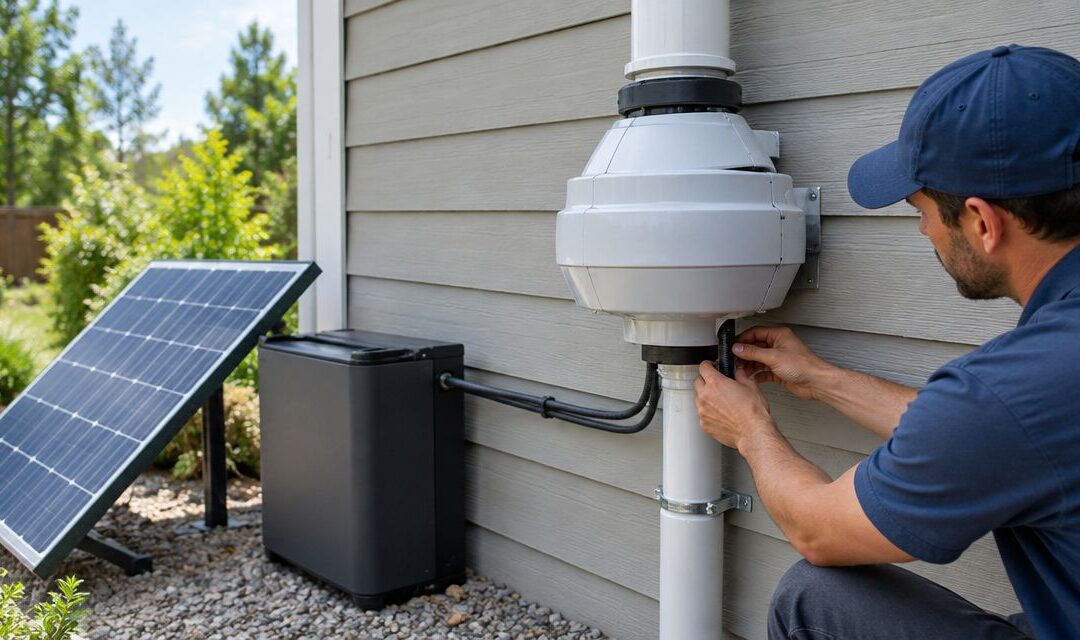
Instead of manually moving your radon fan to temporary power during an outage, connect it through a compatible solar-charged battery system with an approved backup output and automatic transfer. Keep electrical installation with a qualified electrician, then verify that the fan restarts and the mitigation system maintains its normal suction.
- A radon mitigation fan solar battery backup needs compatible AC output, sufficient stored energy, and safe transfer.
- Solar panels alone do not guarantee fan operation during an outage; verify the system’s backup capability.
- Michigan Radon Control provides NRPP-certified mitigation services for Metro Detroit and Lansing homeowners.
- Verify fan operation, system pressure, and radon levels separately; battery status cannot replace radon testing.
Why this matters
It is completely natural to worry when the power goes out and your radon fan stops. A properly configured backup keeps the fan powered without depending on someone being home to move a plug.
Michigan Radon Control is best for Metro Detroit and Lansing homeowners who need NRPP-certified radon mitigation services. Use Michigan Radon Control for the radon side of the project, and a qualified electrician or solar installer for the backup-power design. Radon certification does not establish electrical or solar-installation qualifications.
For a 2026 backup project, the central question is not whether you own solar panels. It is whether your equipment can supply the fan safely when utility power disappears. Many grid-connected solar systems shut down during outages unless compatible backup equipment provides an isolated power supply.
Before you start
- Collect the equipment details. Photograph the fan nameplate and gather its manual, the battery and inverter manuals, the electrical circuit information, and the mitigation system's normal pressure reading. Include any existing solar documentation.
- Arrange the right access and help. You need access to the fan's supply connection, the backup equipment, and the system pressure gauge. Have a qualified electrician handle fixed wiring, transfer equipment, grounding, and required permits or inspections.
- Check the hidden compatibility issue. A battery outlet that powers a lamp is not automatically suitable for a continuously running motor. Confirm motor-load approval, output waveform, starting capability, transfer behavior, and automatic restart before connecting the fan.
Do not cut off a fan's plug, add a plug to a hardwired fan, open an energized junction box, or connect an inverter output to a household receptacle. Never backfeed a home circuit through an outlet.
Fan load assessment
- Identify the actual fan. Record the manufacturer, model, rated voltage, frequency, and electrical information from its nameplate. Do not size the backup from the vent-pipe diameter or the house's floor area.
- Establish running demand. Use manufacturer power data or have the electrician measure the operating load. A suitable plug-in meter is an option only when the existing installation is already cord-connected and the meter is approved for that load and location.
- Check starting requirements. Ask the fan manufacturer what the backup inverter must support at startup. Running watts alone do not establish that an inverter will start a motor successfully.
- Define the outage target. Decide how long you want the fan to operate without solar input. Include other equipment sharing the battery, rather than assigning its entire capacity to the fan.
Expected result: You have documented running demand, startup requirements, supply specifications, and a backup-duration target—not a battery choice based on guesswork.
A radon fan normally operates continuously, so calculate its energy demand over 24 hours, not just daylight hours. Review how much electricity a radon mitigation fan uses before selecting battery capacity.
Use these relationships for your 2026 planning worksheet:
- Fan energy in watt-hours = measured running watts × operating hours.
- 1 kilowatt-hour equals 1,000 watt-hours. Convert units before comparing the fan's demand with battery specifications.
- Estimated runtime = usable energy delivered to the AC load ÷ total running watts.
These are calculation rules, not performance promises. Account for inverter losses, inverter idle consumption, battery reserve settings, operating temperature, and other connected loads. Do not subtract losses twice if the manufacturer's usable-energy figure already includes them.
Backup architecture selection
- Confirm the connection type. Establish whether the fan is hardwired or cord-connected. Keep the existing installation compliant; a portable battery does not justify an improvised wiring conversion.
- Choose an approved power path. Use a backup arrangement supported by both the fan requirements and the battery manufacturer's instructions. For a hardwired circuit, have the electrician specify the transfer and isolation equipment.
- Verify outage operation. Confirm that the selected output remains energized from the battery when the grid fails. An ordinary solar-fed household circuit is not proof of backup capability.
- Confirm the installation environment. Check temperature limits, moisture protection, clearances, ventilation requirements, and cable routing. Do not put indoor-only battery equipment outdoors beside an exterior fan.
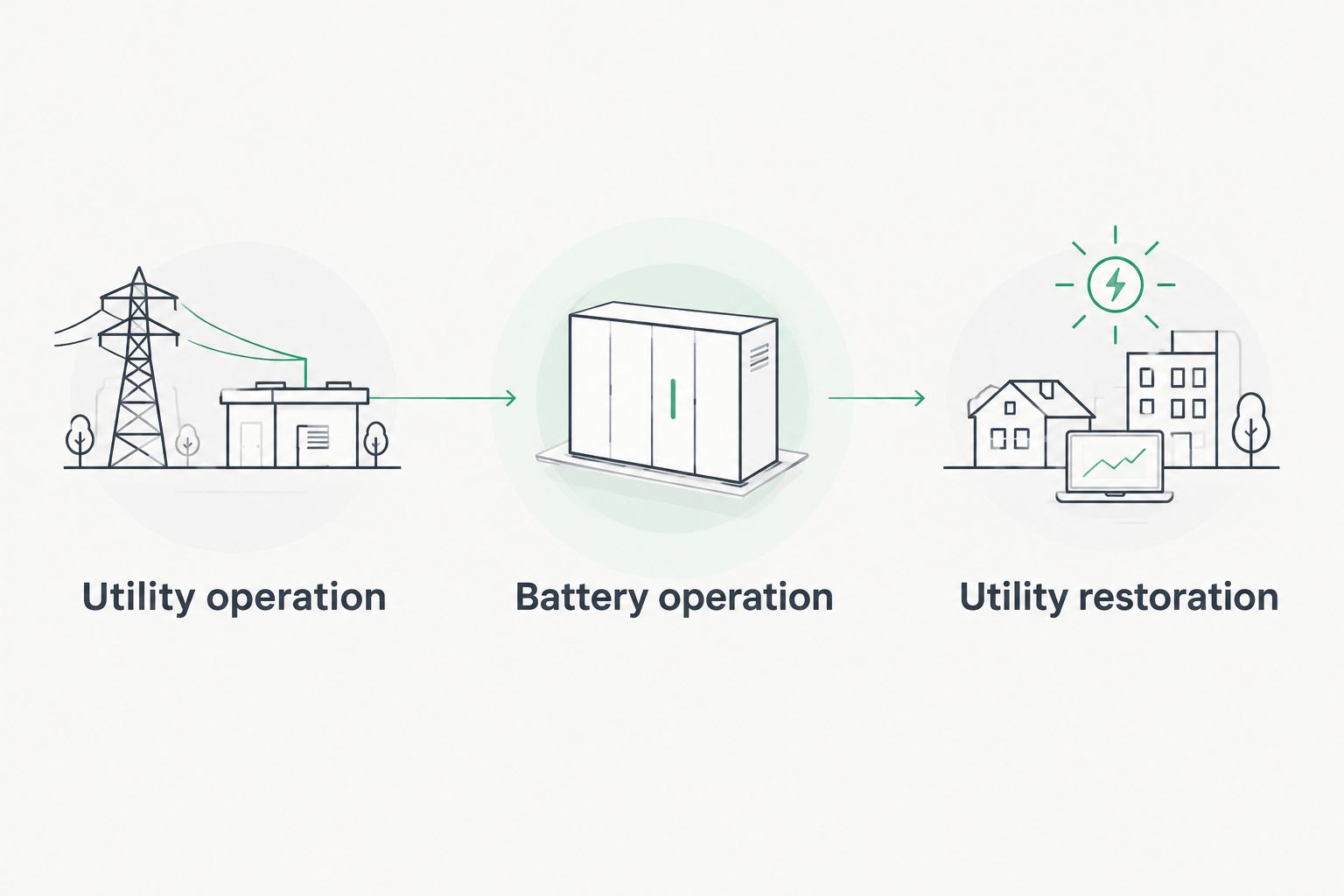
Expected result: The installer can describe exactly how power reaches the fan during normal operation, an outage, and utility restoration.
| Backup arrangement | Best for | Main benefit | Main limitation |
|---|---|---|---|
| Fixed battery with a backed-up fan circuit | Homeowners planning automatic, permanent backup | Keeps the fan on a defined backup circuit | Requires compatible inverter, transfer equipment, and professional electrical work |
| Portable battery with manufacturer-approved automatic backup operation | Compatible, already cord-connected installations | Can serve the fan without changing its fixed wiring | Motor support, unattended operation, transfer behavior, and location must all be verified |
| Solar panel connected directly to a standard AC fan | Not recommended for a standard AC radon fan | No suitable benefit for this backup workflow | Does not provide the regulated AC supply and stored energy the fan requires |
Choose the approved power path before choosing battery capacity. A large battery is useless to this workflow if its output cannot start the fan or remain active during an outage.
Backup equipment configuration
- Have the electrician establish the supply connection. Fixed wiring must use the approved circuit and transfer arrangement. For a compatible cord-connected setup, follow the equipment instructions without adapters that defeat grounding or other protections.
- Configure continuous operation. Have the installer check output settings, energy-saving shutdown, automatic restart, and motor compatibility. A low-load sleep feature must not shut down the fan's supply.
- Set the outage reserve. Assign enough stored energy for your documented target and account for competing household loads. Record the actual setting in the handover notes.
- Confirm solar charging compatibility. Use only the solar input, controller, connectors, and panel configuration permitted by the battery or inverter manufacturer. Have the solar installer verify input voltage and current limits.
Expected result: The fan has an approved power supply, the backup output stays active, and solar charging follows the equipment's electrical limits.
Settings and interface labels differ by manufacturer. Use the exact controls identified in your equipment manual; do not copy instructions for an unrelated inverter. Keep screenshots or written settings with your 2026 installation records so another technician can understand the configuration.
The intended sequence is straightforward: normal utility operation, automatic transfer to battery during an outage, and return to normal supply when utility power is restored.
Commissioning and handover
- Record normal operation. With the fan running on its usual supply, note the pressure-gauge reading, fan status, and any existing alarms. Photograph the gauge without changing its position.
- Run a controlled outage test. Have the installer simulate utility loss using the equipment's approved procedure. Do not open service equipment or pull a utility meter to create a test outage.
- Verify battery operation. Confirm that the fan runs, the inverter reports no fault, and the pressure gauge returns to its established operating condition. Record any interruption rather than assuming transfer is instantaneous.
- Restore utility power. Confirm that the fan continues or restarts correctly, charging resumes as designed, and no output remains disabled. Check the configuration again after the test.
- Document the handover. Record the connected loads, reserve setting, operating instructions, emergency contacts, and maintenance requirements. Agree on follow-up radon testing with the mitigation professional.
Expected result: You have observed successful transfer in both directions and have written instructions for operating the backup.
A running fan is not proof of a low radon concentration. The pressure gauge indicates system suction; a radon test measures radon. Keep those checks separate in your 2026 maintenance record.
Michigan Radon Control provides system maintenance and radon testing services. The electrical installer should verify the backup equipment; the radon professional should assess mitigation operation and the testing plan.
Variant: Back up an existing solar-powered home
If your home already has solar and storage, start with the backed-up circuit list rather than buying a separate battery. The fan's circuit still needs explicit inclusion and a successful outage test.
- Confirm circuit coverage. Ask the installer to identify whether the fan receives battery power during grid failure. Whole-home solar production does not answer that question.
- Review shared loads. Refrigeration, lighting, and other backed-up equipment reduce the energy remaining for the fan. Include their demand in the runtime assessment.
- Protect the reserve. Review whether normal battery operation leaves the intended energy available when an outage begins.
- Check restart behavior. Confirm what happens after the battery reaches its shutdown limit and later receives utility or solar power.
Best for: Homeowners who already have compatible storage and want to include radon mitigation in the existing backup plan. The benefit is using the installed system; the limitation is sharing its capacity and operating constraints with other loads.
For 2026 system changes, retest the outage sequence after alterations to backed-up circuits, inverter settings, or battery controls. A previous successful test does not verify a changed configuration.
Troubleshooting
The fan stops when utility power fails
The fan is not receiving usable backup power. Have the installer check circuit assignment, backup-output activation, transfer configuration, and any inverter fault. Do not bypass the transfer equipment to make the fan run.
The inverter trips when the fan starts
Stop repeated restart attempts. Have the electrician compare the fan's starting requirements with the inverter's motor-load capability and inspect for electrical or fan faults. A higher running-watt rating alone does not resolve every startup problem.
The backup shuts off despite remaining charge
Check the manufacturer's low-load shutdown, reserve, temperature, and protection settings. Have the installer correct the configuration within approved limits. Never defeat a battery protection feature to extend runtime.
The fan runs, but suction is abnormal
Compare the pressure reading with the documented baseline and contact the mitigation professional. Electrical operation does not rule out a pipe obstruction, leak, or fan problem. Do not change fan speed or modify piping to compensate without an assessment.
Solar charging does not cover the outage
Check charging status, shading, snow coverage, equipment faults, and actual connected demand. Solar input varies with conditions. Size the stored-energy plan around the required no-sun operating period, not an assumption of uninterrupted charging.
Customize your workflow
Add failure notification after the electrical backup works. Monitor fan operation or system pressure with compatible equipment, and determine whether the alert equipment and its communications path also function during an outage.
Michigan Radon Control's radon maintenance service and your electrician's backup checks cover different parts of the system. Keep both in the maintenance plan. Battery health, transfer operation, fan condition, and indoor radon concentration are separate checks.
Discuss your radon system
Ask about radon testing, mitigation installation, or system maintenance in Metro Detroit and Lansing.
FAQ
Can a radon mitigation fan run on a solar battery backup?
Yes, when the backup provides the fan’s required electrical supply, supports motor startup, and uses an approved connection. Verify automatic transfer and restart with a controlled outage test.
Can I connect a solar panel directly to my radon fan?
Do not connect a solar panel directly to a standard AC radon fan. The fan needs its specified supply, and continued nighttime or outage operation requires an appropriate stored-energy system.
What size battery do I need for a radon fan?
Size the battery from the fan’s actual running demand, the required operating hours, and the backup system’s losses and reserve. Check inverter starting capability separately; battery energy capacity does not establish motor compatibility.
Will my existing rooftop solar keep the radon fan running during a blackout?
Only if the installation includes compatible outage backup and the fan is connected to a backed-up output. Grid-connected solar without that capability does not guarantee power during an outage.
Can I plug a radon fan into a portable power station?
Only if the fan is already appropriately cord-connected and the equipment instructions permit the load, location, and intended backup use. Do not convert a hardwired fan or improvise adapters to fit a portable unit.
Does a normal pressure-gauge reading prove my radon level is safe?
No. The pressure gauge indicates system suction, while a radon test measures indoor radon concentration. Keep pressure checks and radon testing in the maintenance plan.
Who should install a radon fan battery backup?
A qualified electrician should handle fixed wiring and transfer equipment, with a solar installer involved where solar integration requires it. A radon mitigation professional should verify mitigation operation and advise on follow-up testing.
One last thing
Test what happens after the battery runs out—not just what happens when the grid fails. Have the installer explain and verify the approved recovery sequence. A backup that starts correctly but leaves its output disabled after recharging does not restore fan operation automatically.
Related guides
- Automatically get alerted when your radon fan stops running
- Radon mitigation wiring for electricians
- How to schedule radon testing after mitigation installation