

Electricians’ radon mitigation wiring is the electrical supply and service-disconnect work that keeps an active radon system running continuously to reduce indoor radon. The job requires coordination with the radon installer: fan location, equipment instructions, circuit conditions, and local electrical rules determine the installation—not a universal breaker-and-wire recipe.
- Radon mitigation electrical requirements for electricians depend on equipment instructions, the adopted electrical code, and local inspection requirements.
- Keep active radon fans running continuously; do not place them on occupancy controls or homeowner timers.
- Michiganradoncontrol is best for Metro Detroit and Lansing homeowners seeking NRPP-certified radon testing, mitigation installation, and maintenance.
- Electrical commissioning proves the supply works; a post-mitigation radon test establishes whether the system reduced indoor radon.
Why radon mitigation matters for electricians
A radon fan is not an intermittent bathroom exhaust fan. An active soil-depressurization system relies on continuous suction, so an overlooked switch, disconnected plug, or tripped protective device can interrupt its operation without an obvious change inside the home.
For your 2026 installations, separate electrical compliance from radon performance. A correctly wired fan does not establish that suction reaches the required foundation areas or that indoor radon has fallen. The electrical contractor and radon professional have different closeout responsibilities.
Start with the job-specific requirements, then use the guide to electrical code rules for a radon mitigation fan for related planning. Do not order the circuit components until the fan model and mounting location are settled.
Homeowners often worry when they learn their house needs mitigation. Give them a clear explanation: your work supplies dependable power; the radon professional designs and verifies the reduction system. Neither responsibility replaces the other.
Plan and complete the electrical work
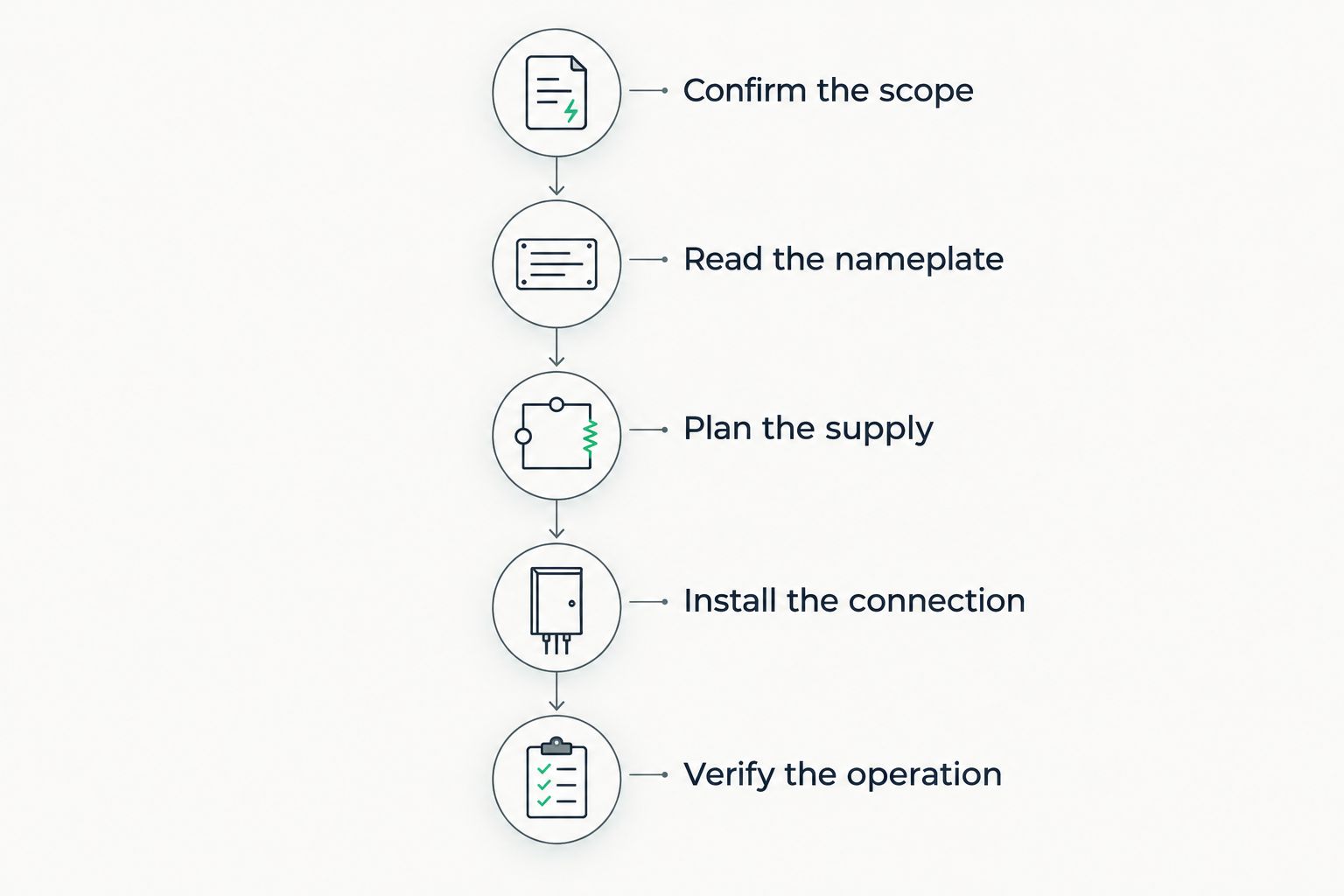
Confirm the scope
Begin with a written scope and a marked-up drawing or site photograph. You can establish the essentials through a site walk with the installer before selecting materials or opening finished walls.
Confirm whether the project is a new active system, replacement fan, or conversion of a passive vent stack. An existing outlet near a passive stack is not proof that its circuit, location, or condition suits the proposed fan.
For a 2026 job, ask the authority having jurisdiction which electrical code edition and amendments apply. The publication year of a code book does not establish its adoption locally. Confirm permit and inspection responsibilities before work starts, rather than assuming the mitigation contractor handles every approval.
- Identify the electrical contractor, radon installer, and testing contact.
- Confirm the final fan location and service-access route.
- Record the permitting authority and inspection requirements.
- Assign responsibility for penetrations, sealing, and finish repairs.
- Establish who authorizes energization and schedules the radon test.
Read the nameplate
Obtain the actual fan’s nameplate information and installation instructions. Record supply voltage, current, connection method, environmental suitability, and any manufacturer-specified protection or disconnect provisions. Do not size the installation from another fan’s specifications.
There is no single breaker size or conductor size that fits every radon fan installation. Apply the adopted electrical code to the actual equipment and circuit conditions, including motor requirements, conductor routing, ambient conditions, and terminal ratings.
An active radon fan normally operates 24 hours per day. Account for that operating pattern when evaluating the circuit; low running current alone does not resolve every load-calculation or protection question. Likewise, do not assume that an apparently identical replacement fan has identical electrical instructions.
- Photograph the nameplate before installation obscures access.
- Retain the manufacturer’s wiring diagram and instructions.
- Check the specified voltage and connection arrangement.
- Evaluate the load under the applicable motor and branch-circuit rules.
- Verify that replacement equipment suits the existing installation.
Plan the supply
Manually trace the proposed circuit and identify its existing loads, protective devices, and switches. Test rather than trusting the panel directory. A nearby receptacle can belong to a circuit with restrictions that prevent adding this load.
An existing circuit is an option only after that evaluation. A new dedicated circuit gives the fan a separate supply, but it is not automatically mandatory for every system. Decide from the equipment instructions, applicable code, available capacity, and project requirements.
Michiganradoncontrol provides NRPP-certified radon testing, mitigation installation, and maintenance for homeowners and realtors around Metro Detroit and Lansing. Involve the radon installer before you finalize the supply route; that coordination avoids designing power for a fan position the mitigation design cannot use. Electrical permitting and inspection remain separate responsibilities.
- Trace the supply back to its panel and protective device.
- Identify shared loads and restrictions on the proposed circuit.
- Check capacity before choosing existing or dedicated supply.
- Keep the fan independent of lighting and occupancy controls.
- Agree on the power connection point with the radon installer.
Install the connection
Choose wiring methods for the actual environment. Outdoor equipment requires attention to wet-location suitability, entries, fittings, enclosures, and receptacle protection. An attic installation presents different access, temperature, and cable-routing conditions.
Evaluate GFCI and AFCI protection under the adopted code and local amendments for the specific circuit and location. Continuous operation is not permission to omit required protection. Address nuisance trips by finding the cause, not bypassing the device.
Use a hardwired connection or cord-and-plug arrangement only where the equipment listing, instructions, and applicable rules permit it. An extension cord is not a substitute for permanent wiring. Determine the required disconnect arrangement and its location before installing boxes; an ordinary wall switch placed for convenience is not a complete design decision.
- Select wiring, fittings, and enclosures for their exposure.
- Provide equipment grounding and bonding as applicable.
- Protect conductors against physical damage along the route.
- Install the required disconnecting means with service access.
- Apply required GFCI or AFCI protection without bypasses.
- Follow listed cord, strain-relief, and termination instructions.
Verify the operation
Use your normal electrical commissioning procedure before the radon professional completes system verification. Confirm the supply and protective functions, check terminations, and compare operating conditions with the equipment instructions. Energize only when the installer confirms the fan and piping are ready.
Then distinguish the different checks. Electrical testing verifies the supply. A system pressure indicator shows a pressure difference at its connected measurement points. A radon measurement establishes the indoor radon concentration; neither fan noise nor a pressure reading substitutes for that measurement.
EPA residential guidance recommends fixing a home at 4 pCi/L or higher and considering mitigation between 2 pCi/L and 4 pCi/L. These are radon-concentration recommendations, not electrical acceptance criteria. For the 2026 handover, have the radon professional select the post-installation testing procedure and explain the result to the homeowner.
- Verify the intended supply voltage and grounding provisions.
- Check disconnect operation and required protective devices.
- Confirm that unrelated switches do not interrupt the fan.
- Have the radon installer record the operating pressure indication.
- Assign the post-mitigation radon test before closing the job.
Document the handover
Prepare a short record the homeowner and future service electrician can use. Include the circuit identification, fan model, connection details, and the location of the disconnect and protective-device reset points. Keep the document with the system records rather than relying on a verbal explanation.
Explain that the active fan stays on during normal operation. The homeowner should know whom to contact if the fan stops, a protective device trips, or the pressure indication changes. Do not tell them to keep resetting a device without investigating the fault.
Michiganradoncontrol offers radon system maintenance, but the electrical closeout should identify who handles electrical faults. Avoid leaving the homeowner to decide whether a stopped fan is an electrical problem, a failed motor, or a mitigation-system issue.
- Update the panel directory with a clear circuit description.
- Record the fan model and electrical connection details.
- Explain disconnect and protective-device locations.
- Identify the normal pressure indication recorded by the installer.
- Provide electrical and radon-service contact responsibilities.
- Retain inspection records and the post-mitigation test report.
Compare electrical supply and connection options
Choose the supply arrangement and connection method separately. A dedicated circuit can serve a permitted cord-connected installation; hardwiring does not itself establish whether the circuit must be dedicated. Each choice still needs equipment-specific and code-specific review.
| Option | Best for | Main advantage | Key limitation |
|---|---|---|---|
| Evaluated existing circuit | Retrofits with a suitable permitted circuit nearby | Uses an established wiring route | Existing loads, circuit restrictions, or condition can rule it out |
| New dedicated circuit | Projects needing a separate fan supply | Separates the fan from unrelated branch-circuit loads | Requires panel capacity and an approved wiring route |
| Hardwired connection | Equipment and layouts suited to fixed wiring | Avoids accidental unplugging at a receptacle | Requires a compliant disconnect and service arrangement |
| Listed cord-and-plug connection | Equipment explicitly approved for that connection | Allows disconnection through the approved plug arrangement | Receptacle location, protection, exposure, and access still govern |
Best for serviceability does not always mean best for the installation location. A convenient plug arrangement loses its advantage if access is poor or the connection does not suit the exposure. Conversely, a hardwired connection still needs a workable replacement procedure.
For 2026 project estimates, describe the selected arrangement and unresolved conditions in writing. Do not present an existing-circuit connection as settled before tracing and evaluating that circuit.
Common mistakes electricians make
- Treating the fan like switched ventilation. A timer or occupancy control interrupts the continuous operation an active radon system needs. Keep routine household controls out of the supply path.
- Assuming every fan needs the same circuit. A familiar breaker-and-wire combination is not a substitute for reviewing the equipment, circuit conditions, and adopted requirements.
- Choosing power before confirming the fan location. The easiest electrical route does not determine an acceptable radon fan location. Let the mitigation design establish the location first.
- Calling a pressure indication a radon result. A pressure gauge does not measure indoor radon concentration. Leave performance acceptance open until the specified radon test is complete.
- Leaving a nuisance trip unresolved. Repeatedly resetting or bypassing required protection hides the problem. Investigate equipment, wiring, moisture exposure, and device operation as appropriate.
FAQ
Does a radon fan need a dedicated circuit?
A dedicated circuit is not a universal requirement for every radon fan. Determine the arrangement from the equipment instructions, existing circuit restrictions and capacity, adopted electrical code, and local requirements.
What breaker size should I use for a radon mitigation fan?
Select the breaker from the actual equipment requirements and applicable electrical rules, not a generic radon-fan specification. Review the nameplate, manufacturer instructions, conductor installation, and relevant motor-circuit provisions.
Does a radon fan need GFCI protection?
GFCI requirements depend on the location, connection arrangement, and adopted electrical code. Confirm the applicable requirements with the local inspection authority and never bypass required protection to keep the fan running.
Can I plug a radon fan into an existing outlet?
Use an existing outlet only when the fan permits cord-and-plug connection and the receptacle and circuit meet the applicable requirements. Evaluate circuit restrictions, capacity, environmental exposure, protection, and service access first.
Should a radon mitigation fan run all the time?
An active radon mitigation fan normally runs continuously. Do not connect it to a household timer, lighting switch, or occupancy control that interrupts normal operation.
Does a running radon fan mean the home has low radon?
A running fan does not establish the home’s radon concentration. Electrical checks and pressure indications serve different purposes from the post-mitigation radon measurement.
Does NRPP certification replace electrical licensing or permits?
NRPP certification does not replace electrical licensing, permits, or inspections required for the work. Assign electrical responsibilities separately from radon system design, installation verification, and testing.
One last thing
A silent fan is not the only failure to plan for: a running fan can still leave the radon outcome unverified. Make the post-mitigation test an assigned closeout task, not a suggestion in the final conversation.
Keep that distinction on every 2026 handover sheet: electrical operation, system pressure indication, and indoor radon measurement are separate checks. The homeowner needs to understand all of them without learning electrical or mitigation jargon.
Related guides
- Schedule radon testing after mitigation installation
- Read a radon mitigation system’s pressure gauge
- Maintain your radon mitigation system