
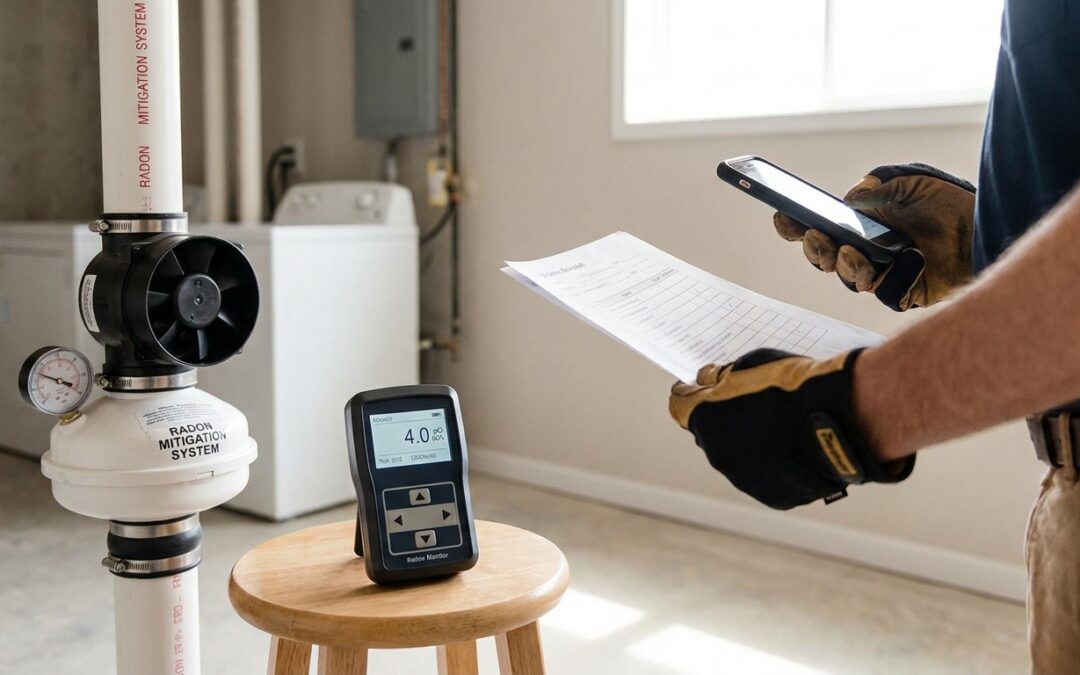
Once the mitigation fan clicks on, most homeowners assume the radon problem is solved and move on with their lives. That's the moment to schedule post installation radon testing, not skip it, because the only way to confirm a mitigation system is actually pulling radon levels down is to measure the air after the fan has been running.
- Post installation radon testing should start no earlier than 24 hours after the mitigation fan is activated, per EPA guidance.
- A short-term test (48 hours) confirms the system dropped levels below 4 pCi/L before you close out the project.
- Michigan Radon Control recommends closed-house conditions during the test window for an accurate reading.
- Retest every two years after the initial post-installation confirmation to catch fan failure or seal drift.
- Skip testing during storms or extreme wind days in 2026 because pressure swings distort short-term results.
Why This Matters
A radon mitigation system is a machine with a motor, a seal, and a pressure field. Motors fail. Seals crack. Foundations settle. None of that is visible from the basement stairs.
The EPA and most state radon programs, including guidance Michigan homeowners rely on, call for a confirmation test after any mitigation installation and a follow-up retest on a recurring schedule after that. Post installation radon testing is the only data point that tells you the system did what it was installed to do, which is pull indoor radon below the 4 pCi/L action level. Without it, you're trusting a fan you can hear but can't verify.
Realtors and home sellers care about this timing even more. A mitigation system installed without a documented post-test can stall a closing if a buyer's agent asks for proof the fix worked.
What You'll Need
- A short-term charcoal test kit or a continuous radon monitor
- A basement or lowest-livable-level location away from the mitigation fan's exhaust point
- 48 hours of closed-house conditions (windows and exterior doors kept shut except for normal entry and exit)
- The mitigation system's activation date and manometer reading at installation
- A pen and a spot to log the start time, end time, and manometer reading at test's end
The Steps
1. Let the fan run for at least 24 hours before testing
Radon levels don't drop instantly the moment the fan turns on. The soil gas field under the slab needs time to stabilize under the new negative pressure the system creates.
Starting a test too early gives you a false-high reading that doesn't reflect the system's real performance. Wait a full 24 hours minimum after activation, and 48 hours is safer if your schedule allows it. Expected outcome: by the time the test starts, the sub-slab depressurization field is fully established. Common mistake: starting the test kit the same afternoon the installer leaves.
2. Pick a short-term test or a continuous monitor
A short-term charcoal kit gives you one number over 48 hours and is the standard choice for confirming a fresh installation. A continuous radon monitor gives hourly data and lets you watch the trend line, which is useful if you want to see the drop happen in real time.
For a straightforward post-installation confirmation, a short-term kit is usually sufficient and cheaper. If you want ongoing visibility after the confirmation test, a monitor pays for itself over a few years. See the best continuous radon monitors for Michigan homes for models that hold up in basement humidity. Common mistake: using a long-term 90-day kit when you need a fast confirmation for a real estate closing.
3. Place the test in the lowest livable level, away from the fan pipe
Radon pools lowest in the house, so the test needs to sit in the basement or lowest room used regularly, not the main floor. Keep it at least 3 feet from exterior walls, windows, and the mitigation system's own pipe or fan housing.
A test placed too close to the mitigation exhaust can pick up a false reading skewed by the equipment itself. Place it on a shelf or table, 20 inches off the floor, away from direct airflow. Expected outcome: a reading that reflects the room's air, not the machine. Common mistake: setting the kit directly on top of the mitigation pipe.
4. Close the house 12 hours before the test starts and keep it closed
Closed-house conditions mean windows shut and exterior doors used only for normal entry and exit, with no propping doors open for a delivery all afternoon. Start closing the house 12 hours before the test begins so indoor air stabilizes.
This matters because open windows introduce fresh air that dilutes the reading and makes it look better than it actually is. Expected outcome: a number that represents typical living conditions, not a ventilated best case. Common mistake: running the test during a week with an open-house showing or a contractor in and out all day.
5. Run the test for the full 48-hour window without interruption
Don't pull the kit early because the number looks good after 24 hours. Radon fluctuates through the day, and a partial test misses that variation.
Log the exact start and stop time on the kit's label, since most labs need that to calculate the result correctly. Expected outcome: a complete 48-hour average, which is what the EPA protocol is built around. Common mistake: forgetting to log the stop time and having the lab estimate it.
6. Send the kit to the lab immediately and compare to the pre-mitigation number
Mail the kit the same day the test ends, because charcoal kits lose accuracy the longer they sit before analysis. Once results come back, compare the new number to whatever the radon level was before the mitigation system went in.
A successful post-installation test should show levels well under 4 pCi/L, often in the 0.4 to 1.5 pCi/L range for a properly sized system. If the number is still near or above 4, something in the system needs adjustment, not just a rerun of the same test. Expected outcome: documented proof the system works, which you'll want on file for future home sales. Common mistake: losing the lab report and having no record when a buyer's agent asks for it years later.
Need help scheduling your post-test?
Michigan Radon Control can confirm your mitigation system is working correctly.
Troubleshooting
- Result is between 2 and 4 pCi/L, not clearly low. The system may be undersized for the soil conditions or a seal is leaking. Use the guide on how to verify your radon mitigation system is still working before assuming the test itself is wrong.
- Fan sounds different or stopped during the test window. Check the manometer gauge on the pipe. If it reads zero, the fan lost power or failed, and the test is invalid until it's fixed and rerun.
- Test was run during a storm or high-wind week. Barometric pressure swings can push radon readings up temporarily; rerun the test on a calmer week for a cleaner number.
- House wasn't fully closed because of guests or a contractor. Restart the test rather than submit a compromised sample. A partial closed-house condition invalidates the result for documentation purposes.
- Continuous monitor shows spikes at specific hours. Note the time of day and check if it lines up with a furnace cycle, sump pump run, or exhaust fan use. Those can temporarily disturb sub-slab pressure.
- Lab report takes longer than expected. Most Michigan labs turn results in 3 to 5 business days; if it's been longer than two weeks, call the lab directly rather than resubmitting.
Tools and Resources
- A calibrated short-term charcoal kit or continuous monitor
- The manometer reading logged at system activation, for comparison
- Guidance on how to prepare your basement for a radon test if this is your first time testing that space
- A maintenance schedule to check between tests
- A written record of the 2026 post-installation result, stored with your home's paperwork
What to Do Next
Once the post-installation number comes back low, the work isn't fully done, because mitigation systems need a retest cycle, not a one-time check. Set a reminder to retest every two years, and check the manometer gauge monthly in between. If you're still deciding on installation details or sizing before this stage, the radon mitigation system installation guide for Michigan homes walks through what happens before the fan ever turns on.
FAQ
When should I schedule post installation radon testing?
Schedule it no earlier than 24 hours after the mitigation fan is activated, and ideally after 48 hours of continuous operation. Testing too early gives a false-high reading before the sub-slab pressure field stabilizes.
What radon level counts as a passing post-installation test?
A passing result is below the EPA action level of 4 pCi/L, and most properly installed systems land between 0.4 and 1.5 pCi/L. If the result is close to 4 pCi/L, the system likely needs adjustment, not just a retest.
How long does a post-installation radon test take?
A standard short-term test runs 48 hours under closed-house conditions. Continuous monitors can give a shorter preliminary read, but a full 48-hour cycle is the standard for documentation.
Do I need to retest after the first post-installation confirmation?
Yes, retest every two years even after a passing post-installation result. Fans wear out, seals shift with foundation settling, and only a retest catches that.
Can I test myself or do I need a professional?
A homeowner can run a short-term charcoal kit correctly by following closed-house protocol. Real estate transactions and disclosure situations often require a certified tester’s documented result instead.
Does weather affect post-installation radon test results?
Yes, storms and high wind change barometric pressure and can temporarily raise indoor radon readings. Avoid testing during severe weather weeks for the cleanest result.
Where should the test go in the house after mitigation?
Place it in the lowest livable level, at least 3 feet from exterior walls and away from the mitigation system’s own pipe or fan housing. Testing too close to the equipment can distort the reading.
What if my post-installation test still shows high radon?
A high result after installation usually means the fan is undersized, a suction point is blocked, or a seal is leaking. Have the system inspected and adjusted before running another test.
One Last Thing
The number that matters most isn't the one on the day the installer leaves. It's the one two years from now. Radon mitigation fans typically run five to ten years before the motor wears out, and a slow fan failure doesn't announce itself with noise. It shows up quietly as a rising number on the next test. Schedule that 2026 confirmation test now, then put the 2028 retest on the calendar before you forget.
Related Guides