
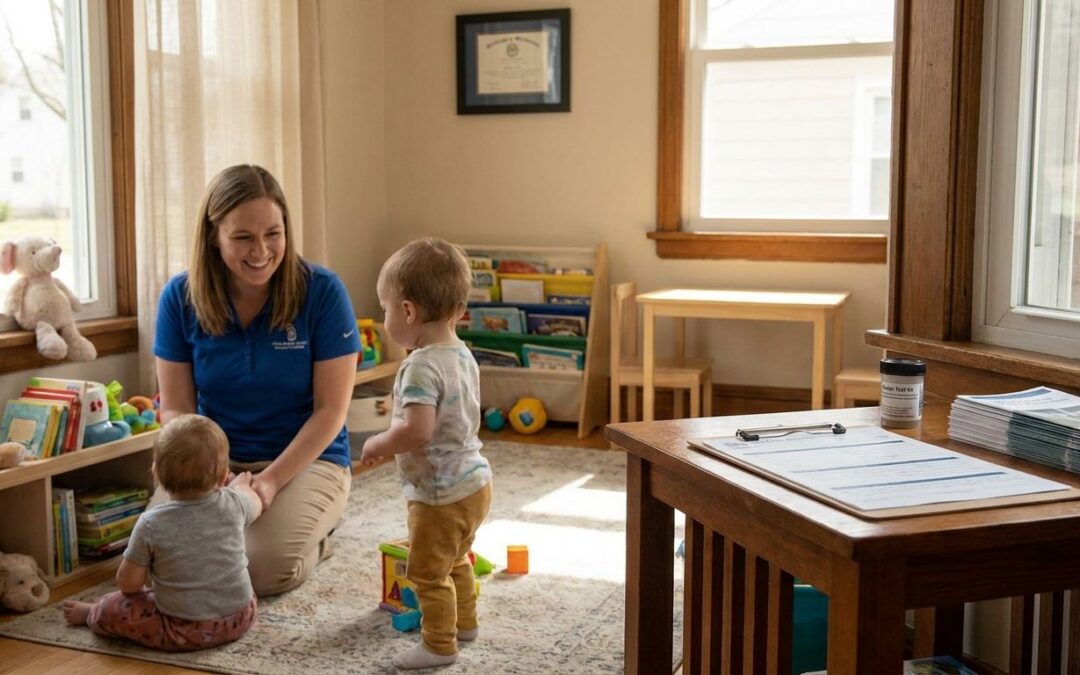
Radon testing for licensed in-home daycare providers in Michigan means measuring radon gas in the same rooms where children nap, play, and eat, with the goal of catching a hazard before it becomes a liability on your license file or a health risk to a child in your care. A licensed in-home daycare operates out of a residential structure, so the test itself works the same way it does for any Michigan homeowner — but the stakes are different because you're responsible for other people's kids, not just your own family.
Children breathe faster than adults and spend more time close to the floor, where radon concentrations run highest in a basement or slab-level play space. That's why radon testing in-home daycare Michigan providers rely on isn't optional caution — it's part of running a defensible, insurable business. Radon testing for Michigan home-based businesses covers the broader category; this guide narrows in on what changes when your home-based business is licensed childcare.
- Radon testing in-home daycare Michigan providers need starts with a test in the actual play/nap area, not just the basement.
- The EPA action level is 4 pCi/L — at or above that, plan for mitigation before your next license renewal.
- A 90-day to 1-year short-term kit works for a first check; continuous monitors work better for ongoing licensing documentation.
- Michigan’s glacial till and uranium-bearing bedrock push many home radon readings above the national average.
Why radon testing matters for in-home daycare providers
Michigan sits on geology — glacial till over uranium-bearing bedrock — that produces radon readings above the national average in a large share of homes tested statewide. A daycare operating out of a ranch or bungalow with a finished or partially finished basement play space is exposed to exactly the same soil gas pathway as any other Michigan home: cracks in the slab, sump pits, and gaps around pipe penetrations.
The difference for a licensed provider is documentation and exposure duration. A child in full-day care can spend 8-10 hours a day, 5 days a week, in your lowest-level rooms — more cumulative time than that child spends in their own basement. Parents ask about it, licensing consultants sometimes ask about it during home inspections, and insurers increasingly ask about it when underwriting a home-based business policy.
Test your daycare space before your first enrollment or renewal
Don't wait for a parent or licensing consultant to raise the question. Test proactively, and keep the paperwork.
- Test the lowest occupied level of the home, not just a random room upstairs
- Include any room used regularly for naps, meals, or play, even if it's not technically a basement
- Test before you finalize your license application if you're opening new
- Re-test any time you finish a basement or add square footage to the licensed space
- Keep the lab report or digital printout in your licensing binder alongside your other required records
Choose the right test kit for a licensed care environment
Not every kit sold at a hardware store is built for a business that needs a defensible paper trail.
- Short-term charcoal or alpha-track kits (2-90 days) give you a fast baseline reading, useful for a first test
- Long-term alpha-track kits (91 days to 1 year) average out seasonal swings and give a more representative number for a year-round licensed operation
- Continuous radon monitors log daily readings and produce a report you can hand to a licensing consultant or parent on request — the best continuous radon monitors for Michigan homes breaks down which models hold up for that kind of ongoing documentation
- Lab-analyzed mail-in kits work fine for a one-time compliance check but won't give you a running record
- Avoid kits meant for large commercial buildings — a residential in-home daycare needs a residential-grade kit, not an industrial one
Place the test kit in the correct location for accurate daycare readings
Bad placement is the single most common reason a daycare provider gets a misleading number.
- Place the kit in the lowest level of the home that's actually used by children, 20 inches to 6.5 feet off the floor
- Keep it away from exterior doors, windows, and heating/cooling vents
- Don't place it in a closet, a bathroom, or near standing water
- Leave it undisturbed for the full test period — moving it resets the clock
- How to prepare your basement for a radon test walks through closed-house conditions in more detail if this is your first test
Schedule testing at the right time of year
Michigan winters push radon readings higher because closed windows and running furnaces trap soil gas indoors — which is actually good for accuracy, not bad.
- Test during heating season (roughly October through March) for the most representative Michigan reading
- Keep doors and windows closed for at least 12 hours before and during a short-term test
- Avoid testing during unusually warm winter stretches when windows might get opened
- If your license renewal falls in summer, consider a long-term kit that spans into the following heating season
Read your results against the EPA action level
Once the test period ends, the number tells you exactly what to do next — there's no ambiguity built into the scale.
- Below 2 pCi/L: no action needed, re-test on your normal renewal cycle
- 2 to 4 pCi/L: EPA recommends considering mitigation; radon mitigation guidance for Michigan homes at 2 to 4 pCi/L covers the judgment call in more depth
- 4 pCi/L or above: EPA's action level — mitigation is the standard recommendation, not optional caution
- How to read your radon test results is worth bookmarking if this is your first time interpreting a lab report
Get a mitigation system installed if levels test high
If your reading comes back at or above 4 pCi/L, a sub-slab depressurization system is the standard fix, and it's a faster path than re-testing repeatedly and hoping the number changes.
- A licensed NRPP-certified contractor can typically install a system in a single day for most home configurations
- Post-mitigation testing confirms the system dropped levels below the action level — how to schedule radon testing after mitigation installation explains the timeline
- Fan noise and pressure gauge readings should be checked periodically — how to read a radon mitigation system's pressure gauge is a two-minute check you can do yourself
- Get the system's warranty terms in writing before the crew leaves
Get your daycare tested in 2026
NRPP-certified radon testing for Metro Detroit and Lansing home-based providers.
Document your results for licensing and insurance
A test result sitting on a shelf doesn't protect you — a filed, dated record does.
- Keep the original lab report or monitor printout, not a photo of it
- Note the test dates, kit type, and placement location in your licensing binder
- Share results with your homeowner's or business insurer if radon comes up in underwriting
- If you ever sell the home or transfer the license, retain copies — how to meet Michigan's radon disclosure requirements when selling covers what buyers and their agents will ask for
Re-test on a schedule tied to your license renewal
A single clean test at intake doesn't mean the house stays clean forever — soil conditions and foundation settling shift over time.
- Re-test every 2 years at minimum, and every renewal cycle if your license requires periodic review
- Re-test immediately after any foundation repair, new addition, or sump pump installation
- Re-test after any basement remodel — how to plan radon mitigation before a Michigan basement remodel covers sequencing if you're renovating the licensed space
- If a mitigation system is already installed, confirm it's still functioning — how to verify your radon mitigation system is still working is a quick self-check between professional visits
Comparison: testing options for licensed daycare providers
| Option | Best For | Key Limitation |
|---|---|---|
| Short-term charcoal/alpha-track kit | A fast first baseline before license application | Doesn't average out seasonal swings |
| Long-term alpha-track kit (91+ days) | Providers who want a year-representative number | Slower — you wait months for results |
| Continuous radon monitor | Ongoing documentation for licensing and insurance | Higher upfront cost than a single-use kit |
| Professional NRPP-certified test | Providers who need a defensible third-party report | Costs more than a self-administered kit |
A licensed in-home daycare provider testing for the first time should start with a short-term kit or a professional test, then move to a continuous monitor if the property stays in year-round use.
Common mistakes in-home daycare providers make
- Testing once at intake and never again — a clean result in year one doesn't guarantee a clean result in year five
- Testing a room upstairs instead of the actual play space — if naps happen in a finished basement, that's where the kit goes
- Assuming licensing silence means it's a non-issue — a licensing consultant not asking about radon doesn't mean a parent won't
- Opening windows mid-test to "air things out" — this invalidates a short-term reading and can produce a falsely low number
- Skipping documentation — an undated, unfiled test result is worthless if a question comes up later
FAQ
Does Michigan require radon testing for licensed in-home daycare providers?
Michigan does not mandate radon testing as a specific childcare licensing requirement as of 2026, but EPA guidance recommends testing every home, and licensed daycare providers carry added liability if a hazard is later found untested.
What radon level is unsafe for a daycare?
The EPA action level is 4 pCi/L. At or above that number, mitigation is the standard recommendation for any occupied space, including a licensed in-home daycare.
How often should a home daycare re-test for radon?
Re-test at least every 2 years, and immediately after any foundation work, basement remodel, or sump pump installation that could change soil gas entry points.
Is radon testing in-home daycare Michigan providers do different from a regular homeowner test?
The testing method is identical — the difference is placement (in the actual licensed play space) and the need to document and retain results for licensing and insurance purposes.
Can a short-term test kit be used for daycare licensing documentation?
Yes, a short-term kit gives a valid baseline reading, but a continuous monitor or long-term kit produces a more defensible year-round record for ongoing licensing files.
What happens if a daycare tests above 4 pCi/L?
A sub-slab depressurization system, installed by an NRPP-certified contractor, is the standard fix and typically completes in a single day, followed by a post-mitigation re-test.
Does a radon mitigation system need ongoing maintenance for a daycare property?
Yes — check the fan and pressure gauge periodically, since a failed fan can let radon levels climb back above the action level without any visible sign in the home.
One last thing
Michigan's glacial till sits directly over uranium-bearing bedrock in large parts of the Lower Peninsula, which is why statewide radon averages run higher than the national average — a fact that has nothing to do with how new, clean, or well-maintained a home looks. A licensed daycare in a newly built home is not automatically safer than one in an older house; soil geology, not home age, drives the radon reading in 2026 just as it did a decade ago.
Related guides
- Radon mitigation for daycare centers and schools in Michigan
- Radon mitigation for Michigan homes with infants and toddlers
- How to test your home for radon
- How to choose the right radon mitigation system type