
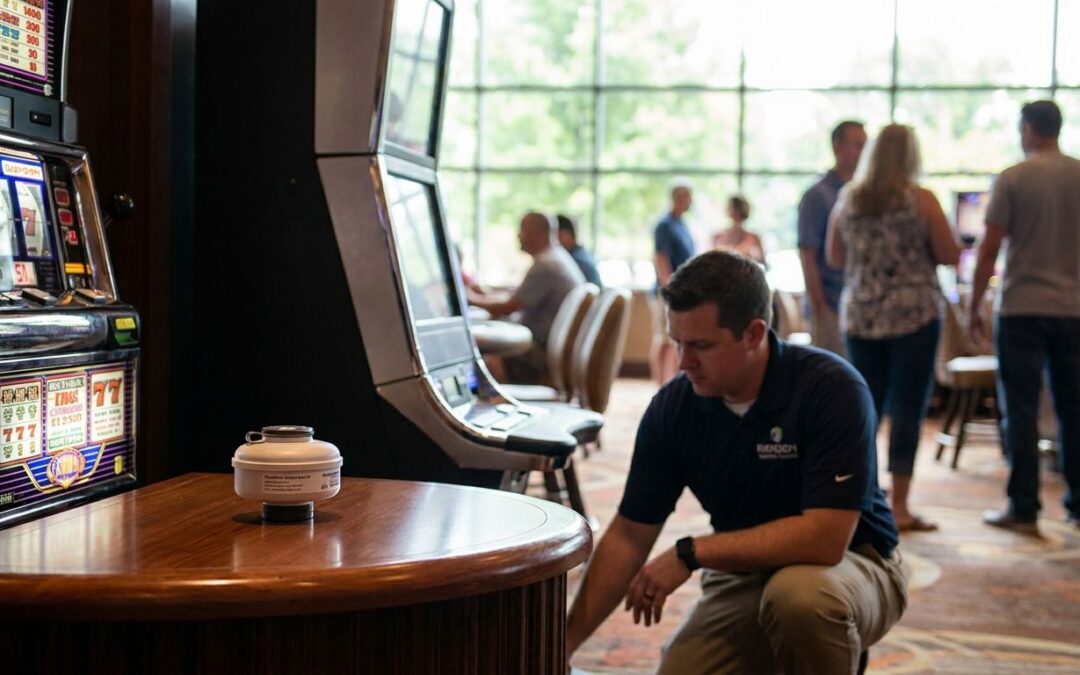
Radon testing for casinos and gaming facilities in Michigan means measuring indoor radon gas across gaming floors, cash cages, mechanical rooms, and back-of-house corridors that a residential test kit was never built to cover. A 24-hour casino runs continuous HVAC cycles, negative-pressure exhaust zones near smoking areas, and slab-on-grade footprints that can exceed 100,000 square feet — all of which change how radon moves through the building compared to a single-family home.
- Radon testing casinos Michigan facilities requires multiple test points per floor, not one canister for the whole building.
- EPA’s 4.0 pCi/L action level applies to gaming floors the same as it does to homes — there’s no separate casino threshold.
- Continuous radon monitors, not short-term kits, give the most reliable data for a facility that never fully closes.
- Michigan Radon Control tests commercial gaming spaces the same way it tests hotels and medical offices — zone by zone, with NRPP-certified equipment.
Why radon testing matters for casinos
A dealer or slot attendant working four 8-hour shifts a week logs more cumulative hours on a gaming floor over a decade than most homeowners spend in their own basement. Radon exposure is cumulative, so occupational duration matters as much as concentration. Michigan's geology — glacial till over limestone bedrock in large stretches of the Lower Peninsula — pushes radon into buildings regardless of whether the structure is a bungalow or a casino with a 100,000-square-foot slab.
The EPA's action level of 4.0 pCi/L doesn't distinguish between building types. A gaming floor reading 4.2 pCi/L carries the same mitigation recommendation as a living room at the same level. What changes for a casino is the scale of the fix and the number of zones that need separate readings before anyone can call the building "tested."
The testing spine: from mapping to verification
Map the gaming floor and back-of-house separately
A single test canister in the lobby tells you nothing about the cash cage, the surveillance room, or the kitchen — each has its own foundation contact, ventilation rate, and occupancy pattern.
- Walk the building and mark every space with direct slab or crawl space contact
- Separate high-occupancy zones (gaming floor, restaurant) from low-traffic zones (vault, mechanical rooms)
- Note HVAC zoning — each independently controlled air handler is its own test zone
- Flag any smoking lounges or exhaust-heavy areas that run negative pressure
- Record square footage per zone for later mitigation sizing
Choose the right test device for a large footprint
A charcoal canister works fine in a bedroom. Across a casino floor, you need enough devices placed correctly to represent every zone identified in the mapping step.
- Use short-term charcoal or alpha track kits for an initial screening pass
- Place one device per 2,000-square-foot zone as a starting rule of thumb
- Keep devices away from exterior doors, HVAC vents, and windows
- Log placement location and start/stop times for every device
- Move to continuous radon monitors for zones with borderline first-round results
Test HVAC-isolated zones on their own cycle
Casinos rarely run a single HVAC system for the whole building. A vault or surveillance room often sits on its own air handler with different pressure behavior than the main floor.
- Test the cash cage and vault separately — low occupancy doesn't mean low radon
- Check mechanical rooms and equipment closets, which often sit below grade
- Confirm exhaust systems near former or current smoking areas aren't depressurizing adjacent zones
- Coordinate with facilities staff to log HVAC settings during the test window
This is where an NRPP-certified team earns its fee over a DIY kit order: reading a building's HVAC zoning correctly before placing devices avoids a second round of testing.
Schedule around closed-building conditions where possible
EPA closed-building protocol assumes windows and doors stay shut for 12 hours before a short-term test. A casino that never closes can't fully meet that standard, so testing protocol has to adjust.
- Test during the facility's lowest-traffic overnight hours when door use drops
- Document any deviation from strict closed-building conditions in the test report
- Favor long-term or continuous monitoring when short-term closed conditions aren't achievable
- Cross-check results against a second testing period before making mitigation decisions
Read results against the 4.0 pCi/L action level
A reading at or above 4.0 pCi/L in any tested zone triggers a mitigation recommendation for that zone — the same threshold used in radon testing for commercial buildings in Metro Detroit.
- Compare each zone's result against 4.0 pCi/L independently, not as a building average
- Flag zones between 2.0 and 4.0 pCi/L for a retest rather than dismissing them
- Keep raw device data and lab reports on file, not just a summary number
- Share zone-by-zone results with facilities management and gaming compliance staff
Install a mitigation system sized to the zone, not the whole building
A casino rarely needs one mitigation system for the entire footprint — it needs one sub-slab depressurization system per zone that failed testing, sized to that zone's slab area and soil conditions.
- Start with sub-slab depressurization for slab-on-grade gaming floors
- Size fan capacity to the specific zone's square footage, not the whole building
- Route exhaust piping away from fresh-air intakes and pedestrian entrances
- Coordinate installation timing with facilities to minimize disruption to gaming operations
Verify post-mitigation performance
A system that passes inspection on day one still needs confirmation that it's holding levels below 4.0 pCi/L under normal operating conditions, not just during a quiet test window.
- Retest each mitigated zone 24-48 hours after system activation
- Check fan pressure readings monthly for the first year
- Compare readings across different HVAC settings (summer cooling vs. winter heating)
- Keep a maintenance log per zone, similar to the documentation used for radon mitigation as part of a whole-home air quality plan — the principle scales to commercial buildings
Document everything for insurance, licensing, and liability
Gaming facilities carry compliance obligations that homeowners don't, and radon records become part of that paper trail.
- File zone-by-zone test results with facilities management, not just a single building certificate
- Keep NRPP-certified technician credentials on record for every test performed
- Update documentation any time HVAC systems or floor layouts change
- Reference test dates and device serial numbers in every report for auditability
Many Michigan gaming facilities sit on real estate held through separate ownership entities, a structure common to triple net lease commercial properties, where the operating tenant — not the property owner — typically carries responsibility for indoor air quality compliance, including radon testing and mitigation upkeep. That distinction matters when a casino's lease renews or changes hands, since radon documentation often becomes part of the due diligence file alongside other building systems.
Get a Michigan casino tested
NRPP-certified commercial radon testing across Metro Detroit and Lansing gaming facilities.
Comparison: testing options for gaming facilities
| Option | Best for | Key limitation |
|---|---|---|
| Short-term charcoal/alpha track kit | Initial screening pass across many zones | Needs closed-building conditions casinos rarely achieve fully |
| Long-term alpha track test | Zones with borderline first-round results | Takes 90+ days before you get an answer |
| Continuous radon monitor (CRM) | 24/7 facilities that can't close doors for 12 hours | Requires professional placement and calibration |
| NRPP-certified professional test | Full-facility zone mapping and compliance documentation | Costs more upfront than a self-administered kit |
Michigan Radon Control's verdict: continuous radon monitors placed zone-by-zone by an NRPP-certified team, not a single lobby canister, are the only reliable way to test a casino that never fully closes.
Common mistakes casinos make
- Testing only the gaming floor and skipping the cash cage, vault, and surveillance room, all of which sit on slab and see low foot traffic that doesn't mean low radon.
- Ignoring exhaust systems near former or current smoking lounges, which can depressurize adjacent zones and pull soil gas into spaces that tested clean months earlier.
- Treating one test as facility-wide certification when a 100,000-square-foot building needs multiple independently-read zones, not one average number.
- Skipping retests after HVAC upgrades — a new air handler changes pressure relationships across the whole building, and a system that passed in 2024 can fail after a 2026 renovation.
- Assuming closed-building protocol applies the same way it does to a home, when a 24-hour casino needs an adjusted testing schedule that accounts for constant door traffic.
FAQ
What’s the radon action level for commercial buildings like casinos in Michigan?
The EPA action level is 4.0 pCi/L for any occupied building, including casinos and gaming floors. There’s no separate commercial threshold — the number that triggers mitigation for a home applies the same way to a 24-hour gaming facility.
Is radon testing required for Michigan casinos and gaming facilities?
Michigan doesn’t mandate radon testing for commercial gaming facilities the way it requires disclosure on some residential sales. Many operators still test as part of occupational safety and property risk management given Michigan’s elevated background radon levels.
How long does radon testing take for a large gaming floor?
A short-term screening pass across multiple zones typically runs 48 hours per device, but a full facility with borderline results needs long-term testing that extends past 90 days for confirmation.
Can a casino stay open during radon testing?
Yes, but strict EPA closed-building protocol assumes 12 hours of closed doors before a short-term test, which a 24-hour casino can’t fully meet. Continuous radon monitors and adjusted scheduling around low-traffic overnight hours work around that constraint.
Does Michigan’s glacial till and limestone geology affect casino radon risk?
Yes. Glacial till over limestone bedrock across large parts of Michigan creates elevated background radon regardless of building type, so a casino built on that geology carries the same underlying risk as a nearby home.
How often should a casino retest for radon after mitigation?
Retest each mitigated zone 24-48 hours after system activation, then check again any time HVAC systems, floor layouts, or exhaust configurations change. Annual verification checks catch fan or system degradation before levels creep back up.
Do tribal gaming facilities follow different radon standards than commercial casinos?
The underlying physics and the EPA’s 4.0 pCi/L action level don’t change based on ownership structure. Tribal facilities may follow their own internal safety policies, but the testing and mitigation approach mirrors any large commercial building.
What’s the difference between testing a casino and testing a hotel for radon?
Both need zone-by-zone testing rather than a single building-wide reading, but a casino adds 24-hour occupancy and complex HVAC zoning around gaming floors, cash handling areas, and exhaust-heavy lounges that a hotel’s guest rooms don’t have.
One last thing
The zone most casinos forget to test isn't the gaming floor — it's the cash cage and vault. Those rooms sit on slab, get almost no fresh-air exchange compared to a busy floor, and often go untested because low foot traffic gets mistaken for low risk. A vault reading above 4.0 pCi/L is just as actionable as a reading on the main floor, and it's one of the first things Michigan Radon Control checks separately during a commercial walkthrough.
Related guides
- Best radon mitigation contractors in Metro Detroit
- How to prepare a Michigan business for a radon inspection
- Radon testing for Michigan hotels and motels
- Radon testing for Michigan strip malls and shopping centers