
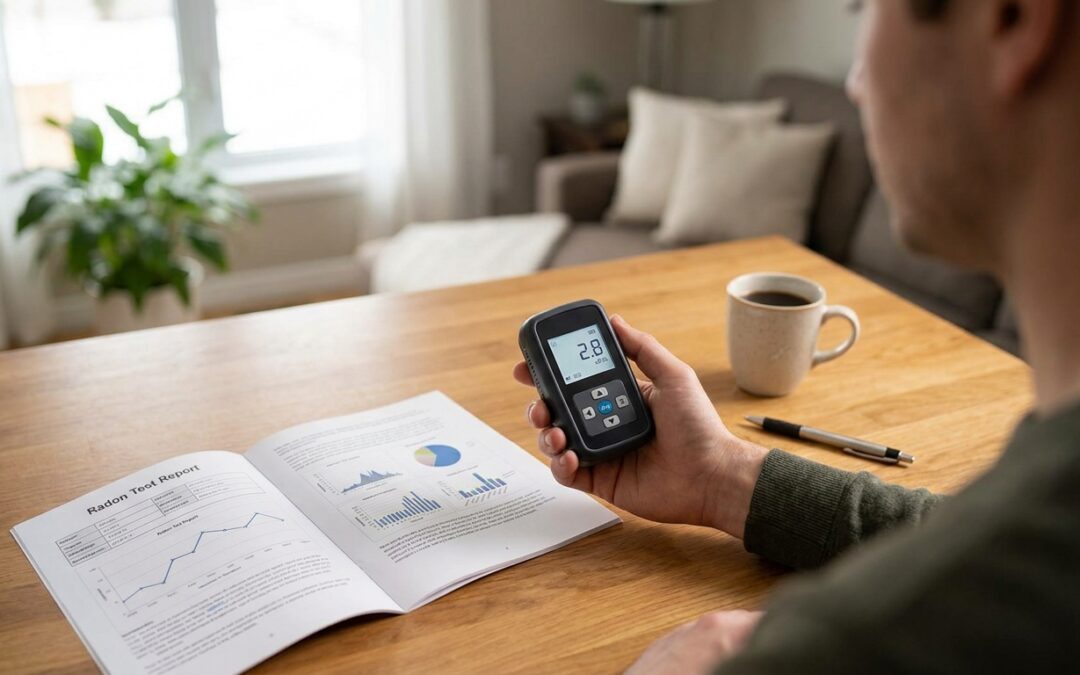
Your radon test results come back as a single number in picocuries per liter (pCi/L), and that number tells you almost everything you need to know about the next step for your Michigan home.
- The EPA action level is 4.0 pCi/L — anything at or above that means you should install a mitigation system.
- Results between 2.0 and 4.0 pCi/L are a gray zone worth a second test or a continuous monitor before deciding.
- Short-term tests (2-7 days) are more sensitive to weather and home conditions than long-term tests (90+ days).
- A single high reading isn’t a diagnosis — retest before you pay for anything, unless you’re mid-closing on a home sale.
- Michigan Radon Control reads results against EPA standards, not just the lab printout, before recommending a fix.
Why this matters
A radon test result isn't just a pass/fail grade — it's a risk estimate, and misreading it either way costs you. Read it too casually and you leave a lung cancer risk factor sitting in your basement for another winter. Read it too aggressively and you spend money on a mitigation system for a level that a second test might have shown was a fluke.
Radon levels swing with barometric pressure, wind, and how tightly a house is closed up. That's why the number on your report needs context, not just comparison to a threshold. In 2026, most Michigan labs still report results the same way they have for years: pCi/L average over the testing period, sometimes with a graph of hour-by-hour readings if you used an electronic monitor.
What you'll need
- Your test report (PDF or paper, from a lab or a continuous monitor readout)
- The EPA action level for reference: 4.0 pCi/L
- Knowledge of test duration — short-term (2-7 days) or long-term (90 days to a year)
- Weather conditions during the test window, if you tracked them
- Whether doors and windows stayed closed for the required 12 hours before and during a short-term test
- A continuous radon monitor if you want to verify a one-time result before acting
The steps
1. Find the average pCi/L number first
Ignore any charts or hourly breakdowns at first glance — find the single average number, usually labeled "Result" or "Average Radon Concentration." This is the number regulators, realtors, and mitigation contractors actually use.
Most lab reports put it in bold near the top of page one. If you tested with a continuous monitor, the average is usually the last data point on the summary screen, not the highest daily spike.
Common mistake: reading the highest single-day spike and panicking. A three-day test with one high day and two low days can still average under 4.0 pCi/L — the average is what matters, not the peak.
2. Compare against the EPA action level
The EPA action level is 4.0 pCi/L. At or above that number, the EPA and Michigan Radon Control both recommend installing a mitigation system. Below 4.0 pCi/L but above 2.0 pCi/L, the EPA still suggests you consider fixing it — there's no truly "safe" level of radon, just diminishing returns on the cost of mitigation.
Anything under 2.0 pCi/L is generally considered low risk for a typical Michigan home. That said, a home with a finished basement bedroom or a family history of lung disease might justify mitigation even at 2.0-3.0 pCi/L.
Expected outcome: you'll walk away knowing which of three buckets your home falls into — under 2.0, the 2.0-4.0 gray zone, or 4.0 and above.
3. Check the test duration against the result
A short-term test (2-7 days) is a snapshot, not a diagnosis. It's the standard for real estate transactions because it's fast, but it's more sensitive to a windy week or a furnace that ran nonstop. A long-term test (90 days or more) smooths out those swings and gives you a truer year-round picture.
If your short-term result landed close to 4.0 pCi/L — say, 3.6 to 4.5 — the test duration matters more than the number itself. Common mistake: treating a borderline short-term result as final when a long-term test or retest would settle it.
4. Cross-check closed-house conditions
Short-term tests require closed-house conditions: windows shut, exterior doors used only for entry and exit, for at least 12 hours before the test starts and for the full test period. If those conditions weren't met — a window left cracked, a door propped open during a move — the result isn't reliable in either direction.
Look at the report's notes section or your own test log for any deviations. If conditions were broken, testing your home for radon again under proper conditions is the only way to trust the number.
5. Decide whether to retest or act
If your result is 4.0 pCi/L or higher and the test conditions were valid, don't wait for a second opinion — schedule mitigation. If it's in the 2.0-4.0 gray zone, a retest with a continuous radon monitor over 90 days gives you a real annual average instead of a snapshot.
If you're selling a home and the buyer's test came back high, timelines shrink fast — real estate closings in Michigan often run on a fixed schedule that doesn't leave room for a 90-day retest.
6. Understand what happens if you're above 4.0 pCi/L
A result at or above the action level means a sub-slab depressurization system, a passive stack conversion, or another mitigation method depending on your foundation type. Crawl space homes, slab-on-grade homes, and homes with sump pumps each need a different approach, and a contractor should tell you which one applies before quoting a price.
Expect the system to bring your level down to well below 2.0 pCi/L in most cases — that's the standard target contractors work toward, and it's how you lower radon levels below the EPA action level reliably.
7. Verify the fix worked
After a mitigation system is installed, a follow-up test — typically 24 to 48 hours after activation — confirms the level dropped. Don't skip this step. A system that's wired wrong or vented too close to a window can fail to bring levels down even though it's technically installed.
Not sure what your result means?
Michigan Radon Control reads your report and tells you the next step, free of guesswork.
Troubleshooting
Result came back exactly at 4.0 pCi/L. Treat this as "above action level" — the EPA action level is a floor, not a buffer. Schedule mitigation rather than splitting hairs over the decimal.
Two tests from the same week gave different numbers. Weather, HVAC cycling, and even which room the test sat in can shift results by a full point or more. Trust the longer test or the one with stricter closed-house conditions.
Report has no clear "average" field. Look for a graph and eyeball the trend line, or call the lab that processed it — most will explain the number over the phone in under five minutes.
Test happened during an unusually mild or windy stretch. Radon levels run higher in cold, still weather because homes stay sealed up. If your test window in 2026 was unusually warm, timing a radon test for accurate winter results again during a colder month gives you a more representative number.
You're mid-sale and the buyer's test came back high. There's a specific playbook for this that differs from a routine homeowner retest — see how other Michigan sellers have handled a failed radon test during a home sale.
Mitigation system installed years ago, now you're not sure it's working. Old fans lose suction over time. Check whether it's time to replace your radon mitigation fan before assuming a new high reading means the system failed entirely.
Tools and resources
- EPA action level reference: 4.0 pCi/L, with 2.0-4.0 pCi/L as a consider-mitigation range
- A continuous radon monitor for a 90-day retest instead of relying on a single short-term snapshot
- Your original test report, with test start/end dates and closed-house condition notes
- A mitigation contractor quote if your result sits at or above 4.0 pCi/L
- Michigan Radon Control's guidance on radon testing and mitigation for homeowners across Metro Detroit and Lansing
What to do next
If your number sits above 4.0 pCi/L, the next real decision isn't whether to fix it — it's how much a proper system costs and what's involved. Read through how to budget for a radon mitigation system installation before you get your first quote, so you know what a fair number looks like.
FAQ
What is a good radon test result?
A result under 2.0 pCi/L is considered low risk in most Michigan homes. Between 2.0 and 4.0 pCi/L, the EPA still recommends considering mitigation, and 4.0 pCi/L or higher means you should install a system.
Is 4.0 pCi/L dangerous?
4.0 pCi/L is the EPA action level, the point at which mitigation is officially recommended. It’s not an instant health emergency, but it represents a measurable increase in long-term lung cancer risk if left unaddressed.
How do I read a radon test report?
Find the average pCi/L number, usually bolded near the top of the report, and compare it to the EPA action level of 4.0 pCi/L. Ignore single-day spikes on a chart — the average over the full test period is what matters.
Should I retest if my radon result is borderline?
Yes, if your short-term result falls between 3.5 and 4.5 pCi/L, a retest or a 90-day reading from a continuous radon monitor gives you a more reliable number before you spend money on mitigation.
How long does a radon test take?
Short-term tests run 2 to 7 days and are standard for home sales. Long-term tests run 90 days or more and give a more accurate year-round average, since radon levels shift with weather and season.
Does a high radon test result mean I have to sell my house for less?
Not necessarily. A mitigation system typically resolves the issue and can be negotiated as a repair credit or completed before closing, similar to any other inspection item.
Can weather affect my radon test results?
Yes. Cold, still weather tends to push radon levels higher because homes stay sealed up, while windy or mild stretches can produce artificially lower short-term readings.
What happens after I get a high radon result?
A mitigation contractor installs a system, usually sub-slab depressurization, matched to your foundation type. A follow-up test 24 to 48 hours after activation confirms the level dropped below the action threshold.
One last thing
The number on your report is an average, not a guarantee — two identical homes on the same street can post different radon test results in the same week just because one had a window cracked for painting. Before you sign off on any decision based on a single test, ask what the closed-house conditions actually were. That detail changes more outcomes than the pCi/L figure itself.
Related guides
- How to test your home for radon
- Best continuous radon monitors for Michigan homes
- How to lower radon levels below the EPA action level
- How to handle a failed radon test during a home sale
- How to tell if your radon mitigation fan needs replacing