
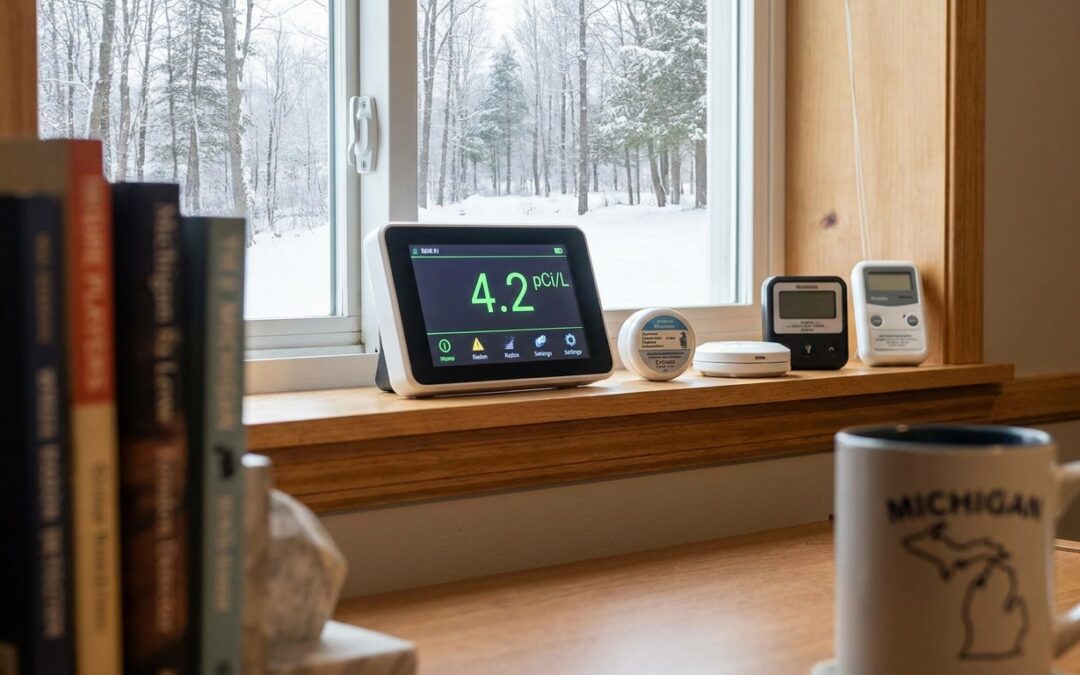
Continuous radon monitors give you hour-by-hour readings instead of a single averaged number, and that distinction matters in a state where indoor radon levels swing with the seasons, the furnace cycle, and even wind direction. This guide ranks the continuous radon monitors that make sense for Michigan homeowners in 2026 and tells you when a DIY device is enough and when you need a certified professional instead.
- Airthings View Plus is the best continuous radon monitor michigan homeowners can install themselves for connected, hourly-logged data.
- RadonEye RD200 wins for real estate pros who need fast Bluetooth readings during a Michigan home closing.
- Safety Siren Pro Series3 is the budget pick for a plug-in alarm, but skip it if you need exportable data for a lender.
- Professional-grade continuous monitors like Radonova stay with certified testers, not DIY buyers.
- Every consumer monitor here should be confirmed with a certified test before a real estate transaction closes.
Why this matters
Radon is a colorless, odorless gas that seeps up through soil and foundation cracks, and Michigan's glacial till and fractured bedrock push levels higher than the national average in a lot of counties. A short-term charcoal kit gives you one number for 48 to 96 hours. A continuous radon monitor logs readings hour by hour for weeks or months, which catches the swings that happen when the furnace kicks on, a sump pump cycles, or a basement door stays open all weekend.
That matters for two groups: homeowners tracking radon after Michigan Radon Control installs a mitigation system, and buyers or sellers who need defensible data during a closing. The EPA sets the action level at 4 pCi/L, and Michigan's radon program estimates roughly 1 in 3 homes tests above that line. A continuous monitor tells you whether your number is a fluke or a pattern.
How we ranked these continuous radon monitors
Ranking pulled from published manufacturer specs, EPA device protocols, and how each unit performs against the criteria that actually matter for Michigan conditions: hourly data logging (not just a daily average), digital or app-based readout, calibration stability over a multi-month deployment, and whether the device is accepted for real estate documentation or strictly a homeowner reference tool. Devices that only produce a single lifetime average, with no data export, dropped down the list regardless of price.
The ranked list
1. Airthings View Plus — the connected pick
This is a WiFi-enabled monitor that logs radon alongside CO2, VOCs, and humidity, syncing to an app with a rolling history graph. It's the only unit on this list that gives you a full trend line without walking to the basement to check a screen. Buy if you want continuous data you can screenshot for a realtor or a mortgage lender without manual logging.
2. RadonEye RD200 — the fast-reading option
The RD200 pairs over Bluetooth and updates hourly, which makes it the go-to for real estate professionals who need a same-day read during a walkthrough. It's compact, runs on standard AC power, and several Michigan agents already carry one to spot-check basements before listing. Buy for anyone working a transaction on a tight closing timeline.
3. Airthings Corentium Home — the reliable starter
A simple digital display, no app, no WiFi — just a number that updates over a rolling short-term and long-term average. It's the least complicated device here and a fine baseline for a homeowner who wants ongoing reassurance after mitigation. Consider it if you don't need exportable data, but skip it for real estate documentation since it has no export function.
4. Ecosense Ecoqube — the compact continuous monitor
Small footprint, digital readout, hourly logging built for placement in a finished basement or a bedroom that sits over a slab. It's a step up from the Corentium Home on data granularity but still lacks app connectivity. Consider for a secondary monitoring point in a larger home, especially one with a finished basement radon mitigation solution already installed.
5. Safety Siren Pro Series3 (HS71512) — the budget alarm
This is a plug-in unit with a built-in audible alarm that triggers past a set threshold, and it's the cheapest device on this list. It's built for alert function, not data logging, so it won't give you a usable trend for a real estate transaction. Consider it only as a supplemental alarm in a mechanical room; skip it as your primary monitor if you need documentation.
6. Radonova / professional continuous monitors — the pro-grade tier
These are the calibrated, chain-of-custody devices certified radon professionals deploy for closings and post-mitigation verification, not units sold direct to homeowners. They cost more, require certified handling, and produce the kind of report a title company or lender will actually accept. Skip buying one yourself — hire a certified tester through professional radon testing services instead.
Comparison table
| Device | Best For | Data Logging | Verdict |
|---|---|---|---|
| Airthings View Plus | Connected homeowners | Hourly, app-synced | Buy |
| RadonEye RD200 | Real estate spot-checks | Hourly, Bluetooth | Buy |
| Airthings Corentium Home | Baseline monitoring | Rolling average, no export | Consider |
| Ecosense Ecoqube | Secondary monitoring point | Hourly, no app | Consider |
| Safety Siren Pro Series3 | Alarm-only alerts | None (threshold alarm) | Consider / Skip for documentation |
| Radonova (professional) | Real estate closings | Calibrated, chain-of-custody | Hire a pro, don't DIY |
Where to buy — and when to hire a pro instead
- Buy consumer monitors directly from the manufacturer or an authorized retailer. Third-party marketplace listings for radon devices carry a real risk of expired calibration or counterfeit units.
- Never submit a DIY continuous monitor reading as your official real estate test. Lenders and title companies in Michigan expect results from a certified device with chain-of-custody documentation, not a consumer app screenshot.
- Pair ongoing DIY monitoring with a professional confirmation test on a schedule tied to your transaction. If you're on a closing clock, check radon testing timelines for Michigan home closings before you assume a DIY reading will satisfy the paperwork.
Need a certified radon reading fast?
Get professional testing and mitigation scheduling for your Metro Detroit or Lansing home.
FAQ
What is the best continuous radon monitor for a Michigan home?
The Airthings View Plus is the best continuous radon monitor for most Michigan homeowners in 2026 because it logs hourly data and syncs to an app for trend tracking. Real estate professionals working tight closing timelines often prefer the RadonEye RD200 instead for its fast Bluetooth readout.
Is a continuous radon monitor better than a short-term test kit?
A continuous monitor gives you weeks or months of hourly data instead of a single 48-to-96-hour average, which matters in Michigan homes where levels swing with furnace cycles and seasons. Short-term kits are still the standard for a quick pre-closing check.
Can I use a consumer radon monitor for a home sale in Michigan?
Most title companies and lenders require a certified test from a calibrated device with chain-of-custody documentation, not a consumer app reading. Use a DIY monitor for ongoing awareness and a certified test for the transaction itself.
How much does a continuous radon monitor cost?
Consumer continuous radon monitors typically range from budget plug-in alarms to higher-end WiFi-connected units, with pricing that varies by retailer. Check current listings directly with the manufacturer since prices shift.
What radon level requires mitigation in Michigan?
The EPA action level is 4 pCi/L, and Michigan’s radon program estimates roughly 1 in 3 homes tests above that line. Any confirmed reading at or above 4 pCi/L warrants a mitigation system.
How often should I check my radon monitor after mitigation?
Check a continuous monitor’s readout at least monthly after a mitigation system is installed to confirm levels stay below 4 pCi/L. Full guidance on keeping a system working correctly is covered in maintaining a radon mitigation system.
Do continuous radon monitors need calibration?
Consumer units generally hold calibration for one to two years depending on the manufacturer, while professional-grade devices used for real estate closings are recalibrated on a stricter schedule. Check the specific device’s documentation for its calibration interval.
What’s the difference between short-term and continuous radon testing?
Short-term testing runs 48 to 96 hours and produces one average number, while continuous monitoring logs readings hourly over weeks or months to show patterns. Michigan homes with finished basements or sump pumps often see more variation, which continuous monitoring catches and short-term testing can miss.
One last thing
A continuous monitor is only as useful as where you place it — set it in the lowest lived-in level of the house, at least 20 inches off the floor and away from drafts, exterior walls, and windows, or the reading skews low and gives you false confidence. Homes with a sump pump often see the biggest swings because the pit itself is a direct soil-gas pathway; if that's your setup, pair the monitor with proper radon mitigation for homes with sump pumps rather than relying on the device alone to manage the problem.
Related guides
- Maintaining a radon mitigation system
- Radon testing timelines for Michigan home closings
- Best radon mitigation contractors in Metro Detroit