
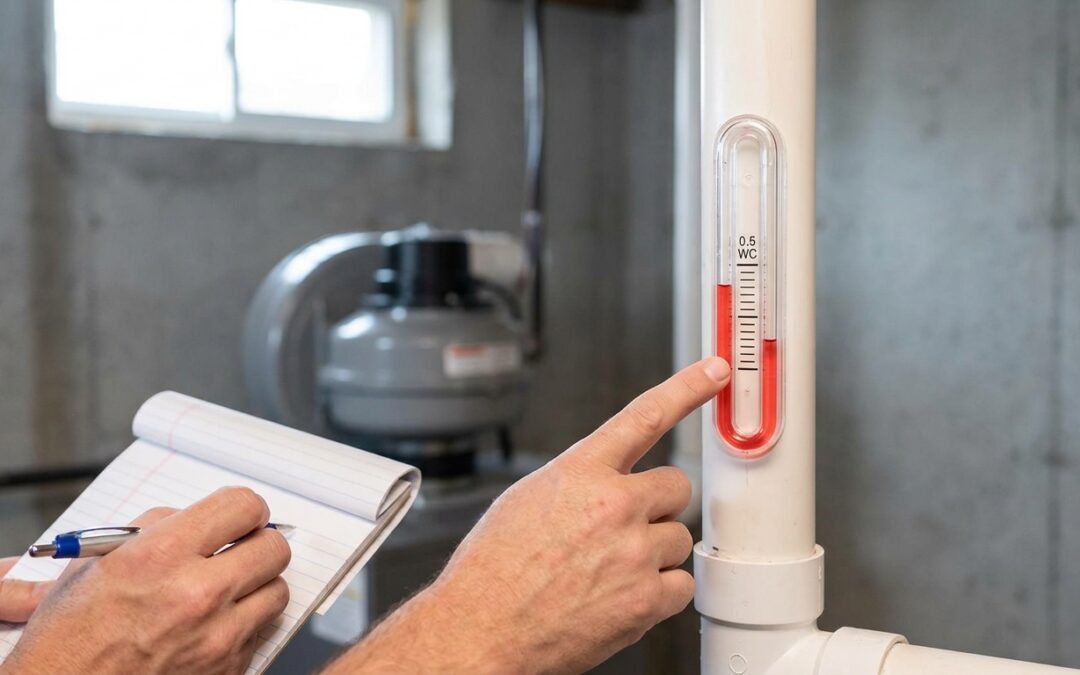
A radon mitigation system's U-tube manometer sits on the exposed pipe in your basement or garage, and it tells you in about five seconds whether the fan below your slab is still doing its job. Most Michigan homeowners walk past it for years without knowing what the liquid inside is supposed to look like.
- A correct radon mitigation system pressure gauge reading shows the liquid split 0.2 to 2.0 inches of water column apart – that means the fan is pulling air.
- A flat, level gauge with zero separation means the fan has stopped – Michigan Radon Control treats this as a same-week service call.
- Write down your baseline reading in the first week after installation; a shift of more than 0.5 inches from that number is your earliest warning sign.
- Most fan failures show up on the gauge weeks before the fan gets audibly loud or quits completely.
Why this matters
A radon mitigation system only works while the fan is actively depressurizing the soil beneath your foundation. The gauge is the one piece of the system that shows you, without any equipment or an appointment, whether that's still happening.
Michigan homes see radon levels swing with the seasons – frozen ground in January seals in soil gas differently than saturated spring soil. A fan that quietly dies in November can go unnoticed until a real estate radon test in March flags a level back above 4 pCi/L. Reading the gauge takes less time than checking a mailbox, and it catches failures long before a re-test would.
If you've gone more than a year without a confirmed gauge check, it's worth confirming your radon mitigation system is still working rather than assuming it is.
What you'll need
- Two minutes and a flashlight (basements and crawl spaces are often dim near the pipe)
- The manufacturer reading you got at install, if you have it written down anywhere
- A phone camera to photograph the gauge for a baseline record
- No tools required – you are reading, not adjusting anything
The steps
1. Locate the U-tube manometer on the vent pipe
The gauge is usually mounted on the vertical PVC pipe where it exits the basement floor or crawl space, before it runs up through the wall or attic. It's a clear plastic tube shaped like a U, partially filled with red or blue liquid.
If you can't find it, check where the pipe first becomes visible after leaving the slab – installers mount it at eye level whenever the layout allows. Expected outcome: you locate a small, clear U-shaped tube attached to the pipe with liquid visible inside.
Common mistake: confusing the manometer with a separate humidity indicator or moisture trap some systems include nearby. The manometer is always U-shaped with liquid in both arms.
2. Note the liquid level in both arms of the U
Look at where the liquid sits in the left arm versus the right arm. On a working system, the liquid on the side connected to the fan side of the pipe sits lower than the side open to room air – the fan is pulling suction and dragging the liquid down on that side.
A properly functioning radon mitigation system pressure gauge reading typically shows a difference of 0.2 to 2.0 inches of water column between the two arms, depending on your fan model and duct length. Expected outcome: a visible, uneven split in the liquid, not a flat level line.
3. Compare the reading to your installation baseline
Every reading only means something in relation to what's normal for your system. If Michigan Radon Control or your installer recorded a baseline reading at setup – often somewhere in the paperwork or on a sticker near the fan – that's your reference point, not a generic chart number.
A drop of more than 0.5 inches from that baseline, in either direction, means something changed in the system's airflow. Common mistake: assuming every house should read the same number – duct length, fan model, and soil type all shift the baseline reading.
4. Check for a flat, level reading
If the liquid sits perfectly level in both arms with no separation, the fan has stopped pulling suction. This is the single clearest failure signal the gauge gives you, and it means the system is no longer moving soil gas out from under your home.
A flat gauge for more than a day or two calls for a fan check – a noisy radon mitigation fan is annoying, but a silent, stopped fan is the problem that actually lets radon back into the house. Expected outcome: confirming whether the fan motor is running by listening or feeling for vibration at the fan housing outside.
5. Check for liquid pooled entirely on one side
If all the liquid has been pushed to one arm and the other arm looks nearly empty, suction is either far stronger or far weaker than normal – sometimes from a blocked duct, sometimes from a cracked gauge tube itself. This reading is less common than a flat gauge but still worth flagging.
Common mistake: topping off or replacing the gauge liquid yourself. The fluid level and type are calibrated to the gauge – adding water or oil changes the reading scale entirely.
6. Log the date and reading every month
A one-time reading tells you today's status. A monthly log, even just a phone photo with the date, tells you whether the fan's performance is drifting before it fails outright. Fan motors in continuous service typically show gradual suction loss over their working life rather than sudden death.
This habit is part of routine upkeep – pair it with the broader steps in how to maintain your radon mitigation system so the gauge check isn't the only thing you're tracking. Expected outcome: a simple record showing the reading stayed within roughly 0.5 inches of baseline month over month through 2026.
Not sure what your gauge is telling you?
Get a professional read on your system’s pressure reading and fan performance.
Troubleshooting
- Gauge reads flat/level: Fan has likely stopped. Confirm by listening at the fan housing outdoors or in the attic; if there's no hum or vibration, the fan needs service or replacement.
- Reading dropped gradually over several months: Normal fan wear. Compare against your logged baseline – a slow decline toward zero over a year or more usually means the motor is nearing end of life, not a sudden fault.
- Reading spiked suddenly, much higher than baseline: Possible duct blockage or a new crack changing airflow. Worth a system check rather than a wait-and-see approach.
- Liquid looks cloudy or discolored: Usually just dust or age in the tube fluid, not a performance issue, but note it and mention it at your next service visit.
- Can't tell which arm should be lower: Check any install documentation for your specific fan model – the low-side convention isn't universal across every manufacturer.
- Fan runs but gauge still reads near zero: This points to a leak somewhere in the pipe run reducing suction at the gauge point, not fan failure – a job for a technician, not a DIY fix.
Tools and resources
- Your installation paperwork or baseline reading, if provided at setup
- A phone camera for a simple monthly photo log
- The guide on how to tell if your radon mitigation fan needs replacing, for when the gauge points to fan trouble specifically
- A continuous radon monitor as a second data point alongside the gauge, if you want ongoing air readings rather than just airflow confirmation
What to do next
A gauge check confirms airflow, not radon levels themselves. If your gauge reading has been flat or dropping for more than a few weeks, the next right move is to schedule radon testing after mitigation installation – it's the only way to know if the levels in your home have actually moved while the fan was down.
FAQ
What is a normal radon mitigation system pressure gauge reading?
A normal reading shows the liquid split between 0.2 and 2.0 inches of water column across the two arms of the U-tube, with the fan-side arm sitting lower. The exact number depends on your fan model and duct length, so your installation baseline matters more than a single universal figure.
What does it mean if my radon mitigation gauge is flat?
A flat, level gauge with no separation between the two liquid arms means the fan has stopped pulling suction. This is the clearest sign of fan failure and should be checked within a few days, since the system is no longer actively removing soil gas.
How often should I check my radon mitigation system’s gauge?
Check it monthly and log the date and reading. A one-time glance tells you today’s status, but a monthly log catches gradual fan wear before it becomes a full failure, especially through Michigan’s 2026 heating season when the system runs continuously.
Can I fix a bad gauge reading myself?
You can confirm the fan is running by listening or feeling for vibration at the housing, but adjusting the gauge liquid or duct connections yourself risks miscalibrating the reading. A flat or erratic gauge calls for a technician, not a DIY repair.
Does a good gauge reading mean my radon level is safe?
A good gauge reading confirms the fan is moving air, not that indoor radon is below the EPA action level of 4 pCi/L. Airflow and radon concentration are related but separate measurements, so periodic re-testing still matters.
Why does my gauge reading change with the seasons?
Soil moisture and ground temperature shift airflow resistance under the slab, so small seasonal swings in the reading are normal. A sudden shift of more than 0.5 inches from your baseline, rather than a slow seasonal drift, is the signal worth acting on.
How long do radon mitigation fans typically last before the gauge shows failure?
Fan lifespan varies by model and run time, but gauge readings typically show a gradual decline in suction over the fan’s working life rather than an abrupt drop. Logging monthly readings is how you catch that decline early.
One last thing
The gauge only tells the truth if you actually looked at it once before anything went wrong. Take the photo this week, write the date on it, and you'll have the one comparison point that turns every future glance from a guess into an answer.
Related guides
- Best radon mitigation fans for Michigan homes
- Best continuous radon monitors for Michigan homes
- How to verify a radon mitigation contractor's NRPP certification
- Radon mitigation as part of a whole-home air quality plan