
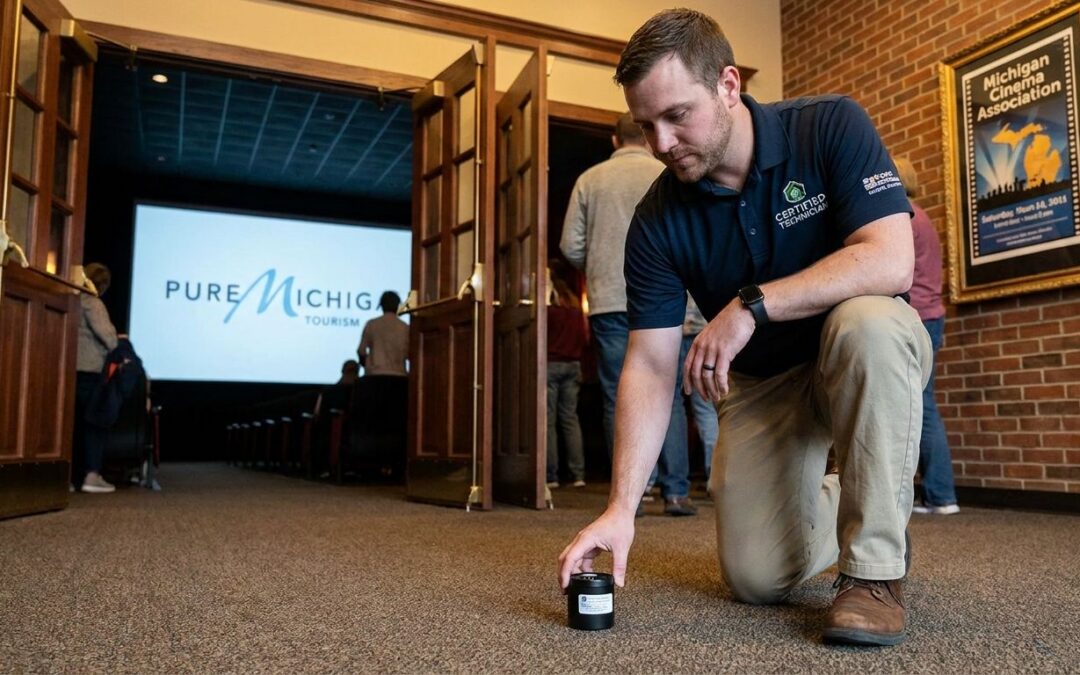
Radon testing for Michigan movie theaters and entertainment venues is short- and long-term gas sampling across below-grade auditoriums, projection booths, and mechanical rooms with the goal of keeping every occupied space under the EPA's 4 pCi/L action level. A multiplex isn't a single-family basement test: several foundations sit under one roof, HVAC runs continuously during business hours, and staff log eight-hour shifts in rooms most homeowners never think to check. Radon testing for Michigan movie theaters and entertainment venues in 2026 has to treat each auditorium as its own building, not one number for the whole property.
- Michigan movie theaters need radon testing in every auditorium, not just one screen — foundations vary across a single building.
- The EPA action level is 4 pCi/L; Michigan’s glacial till soils routinely push below-grade auditoriums to or above it.
- Short-term kits run 48-96 hours; long-term alpha track kits run 90+ days for a seasonal average.
- Multi-screen complexes usually need multiple mitigation fan zones, not one system sized like a house.
- Michigan Radon Control installs NRPP-certified mitigation systems sized for commercial square footage, not just single-family basements.
Why radon testing matters for Michigan movie theaters and entertainment venues
Michigan sits on glacial till soil that traps and channels radon gas upward through slab and below-grade construction — the same geology that pushes residential readings above 4 pCi/L across Metro Detroit and Lansing. A movie theater compounds that risk. Patrons sit in enclosed, sometimes below-grade auditoriums for two to three hours per showing, and projectionists, ushers, and concession staff work full shifts in the same building day after day. Radon testing for commercial buildings in Metro Detroit usually covers offices and retail floor plans, but multiplex auditoriums add stadium seating built into excavated slabs — a foundation type residential testing protocols rarely account for.
In 2026, more Michigan entertainment venues test proactively rather than reactively, often triggered by a lease renewal, an insurance review, or a remodel that adds a screen or expands a lobby. A single passing test in one auditorium says nothing about the screen next door.
Michigan Radon Control tests other high-occupancy commercial spaces the same way it approaches a theater — Michigan hotels and motels with below-grade banquet rooms, and Michigan indoor shooting ranges with ventilation systems that behave nothing like a theater's HVAC. The zone-by-zone approach carries over: test every space where people spend hours, not just the largest room in the building.
How to test and mitigate radon in a Michigan movie theater or entertainment venue
Map the radon risk zones before you test
Before a technician walks the building, use this guide to prepare a Michigan business for a radon inspection — note every room below grade or partially below grade first.
- Below-grade or stadium-seated auditoriums
- Projection booths built into berms or hillside grading (common in older stadium theaters)
- Backstage and storage rooms behind the screen
- Mechanical rooms with sump pumps or floor drains
- Employee break rooms and offices below grade
Choose short-term or long-term test kits for each zone
- Charcoal canister or short-term kits run 48-96 hours
- Alpha track long-term kits run 90+ days for a seasonal average
- Lab-analyzed kits that follow state testing guidelines
- One test point per auditorium — not one test for the entire building
- Backup kits placed in mechanical rooms and projection booths
Time testing around show schedules, not just closed-building rules
- Closed-building protocol (windows and doors shut 12 hours prior) is written for homes and conflicts with a venue open to the public daily
- Best test window is early morning before doors open to guests
- HVAC should run in its normal daily mode — theaters don't shut systems down overnight like a house
- Avoid test weeks with unusual foot traffic, like a grand opening or a film festival
- Log occupancy and HVAC run-time during the test period
Read results against 4 pCi/L per auditorium, not building-wide
- Flag any single auditorium at or above 4 pCi/L for mitigation
- Retest readings between 2 and 4 pCi/L before deciding
- Average multiple sample points inside a large auditorium instead of relying on one corner
- Compare season to season if long-term data exists
- Document readings per room for insurance files and lease records
Install a mitigation system sized for commercial square footage
This is where a homeowner-grade fix runs out of capacity. Michigan Radon Control sizes sub-slab systems to the auditorium's actual square footage rather than defaulting to a single-family setup, and multi-screen complexes typically need more than one fan zone.
- Sub-slab depressurization scaled to large-footprint auditorium slabs
- Sub-membrane depressurization for below-grade lobbies with vapor barriers
- Multiple fan zones for multi-screen complexes instead of one system covering the whole building
- NRPP-certified installation tied into the building's electrical code
- Separate mitigation planning for slab auditoriums versus finished basement lobby space
Verify performance and build in ongoing monitoring
- Check the system's manometer or pressure gauge weekly during facility rounds
- Retest 24-48 hours after installation to confirm the drop
- Install continuous radon monitors in high-occupancy public spaces for real-time data
- Log readings quarterly and tie them into the maintenance calendar
- Retest after any remodel that adds an auditorium or changes slab penetrations
Options at a glance for Michigan entertainment venues
| Option | Best for | Key limitation |
|---|---|---|
| Short-term charcoal kit | Quick screening before a lease renewal or opening | Snapshot result, misses seasonal swings |
| Long-term alpha track monitor | Year-round average across a multiplex's operating seasons | Results take 90+ days |
| Continuous radon monitor | High-occupancy venues needing real-time data | Needs power and periodic calibration |
| Sub-slab depressurization | Slab-on-grade or stadium-seated auditoriums | Needs accessible slab penetration points |
| Sub-membrane depressurization | Below-grade lobbies with vapor barriers | Only as effective as the membrane's condition |
Michigan Radon Control offers testing and mitigation across every format on this list, matched to the auditorium type rather than a single default install.
Common mistakes Michigan movie theaters and entertainment venues make
- Testing one auditorium and assuming the reading applies to every screen — stadium additions built at different times often sit on different slab types.
- Running the residential closed-building protocol on a venue open to the public daily, which skews short-term readings.
- Skipping the projection booth because it's small — booths built into berms or hillside grading often test higher than the auditorium floor below.
- Treating one mitigation system as sufficient for a multi-screen complex when the building actually needs multiple fan zones.
- Forgetting to retest after a remodel that adds a screen, expands the lobby, or changes slab penetrations.
“If one auditorium tests high, test them all — foundations under the same roof rarely behave the same.”
Get your venue tested in 2026
NRPP-certified radon testing and mitigation for Michigan movie theaters and entertainment venues.
FAQ
What is a safe radon level for a movie theater in Michigan?
A safe reading stays below the EPA’s 4 pCi/L action level in every auditorium, not just the building average. Michigan’s glacial till soil means below-grade seating areas often need mitigation even when the lobby tests clean.
Do commercial buildings need radon testing in Michigan?
Michigan doesn’t mandate radon testing for most commercial buildings the way it does for some real estate transactions, but insurers, landlords, and lease agreements increasingly require it. Testing every below-grade room in 2026 is standard practice for venues with public foot traffic.
Can one radon test cover an entire multi-screen theater?
No. Auditoriums built in different construction phases often sit on different slab types, so a single test point can miss a high reading two rooms away. Test each auditorium, the projection booth, and mechanical rooms separately.
How long does radon testing take in a large building?
Short-term charcoal kits run 48 to 96 hours per test point, while long-term alpha track kits run 90 or more days for a seasonal average. Large venues typically run several short-term kits at once across different rooms.
How is commercial radon mitigation different from a home system?
Commercial systems for movie theaters are sized to larger slab footprints and often need multiple fan zones instead of one unit covering the whole building. Below-grade lobbies may need a sub-membrane system separate from the sub-slab system serving the auditoriums.
How often should entertainment venues retest for radon?
Retest after any remodel that adds an auditorium, expands the lobby, or changes slab penetrations, and check the mitigation system’s pressure gauge on a regular maintenance schedule. A full retest every few years catches slow degradation in older systems.
Can radon affect projection booths and backstage areas?
Yes. Projection booths built into berms or hillside grading in older stadium-style theaters often test higher than the main auditorium floor because they sit closer to soil gas sources.
One last thing
Schedule the first test during Michigan's heating season, November through March. Furnaces and the stack effect pull more soil gas into a building during those months, so a winter reading in a movie theater is close to the worst-case number you'll see all year — and if it passes in January, it's unlikely to fail in July.
Related guides