
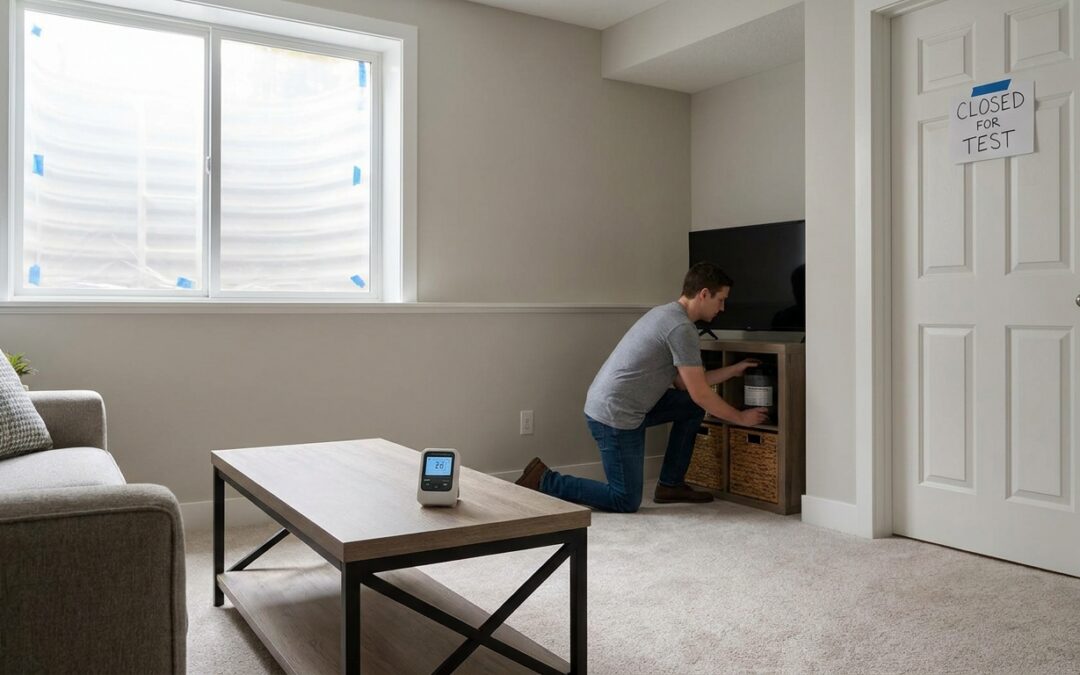
A short-term radon test only works if the basement is sealed up like it's actually being lived in during winter — and most homeowners blow the setup by leaving a door propped open or running a fan during the 48-hour window. This guide walks through exactly how to prep the space so the number on your test report reflects real radon levels in your Michigan home in 2026, not a false low from too much ventilation.
- Close all basement windows and exterior doors 12 hours before starting a radon test.
- Run the test for a full 48 hours minimum — closed-house conditions the entire time.
- Skip using kitchen or bathroom fans, window units, and whole-house fans during the test period.
- Place the test kit 20 inches off the floor, away from drafts, in the lowest livable level.
- A result at or above 4 pCi/L means it’s time to talk mitigation, not retest indefinitely.
Why this matters
Radon is a soil gas, and it moves through cracks in a foundation, sump pump openings, and slab joints faster than most people assume. Michigan sits on glacial till and uranium-bearing bedrock in several counties, which is why basement levels here regularly land above the EPA's 4 pCi/L action threshold.
A botched test setup produces a number that's either artificially low (too much fresh air exchange) or artificially high (a storm system pushing barometric pressure around). Either way, you make a decision — buy the house, list it, install a system — based on bad data. If you're mid-transaction, get the testing timeline for Michigan closings squared away before you set the kit down, because a rushed or improperly closed-house test can get flagged and require a redo.
What you'll need
- A short-term radon test kit — charcoal canister, alpha track, or continuous monitor
- Painter's tape or a small stand to keep the device 20 inches off the floor
- A calendar reminder for the 48-hour start and stop times
- Access to close every basement window and exterior door
- A pen to log the exact start/stop time and any weather notes
If you don't already own a kit, the best radon test kits for Michigan homeowners breaks down which ones hold up in cold, damp basements versus which ones give inflated readings in humid conditions.
The steps
1. Pick the lowest livable level
Radon concentrates near the foundation, so the test goes in the lowest level of the house that's actually used as living space — a finished basement, a rec room, even an unfinished basement if that's the lowest floor. This accomplishes: it captures the highest realistic exposure level in the home, not a diluted reading from an upper floor.
Common mistake: testing on the main floor because the basement is "just storage." If anyone spends time down there, even a home office once a week, test at that level.
2. Close up the house 12 hours before starting
Shut every basement window, storm window, and exterior door 12 hours before the test kit starts recording. This gives the house time to reach the closed-house radon equilibrium the EPA protocol assumes. Expected outcome: radon concentration in the basement stabilizes to a level that reflects normal winter living conditions, since most Michigan basements run closed for months at a time anyway.
3. Place the device correctly
Set the kit 20 inches above the floor, at least 3 feet from exterior walls, windows, and doors, and away from heat vents, sump pits, and drafts. Why it matters: air currents near a sump pump or a heat register skew the reading in either direction, and a device pressed against a cold exterior wall can pick up condensation that throws off charcoal-based kits.
Common mistake: setting the kit directly on a sump pump lid. That's one of the highest-concentration spots in the basement and will spike your number artificially.
4. Run the test for a full 48 hours
Start the clock and don't touch the kit again until the 48-hour mark. This is the minimum window the EPA and most state protocols require for a short-term test to be considered valid in 2026. A shorter window catches too much day-to-day fluctuation; radon levels swing by the hour based on soil moisture and barometric pressure.
Common mistake: pulling the kit at 36 hours because you're in a hurry to mail it. Labs will often reject or flag an early pull, and you'll redo the whole test anyway.
5. Keep the house sealed for the entire window
No opening basement windows, no propping the exterior door for the dog, no running the whole-house fan or a window air conditioner. This accomplishes closed-house conditions the entire measurement period, which is the only way the number is comparable to EPA benchmarks. Bathroom and kitchen exhaust fans should also stay off if they pull air from the lower level.
Specific instruction: tell everyone in the household about the test dates. One open door for ten minutes can undercut the reading enough to miss a real problem.
6. Avoid weather extremes when you can choose the date
High wind and heavy storms change barometric pressure fast enough to pull extra soil gas into the basement, spiking short-term results. Pick a stretch of calm, typical weather if your schedule allows it — this isn't required, but it produces a more representative number.
Expected outcome: a reading that reflects normal conditions rather than a weather anomaly in either direction.
7. Log start time, stop time, and any anomalies
Write down the exact hour the test started and stopped, plus anything unusual — a furnace repair, a storm, guests coming and going. This accomplishes: if the number comes back surprising, you and a mitigation contractor can tell whether it's a real reading or a compromised test.
8. Mail or read the result within 24 hours of pickup
Charcoal kits degrade fast once removed from the basement, so seal the container immediately and mail it the same day. Continuous monitors give you an on-device reading instantly, which is why the best continuous radon monitors for Michigan homes are worth it if you retest often or you're managing a rental property.
Troubleshooting
- Result came back higher than expected. Check your log for storms or open doors during the window. If nothing looks off, retest to confirm before assuming the number is wrong — a second reading above 4 pCi/L means it's time to mitigate, not keep testing.
- Family member opened a window during the test. The test is compromised. Restart with a fresh kit rather than trying to interpret a partial closed-house result.
- Sump pump lid isn't sealed. An open or loosely fitted sump lid is a direct radon entry point and will push readings up regardless of placement. Seal it before testing, not after.
- Basement is finished with carpet and drywall. Finished basements trap radon differently than bare concrete. If levels come back elevated, radon mitigation for finished basements covers system options that don't require tearing out drywall.
- Home has a sump pump AND a French drain. Multiple foundation penetrations mean multiple entry points, and a standard sub-slab system may need modification — this is a case where a licensed contractor should evaluate before you install anything yourself.
- Test was done during a home sale and buyer disputes the result. Real estate transactions have tighter protocols; a redo with a certified third party is standard practice when a result is contested.
Get your radon test read by a certified pro
NRPP-certified testing and mitigation across Metro Detroit and Lansing.
Tools and resources
- Short-term charcoal or alpha track kit, or a continuous monitor for repeat testing
- Painter's tape or a small elevated stand
- A written log for start/stop times and household activity
- NRPP-certified follow-up testing if your result lands near or above 4 pCi/L
If you're testing ahead of a sale, the radon testing guidance for Michigan real estate agents covers disclosure timing that overlaps directly with test scheduling.
What to do next
A reading at or above 4 pCi/L in 2026 means mitigation, not a third retest. Before scheduling a system install, confirm your current setup is even functioning if you already have one — how to verify your radon mitigation system is still working walks through the manometer check most homeowners skip. If you're starting from zero, full-service radon testing services for Michigan homeowners covers the certified retest and mitigation quote in one visit.
FAQ
How long does a basement radon test need to run?
A short-term radon test needs a minimum of 48 hours under closed-house conditions. Pulling the kit earlier risks an invalid or flagged result, especially for real estate transactions.
Do I need to close basement windows for a radon test?
Yes, close all basement windows and exterior doors at least 12 hours before the test starts and keep them closed the entire 48-hour window. Any fresh air exchange dilutes the reading and skews it low.
Where should I place a radon test kit in the basement?
Set the kit 20 inches above the floor, at least 3 feet from exterior walls, windows, doors, and heat vents. Avoid sump pits entirely — they’re a direct radon source and will inflate the reading.
What radon level requires mitigation in Michigan?
The EPA action level is 4 pCi/L, and a confirmed result at or above that number means mitigation is recommended. Many Michigan basements sit above this threshold given the region’s soil and bedrock composition.
Can I run a fan during a radon test?
No, avoid running whole-house fans, window air conditioners, and exhaust fans that pull air from the basement during the test window. These change air pressure and airflow enough to produce an unreliable reading.
Is it better to test in winter or summer?
Winter testing is generally more reliable because homes are naturally closed up, matching the EPA’s closed-house protocol. Summer results can run lower simply because windows and doors get opened more often.
What happens if my radon test result is disputed during a home sale?
A disputed result typically triggers a retest by a certified third-party tester following stricter real estate protocols. Buyers and sellers usually split or negotiate the cost of the retest and any resulting mitigation.
Should I test every basement level if my home has more than one?
Test the lowest level that’s used as living space, since that’s where radon concentrates most. If multiple levels are finished and occupied, testing each gives a fuller picture, but the lowest level result drives the mitigation decision.
One last thing
Most homeowners assume a passing test means they're done for good, but radon levels shift with foundation settling, sump pump changes, and even seasonal soil moisture — a home that tested clean in 2020 can read above 4 pCi/L by 2026 without any renovation at all. Retesting every two years, or immediately after foundation work, catches that drift before it becomes a surprise during a sale.
Related guides
- Best continuous radon monitors for Michigan homes
- How to verify your radon mitigation system is still working