
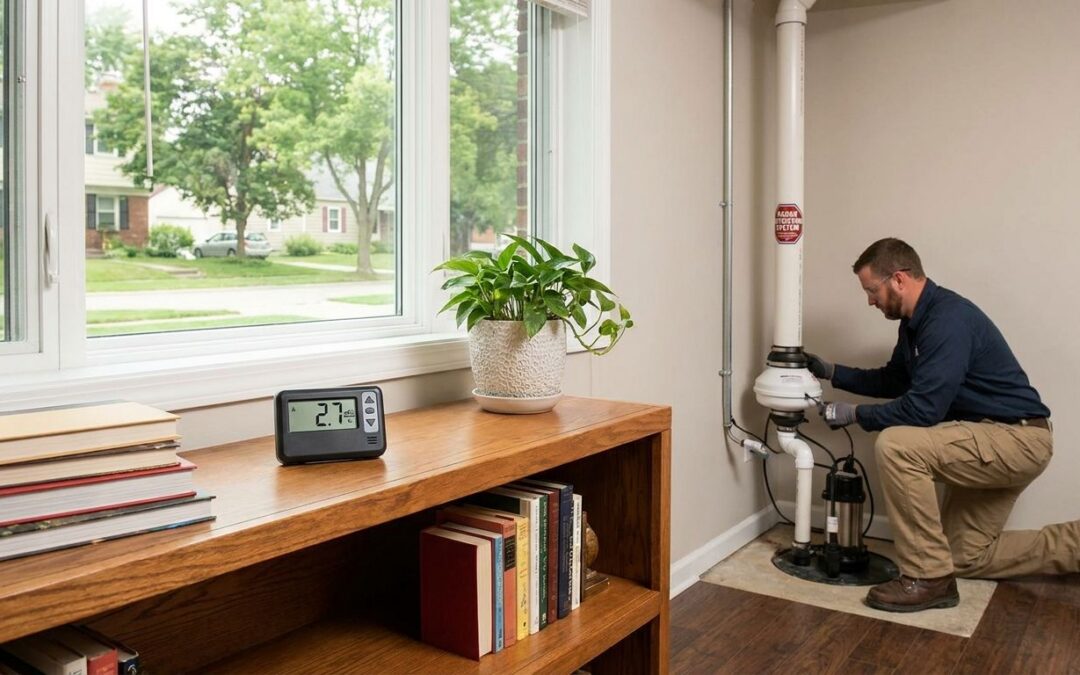
A radon test that comes back between 2 and 4 pCi/L puts you in the gray zone of Michigan radon control: below the EPA's 4.0 pCi/L action level, but far above the 0.4 pCi/L that outdoor air typically carries. Nothing forces you to mitigate at this range, and that's exactly why homeowners get stuck.
- Radon mitigation at 2 to 4 pCi/L isn’t legally required in Michigan, but Michigan Radon Control installs systems at this range routinely in 2026.
- Sub-slab depressurization typically drops a 3.5 pCi/L reading to under 1.0 pCi/L within 24 hours of fan activation.
- Passive systems left passive rarely clear a 2 to 4 pCi/L reading on their own; adding a fan is usually the fix.
- Retest 24 hours to 30 days after any system goes live, and again yearly after that.
Why This Range Keeps Homeowners Up At Night
The EPA sets 4.0 pCi/L as the point where mitigation is officially recommended. That number was chosen as a practical cutoff, not a safety threshold. A reading of 3.8 pCi/L carries most of the same long-term lung risk as a reading of 4.2 pCi/L — the action level is a policy line, not a biological one.
Michigan's glacial till and limestone bedrock push radon into homes at higher rates than the national average, and readings in the 2 to 4 pCi/L band show up constantly across Metro Detroit and Lansing basements in 2026. If you want to understand how the number on your report translates into risk, reading your radon test results is the fastest way to get oriented before you decide anything.
Who This Guidance Is For
This is written for Michigan homeowners who tested in the 2 to 4 pCi/L range and are weighing whether to install a system now or wait. It's also for sellers preparing for disclosure, buyers negotiating post-inspection, and anyone with infants, toddlers, or smokers in the household where the cumulative exposure math changes the calculus even at sub-action-level readings.
If your last test came back above 4.0 pCi/L, this isn't the guidance you need — that range has its own mitigation urgency and its own playbook.
What To Look For In A System At This Level
System type matched to your foundation
A slab-on-grade home, a crawl space, and a basement with a sump pump each need a different mitigation approach. Installing a generic sub-slab system on a home where a sump pit already offers a natural collection point wastes money and undersells the fix. Getting the right mitigation system type matched to your foundation matters more at 2 to 4 pCi/L than it does at 8 or 10, because there's less room for a poorly matched system to still get you under 2.0.
Fan sized for moderate reduction, not overkill
A home reading 3.5 pCi/L doesn't need the same fan horsepower as one reading 12 pCi/L. Oversized fans cost more to run, generate more noise, and don't improve outcomes once you're already in single digits.
NRPP certification, not just a business license
Michigan doesn't require state licensing for radon contractors, which means anyone with a drill can call themselves a mitigation company. NRPP (National Radon Proficiency Program) certification is the credential that actually verifies training on system design, sealing technique, and fan placement.
A retest built into the installation price
A system that isn't retested is a system nobody has confirmed works. Post-installation testing should be quoted as part of the job, not an upsell you discover later.
Warranty length that covers the system, not just the install day
A 5-year warranty on parts and workmanship tells you the contractor expects the system to keep performing, not just pass its first test. Anything shorter is a signal the contractor isn't confident in the install.
A maintenance plan for years two through ten
Fans wear out. U-tube manometers drift. A homeowner who never checks the gauge after year one is the homeowner who finds out at year six that the system has been dead for eighteen months.
Top Approaches For 2 To 4 pCi/L Michigan Homes
Active sub-slab depressurization — the standard fix. This pulls soil gas from beneath the slab before it enters living space, typically cutting a 3.5 pCi/L reading to under 1.0 pCi/L within 24 hours of fan activation. It's the default recommendation for basement and slab-on-grade homes reading in this range in 2026. Verdict: Buy.
Crawl space depressurization — the crawl space pick. Homes built over a crawl space move radon differently than slab homes, and a system designed for crawl space homes combines vapor barrier sealing with a dedicated fan rather than a straight sub-slab pipe. For a 2 to 4 pCi/L reading in a crawl space home, this is usually enough without additional encapsulation work. Verdict: Buy.
Sump pump integration — the retrofit pick. If your basement already has a sump pit, sealing and venting through it avoids drilling a new slab penetration. Homes with sump pumps that read 2 to 4 pCi/L are often the cheapest and fastest installs on this list because the collection point already exists. Verdict: Consider.
Passive stack left passive — the wait-and-see approach. New construction homes sometimes ship with a passive radon-resistant stack that was never activated with a fan. Passive stacks alone rarely bring a 2 to 4 pCi/L reading down far enough to matter, since they rely on natural convection instead of forced air. Verdict: Skip, unless a retest after activation confirms otherwise.
What To Avoid At This Range
- DIY caulk-and-seal fixes with no fan. Sealing cracks slows radon entry but doesn't reverse the pressure differential that pulls gas into your home — it buys you a few tenths of a point, not a real fix.
- Treating 2 to 4 pCi/L as "safe" because it's under the action level. The EPA's own guidance notes risk exists below 4.0 pCi/L; homes reading in the 4 pCi/L and above range get mitigated automatically, but the biological exposure curve doesn't stop at that line.
- Skipping the retest after installation. A system that isn't verified with a follow-up test is a guess, not a result — and a guess doesn't hold up during a home sale disclosure.
Get a radon mitigation estimate
NRPP-certified installs across Metro Detroit and Lansing in 2026.
Verdict Comparison
| Approach | Best for | Typical result | Verdict |
|---|---|---|---|
| Active sub-slab depressurization | Basements, slab-on-grade | Under 1.0 pCi/L | Buy |
| Crawl space depressurization | Crawl space foundations | Under 1.5 pCi/L | Buy |
| Sump pump integration | Homes with existing sump pits | Under 1.5 pCi/L | Consider |
| Passive stack (no fan) | New construction, pre-activation | Minimal change | Skip |
FAQ
Do I need to mitigate at 2 to 4 pCi/L in Michigan?
No, the EPA action level is 4.0 pCi/L, so mitigation isn’t required at 2 to 4 pCi/L. Many Michigan homeowners choose to mitigate anyway because risk doesn’t stop at the action level, especially with children or long-term occupants in the home.
How much does radon mitigation cost for a 2 to 4 pCi/L home in Michigan?
Costs vary by foundation type and system complexity, and a detailed budget breakdown is available on the mitigation budgeting guide. Homes at this range often need standard single-fan systems rather than the larger multi-point systems used above 4.0 pCi/L.
Is 2 pCi/L high for a Michigan home?
It’s above the national indoor average of 1.3 pCi/L and well above the 0.4 pCi/L typical outdoor level, but below the 4.0 pCi/L EPA action threshold. Michigan’s geology means readings in this band are common across Metro Detroit and Lansing.
Will a passive radon system lower a 3.5 pCi/L reading?
Rarely on its own. Passive stacks rely on natural convection, and most homes reading 2 to 4 pCi/L need an activated fan to see the reading drop meaningfully.
How soon should I retest after installing a mitigation system?
Retest between 24 hours and 30 days after the system is activated. A follow-up test confirms the system pulled the reading below 2.0 pCi/L and gives you documentation for future disclosure.
Does radon mitigation help with a home sale if I’m at 3 pCi/L?
Yes, mitigating below the action level strengthens disclosure paperwork and removes a negotiation point buyers commonly raise, even though it isn’t legally required at that reading.
Can I install a radon system myself at this range?
You can, but system design errors are common without NRPP training, and a poorly sealed system can pull moisture and cold air into the house along with reducing radon only partially.
How long does a radon mitigation system last?
Fans typically run for several years before replacement, and systems installed with a 5-year warranty give you a documented service window to catch failures early.
One Last Thing
The number that matters most isn't your first test — it's your retest. A home that mitigates at 3.5 pCi/L and never checks the gauge again in 2026 is functionally no different from a home that never mitigated at all once that fan eventually fails.
Related Guides