
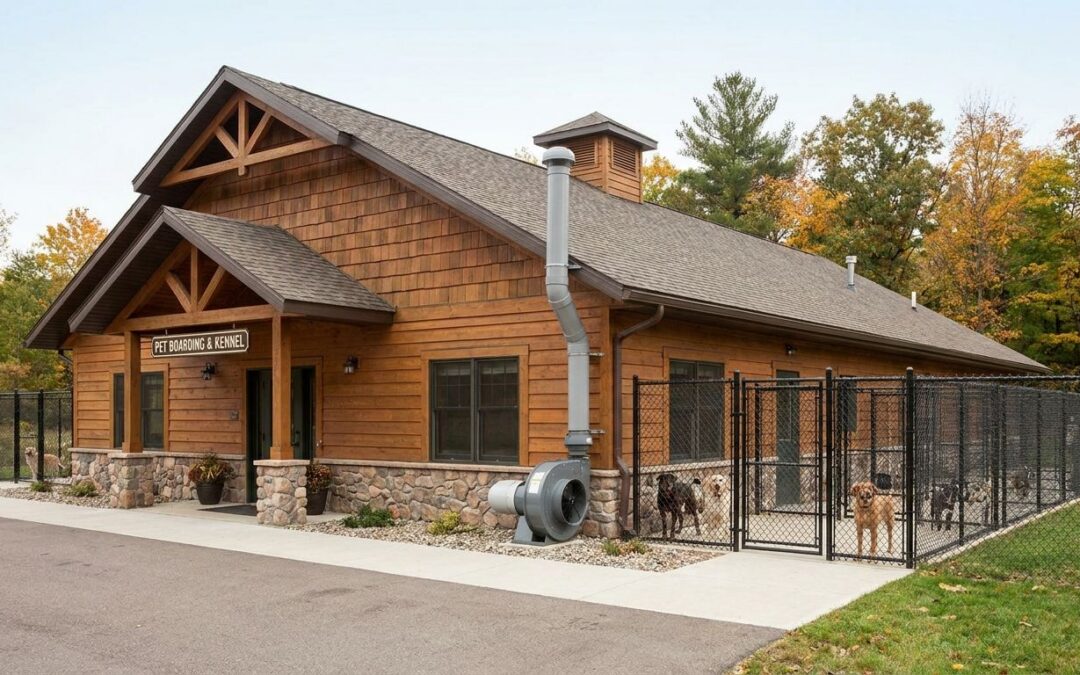
Radon mitigation for a Michigan pet boarding or kennel facility means installing a sub-slab depressurization system sized for a commercial-scale building, with the goal of keeping indoor radon below the EPA action level of 4.0 pCi/L for animals and staff who spend eight-plus hours a day at floor level. Kennels differ from a typical home: dogs and cats live and sleep close to concrete slabs where radon gas concentrates, ventilation is often driven by kennel-cleaning airflow rather than HVAC, and many boarding facilities in Michigan are converted pole barns or slab-on-grade outbuildings with foundation types that behave differently than a poured basement.
- Radon mitigation kennel facility Michigan projects need commercial-grade fans sized for larger slab area, not a residential unit.
- Test at kennel floor level, not office level — animals live closer to the slab where radon concentrates.
- Michigan Radon Control installs NRPP-certified systems for pole barns, slab-on-grade kennels, and mixed-use boarding buildings.
- Most Michigan counties sit in EPA Radon Zone 1, meaning predicted average screening levels above 4 pCi/L.
Why radon mitigation matters for pet boarding and kennel facilities
Dogs and cats spend more consecutive hours at floor level than the humans who own them, and radon gas is heaviest near the slab it seeps through. A kennel building with 10-hour boarding stays multiplies exposure time in a way a typical office or retail space does not.
Many Michigan kennels operate out of pole barns, converted agricultural buildings, or slab-on-grade additions — construction types with different crack patterns and sub-slab conditions than a poured basement. That changes how a mitigation system gets sized and where the suction point goes.
Liability matters too. A boarding facility that skips testing has no record to show a pet owner, an insurer, or a county inspector if radon becomes a question during a claim or a sale of the business.
Test every building on the property, not just the main kennel
Most Michigan boarding operations run more than one structure — a main kennel, a separate cattery, an isolation ward, sometimes a barn used for large-breed runs. Radon levels vary building to building because each slab has its own soil contact and crack pattern.
- Place a test device in the lowest occupied level of every building, including detached kennels and pole-barn additions
- Run short-term tests for 48-96 hours minimum per EPA protocol
- Retest any building with a prior reading above 4 pCi/L, even if a neighboring building tested clean
- Log results by building name and date so you have a record if a pet owner or health inspector asks
- Avoid testing during unusually high winds or right after major door traffic — both skew short-term results
Test at kennel floor level, not office or lobby level
A front-desk area with carpet and raised flooring can read differently than a concrete kennel run 20 feet away. Put the device where the animals actually spend their boarding hours.
- Place the test canister in a kennel run or common holding area, at breathing height for a crated dog (12-18 inches off the floor)
- Skip elevated office space and mezzanines for the primary test — use those only for a secondary reading
- Note any floor drains, sump pits, or unsealed slab penetrations near the test location; those are common entry points
- Repeat the test seasonally if the facility runs mechanical ventilation differently in summer versus winter
Choose the mitigation system type for your building's foundation
A pole barn on a slab behaves differently than a basement-based facility, and the fix has to match. Get to Know the Four Types of Radon Mitigation covers the general categories, but kennel buildings usually land in one of two camps.
- Sub-slab depressurization for poured-slab kennels — a suction point drilled through the slab, piped to an exterior or roof-mounted fan
- Sub-membrane depressurization for kennels with exposed dirt floors in storage or overflow areas
- Block-wall systems if the kennel has cinder block foundation walls with hollow cores acting as a radon pathway
- Passive stack systems only where new construction allows it — most existing kennels need active fan-driven suction
- A commercial-scale fan rated for the building's total slab square footage, not a single residential-sized unit stretched across a larger facility
Michigan Radon Control sizes systems against the actual slab area and construction type of the building, which matters more for a kennel with multiple additions than for a single-family home.
Budget for installation and ongoing operating cost
Facility owners underestimate radon mitigation as a line item because they're used to pricing residential systems. How to Budget for a Radon Mitigation System Installation breaks down what drives cost up or down.
- Get quotes based on total slab square footage across all buildings, not a single flat estimate
- Ask whether the quote includes electrical work for the fan — most commercial installs need a dedicated circuit
- Factor in fan replacement cycles; commercial fans run longer hours than residential units and wear faster
- Ask if multi-building discounts apply when several structures need systems installed in one visit
- Set aside a line for annual retesting, not just the one-time install
Verify the contractor's NRPP certification before signing
Commercial radon work in a facility with live animals raises the stakes on getting it right the first time. How to Verify a Radon Mitigation Contractor's NRPP Certification walks through the check.
- Confirm the installer holds an active NRPP or NRSB mitigation credential, not just a testing certification
- Ask for references from commercial or agricultural-building installs, not only single-family homes
- Check insurance and bonding coverage specific to commercial job sites — How to Verify a Radon Contractor's Insurance and Bonding covers what to ask for
- Get the warranty terms in writing before the crew arrives
- Confirm the contractor can schedule around animal boarding hours to limit disruption to kennel operations
Get your kennel facility tested
NRPP-certified testing and mitigation for Metro Detroit and Lansing area facilities.
Schedule a retest after installation
A mitigation system isn't done until it's proven with a follow-up test. How to Schedule Radon Testing After Mitigation Installation sets the timeline most Michigan contractors follow.
- Retest 24-48 hours after the fan starts running, at minimum, per EPA protocol
- Test in the same locations used for the original baseline reading so results are comparable
- Keep both test reports on file for insurance, lease, or sale purposes
- Schedule an annual retest afterward — radon levels shift with soil moisture and seasonal pressure changes
Maintain the system and watch for warning signs
A kennel runs longer daily hours than a home, so the fan logs more run-time and needs more attention. How to Read a Radon Mitigation System's Pressure Gauge explains what the gauge is telling you.
- Check the manometer or gauge monthly — a flat reading usually means the fan has failed
- Listen for a sudden change in fan noise; a louder or rattling fan often needs replacing before it fails outright
- Keep vent pipe exits clear of snow load and roofline obstructions through Michigan winters
- Confirm exterior fan housings are still sealed against moisture after storms
Comparison of mitigation approaches for kennel buildings
| Option | Best for | Typical setting | Key limitation |
|---|---|---|---|
| Sub-slab depressurization | Poured-slab kennel buildings | Main kennel run, cattery | Requires drilling through slab, needs dedicated electrical circuit |
| Sub-membrane depressurization | Dirt-floor storage or overflow kennel space | Barn additions, overflow runs | Membrane can tear under heavy foot or cart traffic |
| Block-wall depressurization | Cinder block foundation kennels | Older converted buildings | Needs sealing of all block cores to work correctly |
| Passive stack (new construction only) | New-build kennel additions | Ground-up facility expansion | Not sufficient alone for high-radon soil without an added fan |
Common mistakes kennel and boarding facility owners make
- Testing only the office, not the kennel runs. The area with the highest animal occupancy time is usually the last place tested.
- Treating a multi-building property as one test. Each structure needs its own reading; a clean main kennel doesn't clear a separate cattery or barn addition.
- Skipping the retest after installation. A system that isn't verified with a post-mitigation test is an assumption, not a confirmed fix.
- Undersizing the fan for total slab area. A residential-grade fan stretched across a large kennel footprint often can't maintain suction across the whole slab.
- Ignoring seasonal fan checks. Michigan winters put real strain on exterior fan housings and vent stacks; a facility that only checks the system once a year can miss a mid-winter failure for months.
FAQ
Does a Michigan kennel or pet boarding facility legally need radon testing?
Michigan does not mandate radon testing for commercial kennels, but the EPA action level of 4.0 pCi/L is the standard most contractors and insurers use to judge whether mitigation is needed. Facilities with year-round animal boarding are treated similarly to daycare or senior-care buildings because occupants spend extended hours at floor level.
How much does radon mitigation cost for a commercial kennel building?
Cost depends on total slab square footage across all buildings on the property, plus any electrical work needed for the fan. Get a quote based on the facility’s actual footprint rather than a flat residential estimate.
Is radon mitigation kennel facility Michigan work different from residential mitigation?
Yes — kennels typically need a commercial-scale fan sized for larger slab area, testing at floor level across multiple buildings, and system design adapted to pole-barn or slab-on-grade construction rather than a basement.
Where should radon testing devices be placed in a kennel?
Place devices in kennel runs and holding areas at breathing height for a crated animal, roughly 12-18 inches off the floor, rather than in office or lobby space. Test every separate building on the property, since levels vary by structure.
How long does a radon test take at a boarding facility?
A short-term test runs 48-96 hours per EPA protocol. Retest 24-48 hours after a mitigation fan is installed to confirm the system brought levels below 4.0 pCi/L.
Can a pole barn used for dog boarding get a radon mitigation system installed?
Yes. Pole barns on a poured slab typically use sub-slab depressurization; barns with exposed dirt floors in storage areas usually need a sub-membrane system instead.
How often does a kennel’s radon mitigation system need maintenance?
Check the pressure gauge monthly and retest annually, since a kennel’s fan runs longer daily hours than a residential system and wears faster. A flat gauge reading usually means the fan has failed and needs replacement.
One last thing
Most radon guidance is written for a single-family basement, but a kennel with three separate buildings on one lot needs three separate test results, not one facility-wide assumption — the building nobody thinks to test is usually the overflow barn, and that's often where the reading comes back highest in 2026 inspections across Southeast Michigan.
Related guides
- Radon Testing for Michigan Veterinary Clinics and Animal Hospitals
- Radon Mitigation for Michigan Pole Barns and Outbuildings
- Radon Control Services for Michigan Senior Care Facilities
- Best NRPP-Certified Radon Mitigation Companies in Michigan