
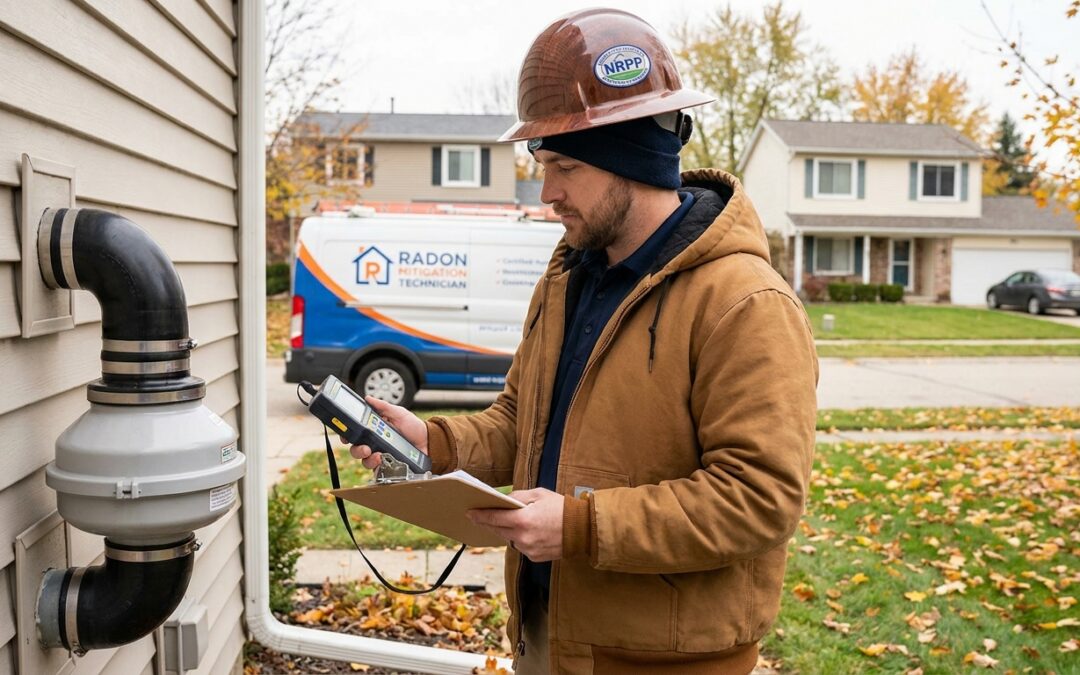
Finding the best NRPP-certified radon mitigation companies in Michigan comes down to one question: does the credential on their truck actually mean anything, or is it marketing language slapped on a website. This guide breaks down what separates a real NRPP-certified installer from a contractor who dabbles in radon on the side.
- The best NRPP-certified radon mitigation companies in Michigan carry an active credential number you can verify on the public directory.
- Michigan Radon Control installs EPA-guided systems with a 5-year warranty for Metro Detroit and Lansing homes — Buy.
- National franchise chains often subcontract the install; confirm who personally holds the NRPP number before signing — Hold.
- General contractors doing radon as a side job skip the radon-specific training NRPP requires — Skip.
- Home warranty-covered mitigation providers handle basic sub-slab jobs but rarely cover readings above 4.0 pCi/L — Consider.
Why this matters
Michigan doesn't require a state license to install a radon mitigation system. NRPP certification is the closest thing homeowners have to a real credential check, and in 2026 that gap still trips up a lot of buyers and sellers rushing a home closing.
A bad install doesn't just waste money — it can leave radon levels above the EPA action level of 4.0 pCi/L while the homeowner thinks the problem is solved. Before you hire anyone, verify a contractor's NRPP certification the same way you'd check a license plate before buying a used car.
How we ranked
The categories below are ranked on four criteria pulled from what Michigan homeowners and realtors actually ask when vetting a radon mitigation company: active NRPP or NRSB certification status, EPA-consistent system design, written warranty terms, and whether the crew doing the install is the same crew holding the credential. None of this is guesswork — it's the same checklist state radon offices and real estate agents recommend across Michigan in 2026.
Companies and categories that fail more than one criterion get a Skip or Hold. Companies that clear all four earn a Buy.
The ranked list
1. NRPP-certified independent radon specialists — the safe pick
One company, one crew, one name on the certification. Michigan Radon Control falls in this category, running NRPP-certified radon testing and mitigation installs across Metro Detroit and Lansing with a 5-year system warranty.
The advantage here is accountability — the person who designed your system is the person who answers the phone if the fan fails in year three. Verdict: Buy for homeowners who want one point of contact from test to warranty.
2. National franchise mitigation chains — the volume play
Franchise operations cover more territory, but the local branch doesn't always employ the certified installer directly. Some subcontract the physical install to a third-party crew and keep the NRPP name on the paperwork only.
Ask directly: who is on-site during the install, and is that person's NRPP number the one on the contract? Verdict: Hold until you get a straight answer.
3. General contractors offering radon as a side service — the risky shortcut
A licensed contractor can pour concrete and run electrical, but radon mitigation is its own discipline with its own NRPP training track. Fan wiring alone has to meet specific electrical code rules that general contractors don't always know.
A system installed without radon-specific training can short-circuit airflow calculations and leave post-mitigation levels barely under the 4.0 pCi/L action level. Verdict: Skip.
4. Test-only companies with no mitigation license — half the job
These companies can hand you an accurate radon reading, but they can't legally install a system. That's fine if all you need in 2026 is a test before listing your home, but it leaves you hunting for a second company mid-transaction.
Verdict: Consider for testing only, Skip if you need mitigation done by the same visit.
5. Realtor "preferred vendor" networks — the convenient referral
Realtor referral lists are usually built on relationships, not certification audits. Some names on those lists are excellent NRPP-certified installers; others just closed deals fast for the agent's last three clients.
Cross-check any realtor referral against a real Metro Detroit contractor list before you sign anything. Verdict: Consider, but verify independently.
6. DIY radon mitigation kits and handyman installs — the false economy
A box-store fan and a length of PVC pipe don't replicate the negative-pressure calculations an NRPP-certified system requires. Homes with sump pumps, crawl spaces, or slab-on-grade foundations each need different suction point placement that a handyman install typically gets wrong.
There's no warranty, no post-install verification test, and no accountability if radon creeps back above 4.0 pCi/L. Verdict: Skip.
7. Home warranty-covered mitigation providers — the budget stretch
Home warranty networks will dispatch a covered contractor for a straightforward sub-slab system, and that can work fine for a simple ranch home. Where it breaks down is anything above baseline: crawl spaces, radon levels well above 4.0 pCi/L, or finished basements needing custom ductwork.
Verdict: Consider for simple jobs, Hold for anything complicated.
“If a company can’t produce an active NRPP certification number on the spot, that’s your answer.”
Comparison table
| Category | NRPP Certified On-Site? | Warranty Typically Offered | Verdict |
|---|---|---|---|
| Independent NRPP specialist (e.g. Michigan Radon Control) | Yes, direct | 5-year | Buy |
| National franchise chain | Sometimes subcontracted | Varies by branch | Hold |
| General contractor side service | Rarely | Little to none | Skip |
| Test-only company | N/A (testing only) | N/A | Consider / Skip |
| Realtor preferred vendor | Varies, verify | Varies | Consider |
| DIY kit / handyman | No | None | Skip |
| Home warranty provider | Sometimes | Warranty-term limited | Consider |
Where to buy
Three rules before you sign a radon mitigation contract in Michigan:
- Pull the NRPP number yourself. Don't take a business card's word for it — check the public NRPP directory before scheduling anything.
- Get the warranty in writing. Compare terms across radon mitigation warranties in Michigan before assuming every company offers the same coverage.
- Ask for the post-install test date. A legitimate NRPP-certified installer schedules a follow-up test, not just a fan install and an invoice.
Talk to a certified radon specialist
NRPP-certified testing and mitigation for Metro Detroit and Lansing homes.
FAQ
What’s the best NRPP-certified radon mitigation company in Michigan?
The best pick is whichever NRPP-certified company personally performs your install and backs it with a written warranty — Michigan Radon Control fits this model for Metro Detroit and Lansing homeowners in 2026. Avoid companies that subcontract the install without disclosing it.
Is a national franchise better than an independent radon contractor?
Not automatically — franchises sometimes subcontract the physical install to a third-party crew. Ask who holds the NRPP number and whether that person is on-site the day of installation.
How do I verify a contractor’s NRPP certification?
Check the certification number against the public NRPP directory before signing a contract. A legitimate contractor will provide this number without hesitation.
Is radon a serious problem in Michigan homes?
Yes — Michigan’s geology and home construction contribute to elevated indoor radon levels above the EPA action level of 4.0 pCi/L in many homes. Testing before buying, selling, or renovating catches this early.
Do all radon mitigation companies need to be NRPP-certified?
Michigan doesn’t mandate a state license for radon mitigation work, which means NRPP certification is the main credential homeowners can check. A company without it may still legally do the work, but there’s no standardized training or accountability behind the install.
Can a home warranty cover radon mitigation?
Some home warranty providers cover basic sub-slab systems, but coverage often stops at complex jobs like crawl spaces or high radon readings above 4.0 pCi/L. Read the policy terms before assuming full coverage.
How long does a radon mitigation system warranty last?
Warranty terms vary by installer, but 5-year system warranties are common among NRPP-certified companies in Michigan as of 2026. Shorter or undefined warranty terms are a signal to keep shopping.
Should I test again after mitigation is installed?
Yes — a post-install radon test confirms the system brought levels below the EPA action level. Any NRPP-certified installer should schedule this test as part of the job, not as an optional add-on.
One last thing
Michigan has no statewide licensing law for radon mitigation contractors — NRPP certification is a voluntary credential, which means the burden of verification sits entirely on the homeowner. That single fact explains why so many general contractors and handyman crews advertise radon "fixes" with zero radon-specific training behind them. Checking the certification number takes five minutes and saves a redo.
Related guides
- How to budget for a radon mitigation system installation
- Best professional radon mitigation companies for home sellers