
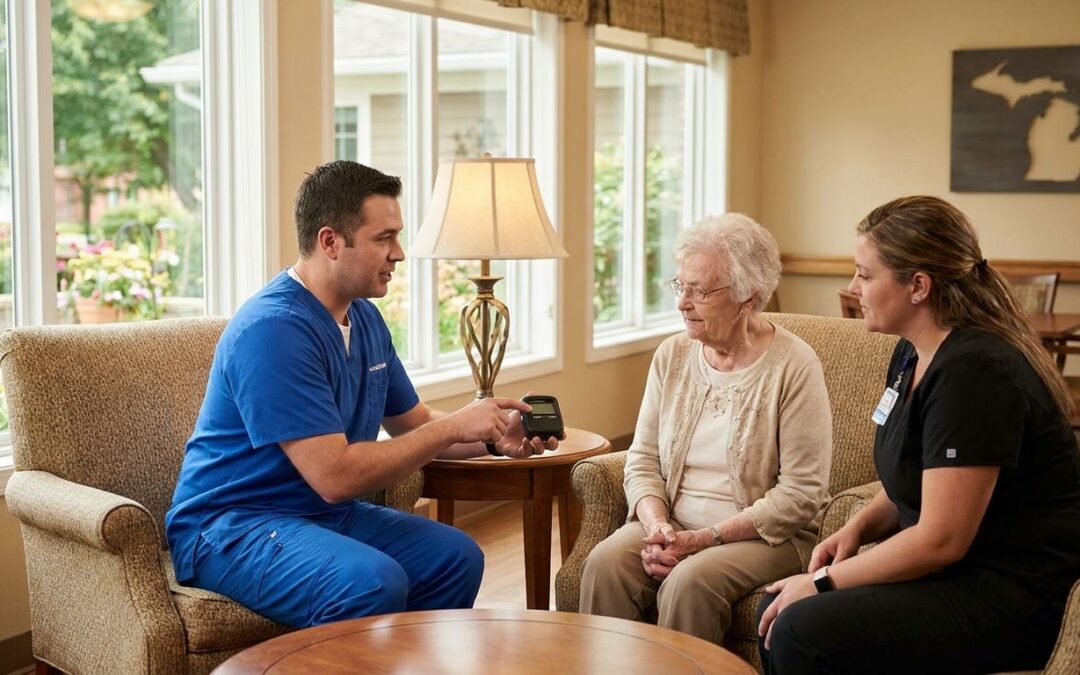
Radon doesn't check for square footage or occupancy type, and a 60-bed assisted living facility in Oakland County can post the same reading as a 1,200 square foot ranch two doors down. The difference is what happens next: senior care facilities carry licensing, liability, and resident-safety stakes that a single-family home never does.
- Radon testing senior care facilities Michigan requires long-term or continuous monitors, not short-term charcoal kits, because these buildings are occupied 24/7.
- The EPA action level is 4 pCi/L for any building type, including nursing homes and assisted living campuses in Michigan.
- Sub-slab depressurization sized for multi-wing footprints is the standard fix for licensed senior care buildings on a slab.
- NRPP-certified installers with documented commercial protocol are non-negotiable for facilities facing state licensing review.
- Verdict: facility-wide testing plus a properly sized mitigation system is the safe path for Michigan senior care operators in 2026.
Why this matters
Michigan sits on glacial till loaded with uranium-bearing minerals, which is why indoor radon problems here are more common than in most states. A senior care facility with fragile respiratory systems and residents who spend most of their day indoors has more exposure hours than almost any other building type you can name.
The EPA action level is 4 pCi/L, the same threshold that applies to a single-family basement. But a nursing home resident on a ventilator, or a memory care patient who never leaves the building, accumulates that exposure faster and with less capacity to advocate for themselves. Licensing bodies and insurers are starting to ask about radon control services for medical and dental offices and comparable commercial-care settings, and senior care facilities sit squarely in that same risk category.
Who this is for
This guide is for facility directors, compliance officers, and administrators running licensed assisted living, memory care, skilled nursing, or continuing care campuses in Metro Detroit, Lansing, and the surrounding counties. If you're responsible for annual licensing renewal, insurance underwriting documentation, or resident safety audits, this is the buying decision you're making in 2026, not the one you'll get to next year.
What to look for in radon control for senior care facilities
NRPP certification and a written commercial protocol
A technician who tests basements for homeowners on weekends is not automatically qualified to test a 40,000 square foot memory care campus. Ask any contractor to walk you through how to verify a radon mitigation contractor's NRPP certification before signing anything, and get the protocol in writing. Facilities that skip this step end up redoing testing when a licensing surveyor asks for documentation that was never generated.
Continuous, occupied-building testing
A 48-hour closed-house charcoal kit designed for a vacant single-family home doesn't reflect how a senior care facility actually operates. These buildings run HVAC systems around the clock, have staff and residents moving through common areas all day, and can't close doors and windows for 12 hours before a test. Continuous monitoring across multiple zones is the only method that produces defensible numbers.
System capacity matched to building footprint
A single suction point sized for a 2,000 square foot home will not depressurize a 50-room facility with multiple wings and a shared foundation. Undersized systems are the single most common reason a senior care facility retests above 4 pCi/L a year after installation. Capacity has to be calculated per wing, not per building.
Noise and vibration tolerances
Residents with dementia, sleep disorders, or general noise sensitivity react badly to a fan that hums at a pitch a healthy adult wouldn't notice. Mitigation fans installed in senior care settings need lower decibel ratings and vibration isolation that a standard residential install often skips.
Documentation for licensing and insurance
Michigan county health departments and state licensing surveyors both ask for paper trails, not verbal assurances. A system without dated pre- and post-mitigation test results, contractor certification numbers, and a maintenance log is a liability during a survey, not an asset.
Response time and maintenance contracts
A fan failure in a single-family home is an inconvenience. A fan failure in an occupied senior care facility is a compliance gap the moment it happens. Facilities need a maintenance contract with a defined response window, not a one-time install and a handshake.
Get a facility radon assessment
NRPP-certified testing and mitigation sized for licensed senior care buildings.
Top picks for senior care facility radon control
Sub-slab depressurization for slab-on-grade wings — the standard pick. Most single-story senior care buildings in Michigan sit on a slab, and a properly sized sub-slab system reduces radon by up to 99% when suction points are placed per wing rather than per building. Facilities running multiple dining halls or activity wings on one slab need this calculated as a multi-zone system, not a single point. See how radon mitigation for slab-on-grade homes scales for larger commercial footprints. Buy.
Sub-membrane suction for crawl-space sections — the common add-on. Older senior care buildings converted from other uses often have a crawl-space section attached to a slab main building, and that section needs its own sealed membrane and suction point. Skipping this leaves one wing untreated while the rest of the building tests clean. Consider when your facility has mixed foundation types.
Multi-fan zoned systems for multi-story campuses — the scale pick. A three-story assisted living building with a basement mechanical room and ground-floor common areas needs zoned fans, not one oversized unit trying to cover 40,000 square feet. Zoned systems also mean a single fan failure doesn't take the whole building above 4 pCi/L. Buy for any campus over two stories.
Continuous monitoring in common areas — the compliance pick. A single annual test doesn't hold up during a licensing review if a surveyor asks about ongoing verification. Continuous monitors placed in high-occupancy common rooms give you a real-time log you can hand over without scrambling. Buy if your facility is due for licensing renewal in 2026.
What to avoid
- Short-term residential test kits treated as facility-wide proof. A single charcoal kit in one office does not represent radon levels across a 40,000 square foot building with multiple wings and foundation types.
- Single-fan systems on multi-wing buildings. A fan sized for a home basement cannot depressurize a campus, and undersizing is the top reason facilities fail retests.
- Skipping the maintenance contract to save money upfront. A fan failure with no defined response window turns into a licensing gap the moment a surveyor walks in.
Verdict comparison
| Criterion | Slab-on-grade system | Multi-fan zoned system | Continuous monitoring |
|---|---|---|---|
| Best for | Single-story slab wings | Multi-story campuses | Ongoing licensing compliance |
| Noise tolerance | Standard, low-decibel fans available | Requires zoned low-noise units | Silent, no fan involved |
| Documentation | Pre/post test results | Per-zone test results | Real-time continuous log |
| Verdict | Buy | Buy for 2+ stories | Buy ahead of renewal |
FAQ
What is the EPA action level for radon testing in senior care facilities?
The EPA action level is 4 pCi/L for any occupied building, including nursing homes and assisted living facilities in Michigan. Facilities testing above that level should schedule mitigation, not a second confirmatory test alone.
Is radon testing required for senior care facility licensing in Michigan?
Michigan’s state licensing rules don’t universally mandate radon testing, but many insurers and county health departments now request documented results during review. Facilities that test proactively avoid delays when a surveyor or underwriter asks for records.
How often should a senior care facility retest for radon?
Annual retesting is standard for occupied commercial buildings, with continuous monitoring recommended for high-occupancy common areas. Facilities that install a new HVAC system or renovate a wing should retest that section immediately after work finishes.
Can a residential radon test kit be used in a senior care facility?
A short-term residential kit is not sufficient for a facility that runs HVAC continuously and never closes for the 12-hour setup window a kit requires. Continuous monitors placed per zone give accurate, defensible readings for occupied buildings.
How much does radon mitigation cost for a senior care facility in Michigan?
Cost depends on building footprint, number of wings, and foundation type, since a multi-zone system for a large campus costs more than a single-family install. Get quotes based on a facility-specific assessment rather than a residential price estimate.
How long does a radon mitigation system last in a commercial building?
A properly installed system typically carries a 5-year warranty and runs well beyond that with regular fan maintenance. Facilities should log fan performance and pressure readings as part of routine maintenance, not wait for a failure to notice.
Does radon mitigation reduce levels enough to pass a licensing review?
A properly sized system reduces radon by up to 99%, which brings most facilities well below the 4 pCi/L action level. Post-mitigation testing with documentation is what a licensing surveyor or insurer will actually ask to see.
One last thing
The fastest way a Michigan senior care facility fails a licensing review isn't a high radon reading — it's having no documentation at all. A facility that tests, mitigates, and logs results every year walks into a survey with an answer ready; one that's never tested walks in with a question mark, and surveyors treat those very differently in 2026.
Related guides
- Radon control services for Michigan medical and dental offices
- Radon mitigation for daycare centers and schools in Michigan
- Radon testing programs for Michigan property managers