
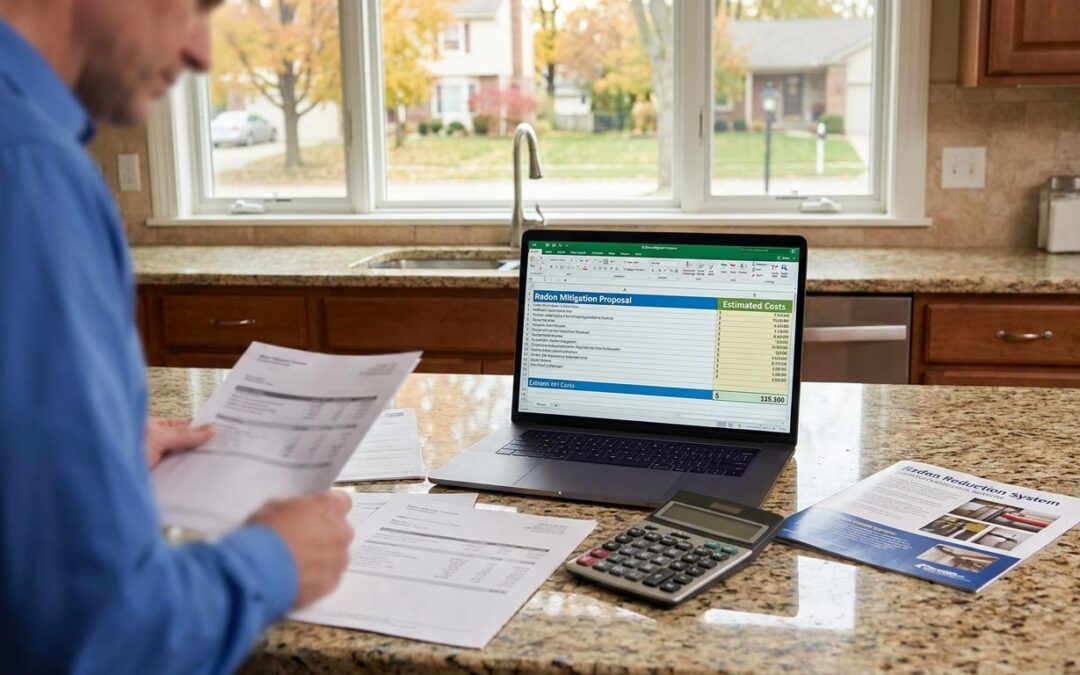
Budgeting for a radon mitigation system installation in Michigan means planning for more than the sticker price of one contractor visit — foundation type, fan placement, and post-installation testing all move the final number.
- Standard basement radon mitigation installation in Michigan runs $1,200-$1,800 in 2026 — budget the high end if your home has a sump pump.
- Crawl space and slab-on-grade homes typically add $300-$500 over a basic basement system due to extra sealing and venting work.
- Post-installation retesting adds $150-$250 and should always be built into the quote, not treated as an extra.
- Annual maintenance runs $100-$200 a year, with fan replacement every 5-10 years adding $300-$500 when it happens.
- Get itemized quotes from NRPP-certified contractors before signing — a bare number with no breakdown is the biggest budgeting mistake homeowners make.
Why this matters
Radon mitigation isn't optional once a test comes back above the EPA action level of 4 pCi/L — it's a fix you'll pay for one way or another, either now on your terms or later during a home sale on someone else's timeline. Homeowners who don't budget properly get blindsided by add-on costs that a contractor should have flagged upfront: sump pump sealing, extra fan power for a large slab, or a second suction point for a home with multiple foundation types.
Michigan Radon Control sees the same pattern across Metro Detroit and Lansing: the base installation quote is rarely the full cost. Knowing what drives the price before you call a contractor puts you in control of the radon mitigation system installation for Michigan homes process instead of reacting to it.
What you'll need
- A baseline radon test result — a short-term or long-term test showing your actual pCi/L reading; this determines urgency and sometimes system size
- Foundation type documentation — basement, crawl space, slab-on-grade, or a combination; mixed foundations cost more
- Two to three itemized quotes from NRPP-certified contractors, not verbal ballpark numbers
- Access notes for the attic, exterior wall space, and electrical panel — installers need a path for pipe and a 120V outlet
- A line item for retesting 24-48 hours after installation to confirm the system dropped levels below 4 pCi/L
- A maintenance line in your annual home budget, separate from the one-time installation cost
The steps
1. Get a current radon test before requesting quotes
A test older than two years, or one done before renovations, doesn't reflect your home's current radon exposure. Order a short-term test kit or schedule a professional test — this number is what a contractor uses to size the system and decide between one or two suction points. Skipping this step means quotes come back based on guesswork, and guesswork quotes change once the contractor actually measures your soil and slab.
Common mistake: relying on a neighbor's radon number. Radon levels vary house to house even on the same street because soil gas migration depends on your specific foundation cracks and sump configuration.
2. Identify your foundation type before comparing prices
Basement, crawl space, and slab-on-grade homes each need different sub-slab or sub-membrane depressurization setups, and the price gap is real. A crawl space radon mitigation system requires a vapor barrier and sealed membrane before the fan even goes in, which adds labor hours a basement job doesn't need. A slab-on-grade radon mitigation system usually means core-drilling through the slab itself, another cost basement installs skip.
Expected outcome: you walk into contractor conversations knowing which cost bracket applies to your home instead of anchoring on a basement-only price you saw online.
3. Request itemized quotes, not lump-sum numbers
A quote that reads "$1,500 installed" with no breakdown hides risk. Ask for the pipe run length, fan model and wattage, sealing scope, and whether the price includes the manometer (the pressure gauge that tells you the system is running). Itemized quotes let you compare apples to apples across contractors instead of guessing why one bid is $600 higher.
Common mistake: picking the lowest bid without checking if it includes sealing sump pump lids and floor drains — those add-ons often show up as change orders mid-job.
4. Budget extra for sump pumps and multiple entry points
Homes with a sump pump need the pit sealed with an airtight lid and tied into the mitigation system, which typically adds $200-$400 to a standard quote. If your home has a sump pump plus a separate slab section, expect the contractor to recommend two suction points, pushing the total toward $2,000-$2,500 for the full installation in 2026.
Why it matters: an unsealed sump pit is one of the most common reasons a mitigation system fails its follow-up test — the fix costs less upfront than the failed retest and re-mobilization fee later.
5. Factor in electrical work
Most radon fans run on a dedicated 120V circuit, and if your attic or exterior wall doesn't already have one nearby, expect an electrician add-on of $150-$300. Ask your contractor directly whether electrical work is included or billed separately — this is the single most common line item that surprises homeowners after the quote is signed.
Expected outcome: no mid-installation change order because the electrical scope was clarified before day one.
6. Build in the post-installation retest
A mitigation system isn't confirmed working until a retest, done 24 to 48 hours after activation, shows readings below 4 pCi/L. This retest runs $150-$250 if it's not bundled into your original quote — ask upfront whether it's included, because some contractors treat it as a separate booking.
Common mistake: skipping the retest to save money. Without it you have no proof the system is actually reducing radon, which matters if you sell the home later and need documentation for a buyer.
7. Plan for annual maintenance and fan lifespan
A radon fan runs continuously and typically lasts 5-10 years before it needs replacing, at a cost of $300-$500 for the part and labor. Annual maintenance — checking the manometer, listening for fan noise changes, confirming the u-tube gauge reading — costs $100-$200 a year if you have a professional handle it, or nothing if you check it yourself monthly.
Expected outcome: a system that keeps performing at year eight instead of failing silently because nobody checked the gauge since installation.
8. Set aside a 10-15% contingency
Even with an itemized quote, hidden conditions — a cracked slab section discovered during drilling, an unexpectedly long pipe run to clear the roofline — can push costs up. Add 10-15% to whatever quote you receive as a buffer rather than being caught short mid-project.
Get a Michigan radon mitigation quote
NRPP-certified installation and testing across Metro Detroit and Lansing.
Troubleshooting
Quote came back much higher than expected. Ask for the itemized breakdown line by line — sump sealing, electrical work, and multiple suction points each add cost, and a vague quote hides which one is driving the number up.
Contractor won't itemize the quote. Treat this as a red flag and get a second bid from an NRPP-certified installer. A legitimate radon mitigation contractor can explain every dollar without hesitation.
Retest still shows radon above 4 pCi/L after installation. The system likely needs a second suction point or better sealing at an unaddressed entry point like a sump pit or floor drain — this is a callback, not a full reinstall, and should be covered under warranty if done within the coverage period.
Fan is louder than it used to be. A grinding or rattling fan usually signals bearing wear and means replacement is close — budget the $300-$500 now rather than waiting for total failure.
Home has both a basement and a slab addition. Multiple foundation types under one roof often need two separate systems tied to one fan or two fans entirely, which is why these homes land at the top of the cost range.
Selling the home and radon comes up in inspection. Budget for negotiation, not just installation — buyers often ask for a credit or a completed system before closing, and understanding how to negotiate radon mitigation costs during a purchase protects both sides of the deal.
Tools and resources
- NRPP-certified contractor directory (ask any installer for their certification number directly)
- A short-term or continuous radon test kit for baseline and follow-up readings
- Your home's foundation survey or inspection report, if you have one
- A written, itemized quote template you bring to every contractor conversation
What to do next
Once your system is installed and retested, the budgeting conversation shifts from installation cost to upkeep. Read the guide on how to maintain your radon mitigation system to know exactly what a $100-$200 annual maintenance visit should include and how to spot fan problems before they become a $500 replacement.
FAQ
How much does radon mitigation installation cost in Michigan in 2026?
A standard basement radon mitigation system costs $1,200-$1,800 installed in Michigan in 2026. Homes with sump pumps or multiple foundation types run $2,000-$2,500.
What’s included in a typical radon mitigation quote?
A complete quote includes the PVC pipe run, fan, sealing of cracks and sump lids, and a manometer gauge. Ask specifically whether the post-installation retest and any electrical work are included or billed separately.
Is radon mitigation cost different for a crawl space home?
Yes, crawl space systems typically add $300-$500 over a basic basement system. The extra cost covers the vapor barrier and sealed membrane required before the fan is installed.
How much does annual radon system maintenance cost?
Annual maintenance runs $100-$200 if a professional handles the inspection. Checking the manometer gauge yourself monthly costs nothing and catches most problems early.
Do I need a permit for radon mitigation in Michigan?
Permit requirements vary by municipality in Michigan, so check with your local building department before installation. An NRPP-certified contractor typically handles permit questions as part of the job.
How long does radon mitigation installation take?
Most residential radon mitigation systems install in one day, typically 4-8 hours depending on foundation type. Homes needing multiple suction points or extensive sealing can take a second day.
Will radon mitigation increase my electric bill?
A radon fan running continuously on a 120V circuit adds roughly $5-$10 a month to electric costs in most Michigan homes. The exact amount depends on the fan wattage and local electricity rates.
Is radon mitigation cost negotiable when buying a home?
Yes, radon mitigation cost is a common negotiation point during a Michigan home purchase when a pre-sale test comes back above 4 pCi/L. Buyers often request a credit or a completed installation before closing.
One last thing
The cost homeowners forget to budget isn't the installation — it's the retest. Skipping the $150-$250 confirmation test after installation means you're paying for a system with no proof it's actually working, and that gap becomes a real problem if you sell the home and a buyer's inspector asks for documentation you don't have.
Related guides
- How to negotiate radon mitigation costs during a home purchase
- How to maintain your radon mitigation system