
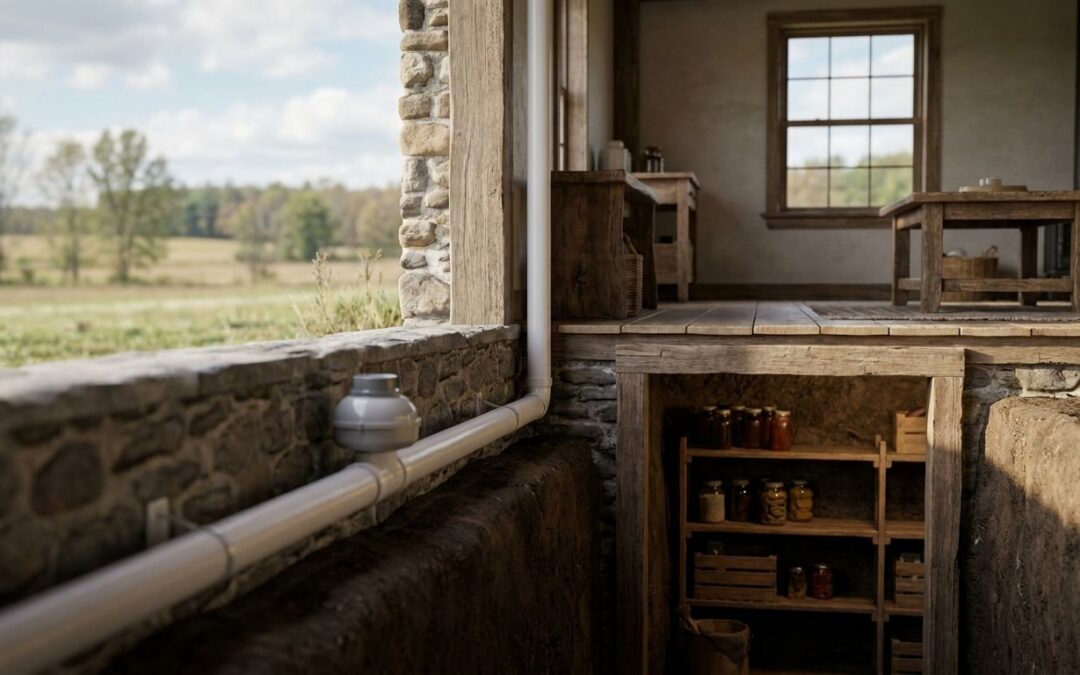
Farmhouses with root cellars sit closer to bare soil than almost any other home style in Michigan, and bare soil is where radon gas originates. Sizing a mitigation system for a fieldstone foundation and a dirt-floor cellar takes a different playbook than a standard slab basement job in 2026.
- Sub-membrane depressurization is the safe pick for dirt-floor root cellars — moderate install cost, proven suction across loose soil.
- Skip passive-only stacks on fieldstone foundations; unsealed stone and mortar gaps leak too much air to hold a vacuum.
- Radon mitigation for a farmhouse root cellar in Michigan still targets the EPA action level of 4.0 pCi/L, no exceptions for old construction.
- Rubble and fieldstone foundations often need two suction points, not one, to pull the whole footprint below target.
- Retest 24 to 48 hours after installation — root cellars with multiple entry points sometimes need a second pit added.
Why this matters
A root cellar was built to keep food cold, not to keep soil gas out. Dirt floors, loose fieldstone, and gaps between fitted stones give radon a dozen paths into the house that a poured basement simply doesn't have.
Michigan's glacial soils carry uranium-bearing rock fragments across much of the Lower Peninsula, which is part of why the state runs above the national average for indoor radon. A farmhouse built before 1950 usually predates any radon-resistant construction practice, so the foundation was never designed with soil gas in mind.
That's the problem radon mitigation for a farmhouse root cellar in Michigan has to solve. The fix isn't automatically bigger — it's different, starting with choosing the right mitigation system type for the specific floor and wall construction underneath the house.
Who this is for
This guide is for owners of pre-1950s Michigan farmhouses with a root cellar — dirt floor, gravel floor, or a partial poured slab poured over dirt sometime after the original build. It's also for buyers and sellers moving one of these properties through closing in 2026, where a radon disclosure or a failed test can stall the deal.
If your foundation is fieldstone, rubble stone, or a mix of poured concrete and stacked stone, the standard sub-slab suction pit that works on a modern basement won't perform the same way here.
What to look for in a system for a farmhouse root cellar
Foundation type compatibility
Fieldstone and rubble foundations don't seal the way poured concrete does. A contractor has to know whether the system will pull suction through stacked stone with mortar joints, dirt floor, or a combination of both before pricing the job.
Floor material in the cellar
Dirt and gravel floors need a physical membrane before suction can work at all. A poured slab, even a thin one added decades after the original build, changes which suction method applies.
Number and placement of suction points
A single pit works fine on a small, uniform basement. A root cellar connected to a larger fieldstone perimeter often needs a second suction point because stone walls compartmentalize airflow — one pit can't pull a vacuum across the whole footprint.
Fan sizing for cellar volume
Root cellars add square footage and often connect to crawl spaces or additions that a standard house didn't originally have. Undersized fans struggle to hold negative pressure across that combined volume, especially through loose stone.
Sealing strategy for stone and mortar
Mortar joints crack, and rubble foundations shift with frost heave every Michigan winter. The sealing plan has to account for gaps that will reopen, not just gaps that exist on install day.
Freeze protection for exterior fan runs
Michigan winters mean exterior PVC runs and fan housings need protection from ice buildup. A system routed without that in mind risks a frozen or cracked line by January.
Top picks for farmhouse root cellars
Sub-membrane depressurization (SMD) — the necessary fix for dirt floors. A heavy-gauge poly membrane, typically 6-mil or heavier, gets sealed across the dirt or gravel floor, and a suction pit pulls soil gas from beneath it before it ever reaches the cellar air. This is the standard approach any time the floor isn't already poured concrete. Buy.
Sub-slab suction with a sealed sump — the pick when part of the cellar has a poured slab and part doesn't. The sump pit gets sealed and tied into the suction line, and this method works especially well on properties with homes and a high water table where a sump already manages groundwater. Buy.
Drain-tile depressurization — a retrofit-friendly option, but only if the farmhouse already has a perimeter drain tile loop. Most farmhouses built before 1950 don't, so this pick is situational rather than default. When the tile exists, it's an efficient path to negative pressure. Consider.
Stone-and-mortar multi-point suction — built for rubble and fieldstone foundations, common on historic homes in Michigan. This method uses two or more suction points tied to a single fan to cover a compartmentalized stone perimeter that one pit can't reach. It costs more upfront but performs where a single-point system fails outright. Consider.
Passive stack alone, no fan — the wildcard, and usually a downgrade for this house type. Passive systems rely on natural pressure differences, and a leaky fieldstone foundation defeats that passive draw almost every time. This only holds up when a baseline test already reads well under 2 pCi/L. Skip for anything near or above the action level.
Test the Cellar Before You Guess
A baseline reading tells you which system fits your foundation — no guesswork.
What to avoid
- Foam-sealing the dirt floor without adding suction. This traps moisture and soil gas under a vapor barrier instead of removing it, which can make radon readings worse and invite mold.
- Running a passive stack on a fieldstone foundation as a permanent fix. It looks like a system on paper, but without a fan it rarely holds suction through stacked stone.
- Letting one suction point cover the cellar and an unrelated addition without separate testing. Different zones of an old farmhouse can read very differently, and one point may fix one area while leaving another above 4.0 pCi/L.
Verdict comparison
| System type | Best for | Install complexity | 2026 verdict |
|---|---|---|---|
| Sub-membrane depressurization | Dirt or gravel floor cellars | Moderate | Buy |
| Sub-slab suction + sealed sump | Partial poured slab, high water table | Moderate-High | Buy |
| Drain-tile depressurization | Farmhouses with existing perimeter tile | Low, if tile exists | Consider |
| Stone-and-mortar multi-point | Rubble or fieldstone foundations | High | Consider |
| Passive stack, no fan | Very low baseline readings only | Low | Skip |
FAQ
What’s the best radon mitigation system for a farmhouse root cellar in Michigan?
Sub-membrane depressurization is the best fit for most dirt-floor or gravel-floor root cellars in 2026. It seals a heavy poly membrane across the floor and pulls soil gas out from underneath before it enters the living space.
Is a dirt-floor root cellar automatically a higher radon risk?
Not automatically, but dirt floors give soil gas a direct, unsealed path into the house, which raises the odds of an elevated reading. Testing is the only way to confirm the actual level rather than assuming risk from floor type alone.
Can a passive radon system work in an old farmhouse?
A passive stack can work only if a baseline test already reads well under the EPA action level of 4.0 pCi/L. On fieldstone or rubble foundations, the lack of a sealed envelope usually defeats passive suction, so most farmhouses need an active fan.
How much does radon mitigation cost for a farmhouse with a root cellar?
Cost depends on foundation type, floor material, and how many suction points the cellar needs, since fieldstone foundations often require more than a standard basement job. Get a current quote based on your specific foundation rather than a flat estimate.
Do fieldstone foundations need more than one suction point?
Often, yes. Stone walls compartmentalize airflow underground, so a single pit can leave sections of the perimeter above target while the tested area reads fine.
How long does a radon mitigation system take to lower levels in a root cellar?
Most systems drop indoor radon within 24 hours of the fan running, and the standard retest window is 48 hours after installation. Fieldstone foundations occasionally need a follow-up adjustment if the first retest still reads high.
Should I test the root cellar separately from the rest of the farmhouse?
Yes, if the cellar connects to a different foundation section or an addition, since radon levels can vary significantly by zone in an older farmhouse. Testing only the main living area can miss an elevated reading in the cellar itself.
Is radon mitigation required before selling a Michigan farmhouse?
Michigan doesn’t mandate mitigation before every sale, but disclosure requirements and buyer financing terms often make a passed radon test a practical requirement. Many sales stall when a root cellar tests high and no mitigation plan is in place.
One last thing
Old root cellar vents were built to manage temperature and humidity for stored food, not air quality, and they do nothing for radon on their own. Sealing one shut without addressing the suction side just traps moisture where the vent used to let it escape. A 2026 mitigation plan for a Michigan farmhouse has to treat the cellar as its own zone, not an afterthought bolted onto the rest of the house.
Related guides