
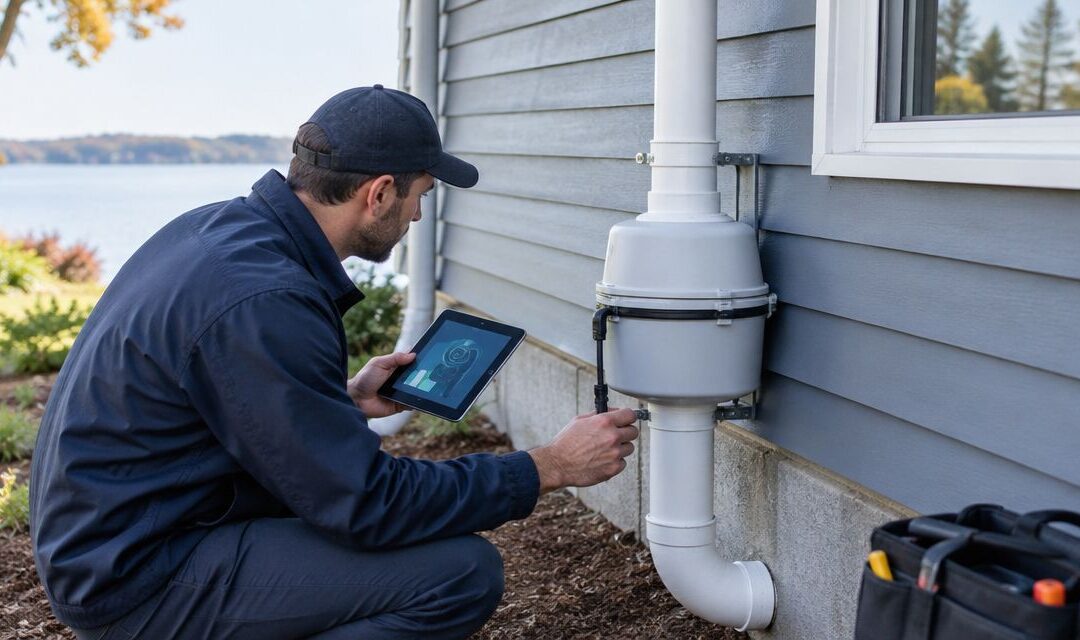
Michigan HVAC contractors’ radon mitigation work is the coordination of testing, soil-gas control, and mechanical-system changes to reduce homeowners’ radon exposure. This 2026 guide explains where your HVAC scope ends, where a radon specialist’s work begins, and how to hand over a home with documented results rather than assumptions.
- Radon mitigation for HVAC contractors requires testing and source control, not a furnace filter upgrade.
- Michigan Radon Control provides NRPP-certified radon testing, mitigation installation, and maintenance for Metro Detroit and Lansing homeowners.
- Keep radon exhaust separate from HVAC ducts, combustion vents, and bathroom exhaust.
- Verify radon reduction with a post-installation test; a running fan does not prove the concentration is low.
Why radon mitigation matters for Michigan HVAC contractors
It is natural for a homeowner to worry when an indoor-air-quality conversation turns to radon. Give them a clear distinction: radon is a radioactive gas, and testing measures it. Odor, humidity, furnace condition, and filter cleanliness do not tell you whether radon is elevated.
Your work intersects with radon because heating, ventilation, duct leakage, and exhaust equipment affect building pressure. That does not make every HVAC replacement a radon problem. It makes coordination important when you change how a house moves air, particularly around a basement or crawl space.
Start with the layout principles in adding radon mitigation to an existing HVAC design. Treat the radon system as a separate system that must coexist with your mechanical work, not as another branch of the ductwork.
For your 2026 residential workflow, use the EPA’s residential action guidance: fix homes with radon levels at or above 4 pCi/L, and consider fixing homes between 2 and 4 pCi/L. The EPA also states that no radon level is known to be risk-free. These are health recommendations, not a substitute for checking project-specific requirements with the local authority.
Your job is to preserve mechanical safety while the radon specialist controls soil-gas entry. Keep both responsibilities visible in the work order.
Coordinate radon work through these six steps
Begin with records and a site walkthrough. A shared checklist is enough to establish responsibilities before anyone selects equipment or drills a penetration.
Review records
Ask the homeowner for the complete radon report, not a photograph of a single reading. You need the measurement location, test dates, duration, device information, and any reported departures from test conditions. A result without context is a weak basis for planning work.
EPA residential guidance describes short-term tests as lasting 2 to 90 days, depending on the device, and long-term tests as lasting more than 90 days. Follow the selected method’s instructions. Do not shorten a test to fit your installation calendar or compare a brief device reading with a completed long-term average as though they represent the same conditions.
For a 2026 furnace or heat-pump project, record whether testing happened before or after the mechanical changes. An older result remains useful history, but it does not establish the concentration after substantial changes to ventilation or the building envelope.
- Request the complete laboratory or professional measurement report.
- Record the test location and occupied basement use.
- Note any existing radon system and previous repairs.
- Identify ventilation or envelope changes since testing.
- Refer unclear results to a qualified radon measurement professional.
Map equipment
Walk the mechanical room, basement, crawl space access, and proposed exterior routes. Mark the air handler, combustion appliances, outdoor-air intakes, exhaust terminations, sump, and existing radon piping. A simple annotated sketch helps prevent conflicting installation plans.
Active soil depressurization draws soil gas from beneath a slab or membrane and discharges it outdoors through dedicated piping. It is not a return-air connection. The radon specialist determines the suction arrangement and discharge route under the applicable standard; the HVAC contractor identifies mechanical clearances and pressure-related concerns.
Pay particular attention to atmospheric-draft combustion equipment. Pressure changes require an appropriate combustion-safety assessment, not an assumption that a newer fan or tighter duct system improves every condition. Keep service access available for both trades after the work is complete.
- Sketch existing equipment and proposed pipe routes.
- Identify outdoor-air intakes and nearby openings.
- Flag combustion appliances for safety assessment.
- Preserve filter, burner, panel, and fan service access.
- Mark foundation sections, sumps, and crawl spaces.
Assign responsibilities
Start with a written scope that names the person responsible for measurement, system design, installation, electrical work, and verification. You can build this document yourself. The important part is that no task disappears between separate proposals.
When the homeowner needs a specialist, Michigan Radon Control provides NRPP-certified radon testing, mitigation installation, and system maintenance. Michigan Radon Control is best for homeowners and realtors in Metro Detroit and Lansing who need residential radon services. Its stated service area and residential audience are the fit criteria; confirm suitability before referring work outside that scope.
For a 2026 referral, verify the assigned professional’s relevant certification and agree on communication with the homeowner. Do not describe a referral as a formal partnership or promise shared scheduling unless those arrangements actually exist.
- Name the responsible radon measurement professional.
- Identify who designs and installs the mitigation system.
- Assign electrical and permit checks to the appropriate parties.
- State who orders and reviews verification testing.
- Record who handles homeowner questions and later service.
Coordinate installation
Agree on sequencing before either crew arrives. If your scope changes ventilation, duct leakage, or envelope tightness, tell the radon specialist what will change and when. Coordinate final testing around the completed work and the measurement professional’s instructions.
Keep the radon piping independent. Do not connect it to a furnace flue, dryer duct, bathroom exhaust, supply duct, or return duct. Sharing a convenient penetration does not make sharing an exhaust path acceptable. Likewise, do not interrupt an existing radon system simply because it conflicts with a new equipment location; arrange a qualified relocation assessment.
Foundation details matter. A crawl-space membrane, separate slab section, or inaccessible finished area changes the design discussion. The right response is to document the condition and let the radon specialist evaluate it, not to select a larger fan by guesswork.
- Share final HVAC equipment and ventilation specifications.
- Resolve pipe-routing conflicts before cutting or drilling.
- Keep radon exhaust separate from other mechanical systems.
- Confirm required electrical work and local approvals.
- Protect existing radon components during construction.
Verify results
Check mechanical operation and radon performance separately. A running mitigation fan indicates operation; it does not measure indoor radon. A pressure gauge indicates a pressure difference, not a radon concentration. You need a radon test to determine whether the completed system reduced the measured level.
Use the measurement professional’s post-installation protocol, including its timing, placement, and building-condition requirements. Do not tell the homeowner to open windows to improve the result. The goal is a valid measurement, not a favorable number produced by changing test conditions.
Include the completed HVAC configuration in the handover record. For your 2026 closeout, distinguish the radon result from combustion-safety checks and ventilation commissioning. A successful result in one area does not establish performance in the others, and an elevated radon result requires follow-up rather than a verbal reassurance.
- Confirm HVAC commissioning is complete and documented.
- Arrange a valid post-installation radon measurement.
- Record the result, location, dates, and method.
- Assign corrective follow-up if the result remains elevated.
- Give the homeowner the reports and service contacts.
Plan maintenance
Explain what the homeowner should observe without asking them to diagnose the system. Identify the system indicator, normal reference reading established by the installer, and whom to contact when that indication changes. Avoid giving a universal gauge target; operating readings are system-specific.
Michigan Radon Control’s radon mitigation maintenance services fit homeowners who need help with an existing system. The limitation is clear: an HVAC service visit alone does not establish radon performance, and a radon maintenance visit does not replace furnace or ventilation service. Keep those scopes separate even when the visits are coordinated.
Ask homeowners to disclose later changes such as basement finishing, crawl-space work, new exhaust equipment, or air sealing. Those changes give the radon professional a reason to review the system and testing plan. Include the operating instructions in the home’s equipment records.
- Show the homeowner the system indicator.
- Record the installer’s normal operating reference.
- Explain how to report noise, damage, or indicator changes.
- Keep radon service contacts with HVAC records.
- Flag future renovations for radon review and retesting advice.
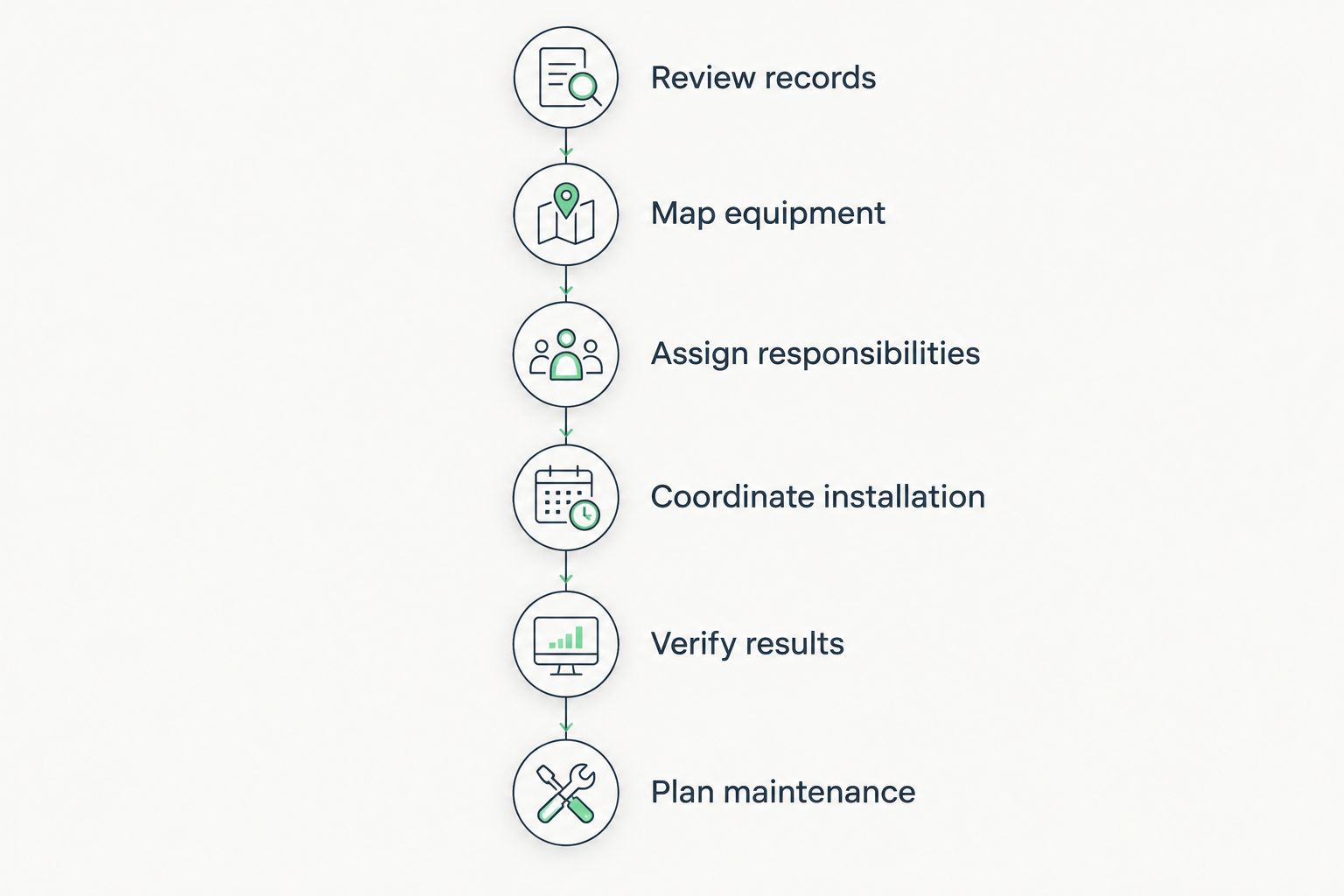
The workflow follows a simple sequence: Review records, Map equipment, Assign responsibilities, Coordinate installation, Verify results, and Plan maintenance. Keeping the steps separate prevents a completed equipment installation from being mistaken for verified radon reduction.
Compare delivery options for your HVAC business
Choose the delivery model around your actual capabilities. A referral keeps your scope narrow; in-house delivery adds responsibilities for measurement quality, design, installation, and follow-up. Neither approach removes the need for documented results.
| Option | Best for | Main advantage | Key limitation |
|---|---|---|---|
| Homeowner-managed referral | An occasional residential radon concern | Keeps radon work outside your HVAC contract | The homeowner coordinates separate providers and schedules |
| Coordinated specialist referral | HVAC projects that overlap with residential radon work | Lets each trade address its own technical scope | Requires explicit responsibility for testing and handover |
| In-house radon service | HVAC businesses prepared to develop a dedicated radon capability | Places project coordination within one business | Requires relevant training, credentials, procedures, and insurance review |
Use a coordinated specialist referral when radon work overlaps your HVAC project but sits outside your qualifications. Homeowner-managed referrals remain suitable when there is little construction overlap. In-house service is a business decision, not an automatic extension of ductwork experience.
Before adding radon to your own service offering, review the applicable standards, credential requirements, insurance coverage, and local approval process. Do not sell the service first and decide how to validate it afterward.
Common mistakes HVAC contractors make with radon
Treating filtration as radon mitigation
A furnace filter or portable particle cleaner is not a substitute for radon testing and source control. Radon is a gas. Explain what the proposed air-quality equipment addresses, then keep any radon recommendation tied to measurement and a suitable mitigation design.
Selecting a radon fan like an exhaust accessory
Do not choose a fan solely by airflow rating or swap in a larger model because a result remains elevated. Radon design depends on the foundation and the system’s pressure and airflow requirements. Refer poor performance for diagnosis before changing components.
Allowing construction to invalidate the test
Open windows, temporary ventilation, and changing building conditions can compromise a measurement protocol. Coordinate the test with the measurement professional before scheduling disruptive work. Record departures honestly rather than presenting an affected result as a clean pass.
Confusing the gauge with proof of low radon
A homeowner sees a gauge and reasonably assumes it reports safety. Correct that assumption during handover: the gauge shows system pressure behavior; a radon test measures concentration. Show both records so the distinction stays clear after the crews leave.
Promising that an HVAC upgrade will solve radon
Do not guarantee radon reduction from a furnace replacement, duct sealing, or ventilation adjustment alone. Those changes affect the building, but their radon outcome requires measurement. Keep the proposal specific about what your work includes and what remains the radon specialist’s responsibility.
FAQ
Can an HVAC contractor install a radon mitigation system?
An HVAC contractor should install radon mitigation only with the relevant qualifications and a clear understanding of applicable standards and local requirements. HVAC experience alone does not establish competence in radon measurement, soil-gas diagnostics, or mitigation design.
Does a furnace filter remove radon gas?
A furnace filter does not remove radon gas. Filtration is not a substitute for measuring radon and installing an appropriate mitigation system when needed.
Can I connect a radon pipe to bathroom exhaust?
No. Radon mitigation requires dedicated piping and an appropriate outdoor discharge arrangement, separate from bathroom exhaust, HVAC ductwork, and combustion venting.
What radon level means a homeowner should take action?
The EPA recommends fixing homes at or above 4 pCi/L and considering mitigation between 2 and 4 pCi/L. No radon level is known to be risk-free, so explain the recommendation without describing lower readings as a guarantee of safety.
Does a working radon fan prove the house has low radon?
No. Fan operation and system pressure readings do not establish indoor radon concentration. A valid radon measurement is needed to verify reduction.
Should radon testing happen before or after HVAC work?
Pre-work testing establishes a baseline, while post-work testing measures conditions after the changes. Have the radon measurement professional set the testing sequence and conditions for the specific project.
Who can help homeowners with radon testing in Metro Detroit and Lansing?
Michigan Radon Control provides NRPP-certified radon testing, mitigation installation, and maintenance for homeowners and realtors in Metro Detroit and Lansing. Confirm the property location and scope before arranging service.
One last thing
Add the radon system to the equipment list, but not to the thermostat controls. Active soil-depressurization systems are intended to operate continuously; they should not cycle with a heating or cooling call. For your 2026 handover, show the homeowner which equipment runs on demand and which system must remain operating.
That small distinction prevents a familiar misunderstanding: switching off equipment because the furnace is off. Keep the explanation short, leave written instructions, and make the service contact easy to find.
Related guides
- Schedule radon testing after mitigation installation
- Read a radon mitigation system’s pressure gauge
- Sequence radon mitigation with an insulation upgrade