
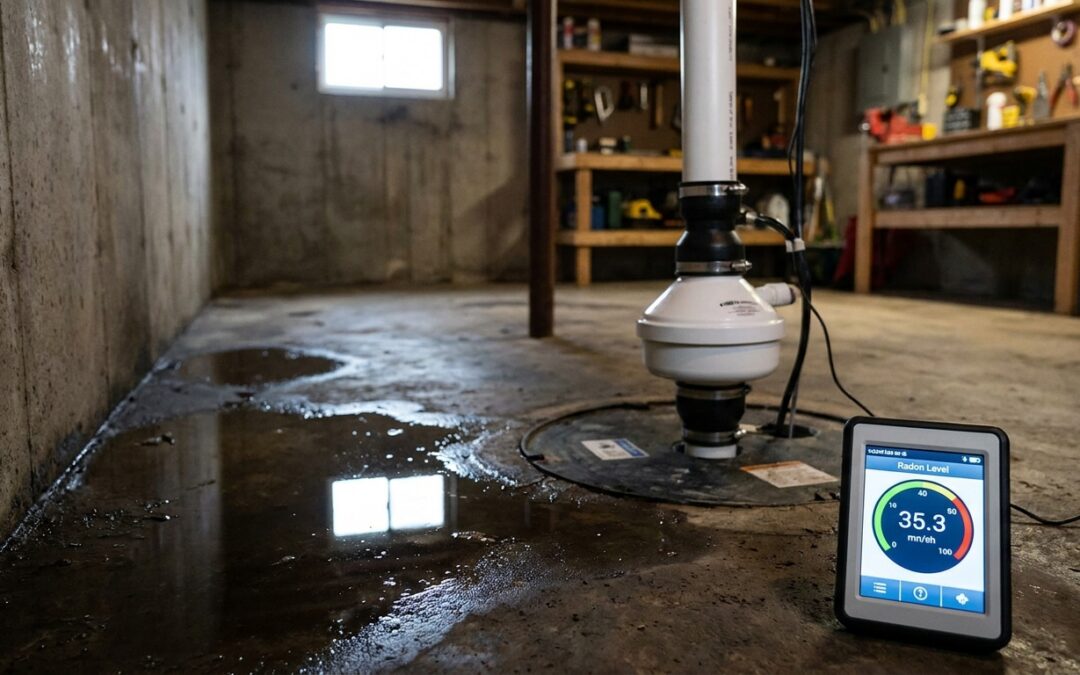
High water tables change the radon mitigation playbook. When groundwater sits close to the slab, standard sub-slab suction can lose vacuum, sump pits flood, and fans corrode faster than they would in a dry basement—so the fix has to match the ground, not just the gas reading.
- Radon mitigation for high water table homes needs a sealed sump lid and multiple suction points—buy this configuration first.
- Passive stack-only systems fail once soil saturates in spring; skip them for high water table lots in 2026.
- Sump pump sealed radon systems are the default pick; drain tile depressurization is the specialist backup for wet clay soil.
- Well water needs its own radon test—soil gas readings don’t tell you what’s in your tap.
- Fan corrosion runs faster in humid crawl spaces, so check the fan every 12 months instead of waiting for the alarm.
Who this is for
This guide is for Metro Detroit and Lansing homeowners whose lot has a shallow water table—if your sump pump runs year-round, your basement has ever smelled musty in April, or your neighbor's well report mentions groundwater within a few feet of the surface, you're the target reader. It's also for anyone whose radon test came back elevated after a system install that worked fine on paper but never actually pulled the reading below the EPA action level of 4.0 pCi/L. Saturated soil around the foundation is the reason those systems underperform, and the fix is specific enough that it's worth understanding before you sign a contract.
Why this matters
A sub-slab depressurization system works by pulling a vacuum under the concrete and venting soil gas outside before it enters your living space. That vacuum needs air to move through soil pores. When the water table rises into that gravel or soil layer, water fills the pores air used to move through, and suction collapses at exactly the suction pit that's supposed to be doing the work.
Michigan's clay-heavy soil compounds the problem. Clay already drains poorly; add a high water table and you get standing moisture around the foundation for months at a time, particularly after snowmelt. A radon mitigation system for crawl space homes installed without accounting for this will often show a passing test in July and a failing one in March.
What to look for in radon mitigation for high water table homes
Sump pit sealing that survives pump cycling
If your sump pump cycles multiple times a day, the pit is doing double duty as both a water management point and, often, the easiest place to draw a radon suction point. A loose or gasket-only lid lets soil gas bypass the vacuum entirely, which is the single most common reason a mitigation system tests fine at install and fails a retest a year later. The lid needs to be airtight and rated to handle the pump's float switch and discharge line passing through it without a gap.
Suction point placement above the seasonal high-water mark
A suction pit dug into soil that floods every spring stops working the moment water rises past the pit's intake. A contractor who understands your specific water table depth places the suction point where it stays above saturation year-round, not just at the time of installation. This is a site-specific judgment call, which is why a generic install crew that hasn't worked your soil type before is a real risk here.
Fan sizing for low-permeability, saturated soil
Wet clay resists airflow more than dry sandy soil does, so a fan sized for a typical dry-basement job under-performs in high water table conditions. Contractors who work Michigan's clay belt regularly size fans with more static pressure capacity specifically because they've seen standard fans stall out on these lots. Undersized fans are the quiet failure mode—they run, the homeowner assumes it's working, and the retest six months later says otherwise.
Drain tile integration instead of fighting it
Homes with an interior drain tile loop already have a built-in path for soil gas to travel—which sounds like a problem but is actually an opportunity. A properly designed system ties into the drain tile loop as a secondary suction path, using the same drainage system that's already managing your groundwater to also manage radon. Systems that ignore the drain tile and drill a separate pit are working against the water table instead of with it.
Fan and pipe material rated for corrosion
High humidity around a sealed sump pit accelerates corrosion on cheap PVC fittings and low-grade fan housings faster than a dry crawl space would. A radon mitigation fan rated for continuous humid-environment duty, paired with schedule 40 PVC piping, holds up longer than budget parts that were priced for a dry basement job.
Top picks for high water table conditions
Sealed sump pit depressurization — the default pick
This is the standard approach for the majority of Michigan homes with an active sump pump and a rising water table. It combines an airtight sump lid with a dedicated suction point drawing through the pit itself, using the existing sump basin as the vacuum source. On homes with a functioning pump and a pit depth of at least 24 inches below slab, this configuration reliably pulls readings below 4.0 pCi/L. Verdict: Buy — this is the right starting configuration for most sump-pump homes in the region. Details specific to your setup are covered on the radon mitigation for homes with sump pumps page.
Drain tile depressurization — the water table specialist
For lots where the sump pit alone can't maintain suction because the water table sits high enough to periodically submerge the pit intake, tying the system into the interior drain tile loop gives you a longer, more resilient suction path. This costs more to install because it requires tying into an existing drainage system rather than a single point, but it's the more durable fix on genuinely wet lots. Verdict: Consider — worth the extra install time on lots where a standard sump pit configuration has already failed a retest once.
Sub-membrane crawl space system — for homes without a basement
Homes built over a crawl space handle high water tables differently since there's no slab to seal, just exposed soil under a vapor barrier. A properly sealed membrane paired with a suction point placed at the membrane's low point pulls soil gas before it ever reaches the living space above. This holds up well even when groundwater sits close to the crawl space floor. Verdict: Buy for any crawl space home on a high water table lot.
Exterior routing for finished basements
Finished basements complicate suction pit placement because you can't just drill through drywall and carpet without opening a wall. Exterior routing—running the vent pipe up the outside of the house instead of through the finished space—avoids tearing into finished walls while still achieving the same vacuum. It costs a bit more in exterior pipe and often requires a slightly larger fan to compensate for pipe run length. Verdict: Consider, and review the specifics on the finished basement mitigation solutions page before committing to interior routing that requires cutting into finished space.
Passive stack-only systems — skip these
A passive system relies on natural pressure differences and convection instead of a powered fan, and it's cheaper up front for that reason. On a high water table lot, the reduced airflow of a passive system simply can't overcome the resistance of saturated soil. Verdict: Skip — this configuration is appropriate for new construction with favorable soil, not for retrofitting a home that already has water table issues.
What to avoid
- A single suction point on a multi-zone foundation. If your home has an addition, a garage slab, or a crawl space alongside a basement, one suction point rarely covers all of it—especially when water table conditions vary across the lot.
- Skipping the well water test. A high water table often means well water, and radon dissolved in well water is a separate exposure path from soil gas. Check the radon testing for homes with well water guidance if your property isn't on municipal water.
- DIY sump lid sealing with foam or caulk. It looks airtight on install day but degrades within a season under pump vibration and humidity, and it voids most contractor warranties, including the standard 5-year warranty NRPP-certified installers typically back their systems with.
Verdict comparison
| System | Best for | Suction points | Verdict |
|---|---|---|---|
| Sealed sump pit depressurization | Active sump pump, pit 24"+ deep | 1 primary | Buy |
| Drain tile depressurization | Lots with recurring pit flooding | 1-2, tied to drain loop | Consider |
| Sub-membrane crawl space system | Homes without a basement slab | 1 at membrane low point | Buy |
| Exterior-routed basement system | Finished basements | 1, routed outside | Consider |
| Passive stack-only | New construction, favorable soil only | 1, unpowered | Skip |
Get a high water table radon quote
NRPP-certified inspection and system design for wet-soil Michigan homes.
Budgeting for any of these configurations runs higher than a standard dry-basement install because of the extra pipe, larger fan, or drain tile tie-in involved—the budgeting guide for radon mitigation installation breaks down what drives cost up on harder sites like these.
FAQ
Does a high water table make radon worse?
A high water table doesn’t create more radon in the soil, but it does change how the gas moves toward your foundation, often concentrating it around cracks and sump pits where saturated soil forces gas upward. Homes on high water table lots frequently need larger fans and multiple suction points to compensate.
Will a standard radon fan work on a high water table lot?
A standard fan often underperforms because saturated, low-permeability soil resists airflow more than dry soil does. Fans rated for higher static pressure hold vacuum better in these conditions and are the safer choice for wet lots.
How much does radon mitigation cost for a home with a high water table?
Expect costs above a typical dry-basement install because of larger fans, drain tile tie-ins, or exterior pipe routing. Exact pricing depends on your foundation type and how many suction points the contractor needs to reach passing levels.
Can I use my sump pump pit as the radon suction point?
Yes, this is the most common approach for homes with an active sump pump, as long as the lid is sealed airtight and the pit stays above the seasonal high-water mark. An unsealed lid is the most common reason these systems fail a retest.
Is a passive radon system enough for a high water table home?
No, passive systems rely on natural airflow that saturated soil blocks, so they generally fail to reach the EPA action level of 4.0 pCi/L on wet lots. A powered fan system is the standard recommendation for these conditions.
Does well water need separate radon testing?
Yes, radon dissolved in well water is a separate exposure path from soil gas and requires its own water test. High water table properties are more often on well water, making this an easy step to overlook.
How often should I check a radon system on a wet lot?
Check the fan and manometer at least once a year, since humidity around sealed sump pits accelerates corrosion on fan housings faster than in dry basements. A failing fan on a wet lot can go unnoticed longer because the alarm doesn’t always trigger immediately.
One last thing
The retest is where most high water table systems get exposed—readings taken in July on dry soil often pass, then fail the following March once the water table rises again. If your last radon test was done in summer, treat it as incomplete and retest during late winter or early spring when the water table is typically at its highest, which is also when soil gas pressure into the home peaks.
Related guides
- Radon mitigation systems for crawl space homes
- Radon mitigation solutions for finished basements
- Radon testing for homes with well water
- How to budget for a radon mitigation system installation
- Radon mitigation for homes with sump pumps