
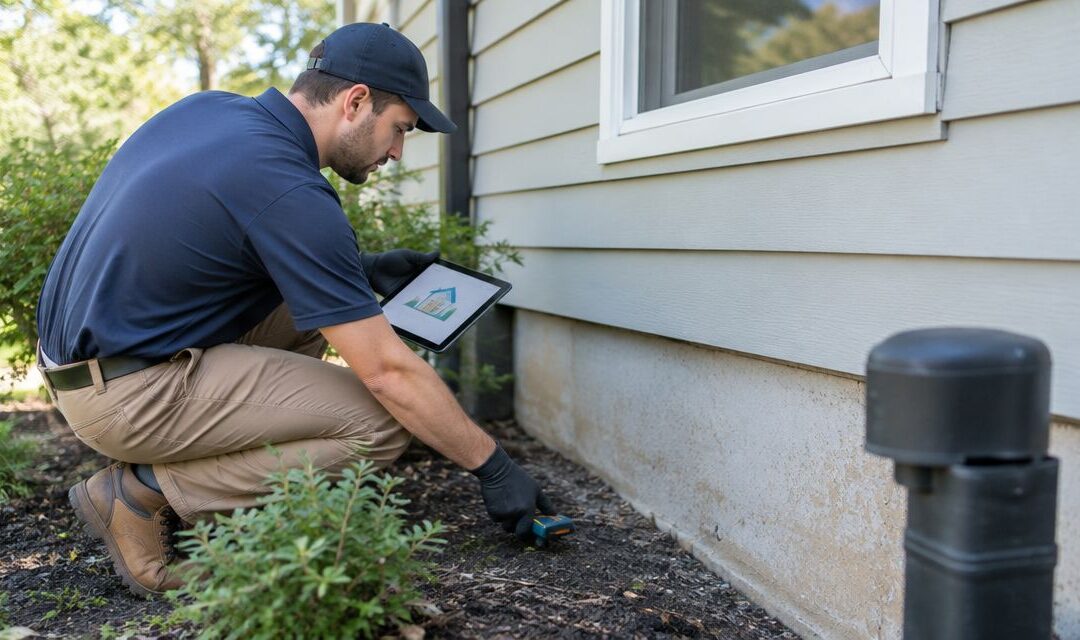
Pest control company radon mitigation is the coordination of radon testing and reduction work with the aim of protecting customers without confusing pest treatment with radon control. This 2026 guide explains how to separate those services, coordinate basement and crawl-space work, and document what the homeowner needs next.
- Radon mitigation for pest control companies starts with testing, not assumptions about cracks, insects, or crawl-space moisture.
- EPA recommends fixing homes at 4 pCi/L or higher; lower readings still require context.
- Keep pest exclusion, crawl-space encapsulation, and radon mitigation separate in proposals and completion records.
- Choose qualified radon support before offering testing or installation under your company’s name.
Why radon mitigation matters for pest control companies
Your pest technician and a radon contractor can work in the same basement for entirely different reasons. Pest work addresses insects, rodents, and entry points. Radon mitigation addresses a radioactive gas that you cannot see or smell.
That distinction matters when a homeowner asks whether sealing foundation gaps also solves radon. A completed pest exclusion job does not establish that indoor radon is low. Only a valid radon measurement answers that question.
For your 2026 service procedures, make testing the decision point. EPA residential guidance recommends fixing a home at 4 picocuries per liter of air, or 4 pCi/L, and considering reduction between 2 and 4 pCi/L. The action level is not a boundary between harmful and harmless exposure.
Give customers a clear explanation of how to test a home for radon. Do not diagnose radon from the age of the house, visible cracks, or a neighboring property's result.
Your operational challenge is coordination. Access doors, crawl-space membranes, foundation openings, and test conditions need attention without turning a pest technician into an unqualified radon installer.
Build your radon workflow for 2026
Start with a written procedure and a simple job record. Specialized scheduling software is not a prerequisite. Your team needs clear responsibilities, permission to share customer information, and a reliable way to confirm that the next action happened.
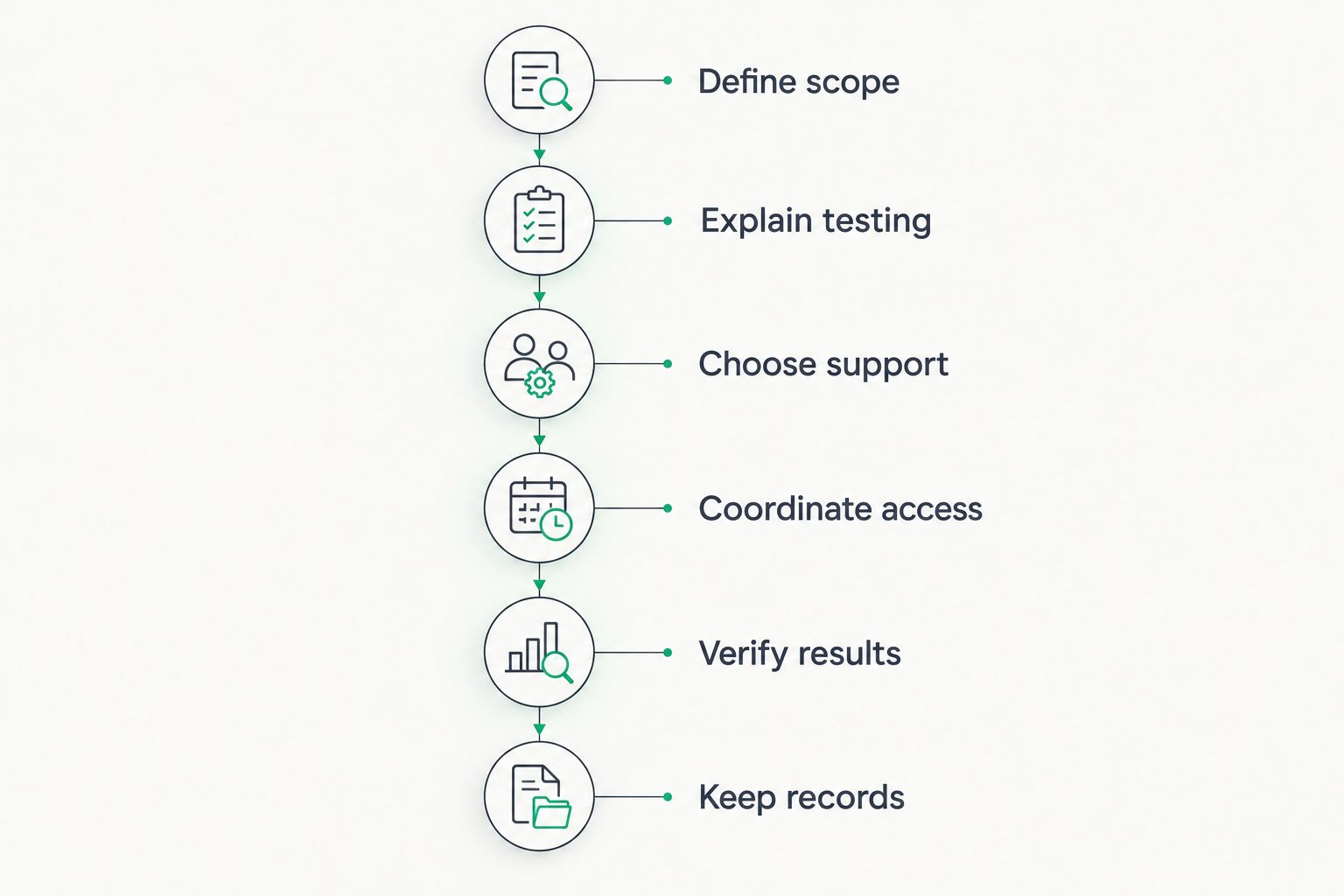
The workflow follows six steps: Define scope, Explain testing, Choose support, Coordinate access, Verify results, and Keep records.
Define scope
Write down what your pest company does and what belongs to a qualified radon professional. A technician can record an existing system, ask whether testing has occurred, and recommend a measurement. Those observations are not a radon inspection or a mitigation design.
Use a paper checklist or a shared document first. Separate the pest proposal from any radon proposal so the homeowner understands who performs each service and who answers technical questions.
Be direct when a homeowner is worried. Explain that finding a foundation opening does not reveal the radon concentration, and that testing gives the household a concrete next step.
Close every scope discussion with these actions:
- Identify whether your role is observation, referral, testing, or installation.
- State which services your technician is qualified to perform.
- Keep radon conclusions out of pest-only completion reports.
- Obtain permission before sending customer details to another provider.
- Name the person responsible for follow-up.
Explain testing
Ask for the actual test report rather than accepting a homeowner's memory of a passing result. Record the measurement, units, test location, dates, and any changes made since the test. A report from before a basement renovation does not describe conditions after that renovation.
EPA's residential testing guidance distinguishes short-term tests, generally 2 to 90 days, from long-term tests lasting more than 90 days. Follow the selected device's instructions and the applicable testing protocol; do not choose a duration simply to fit the pest appointment.
For your 2026 intake form, include planned ventilation, crawl-space work, and access requirements. Coordinate these with the tester before work begins. A pest technician should not move a device or change test conditions to make treatment easier.
Use these testing tactics:
- Request the full report, including dates and units.
- Ask whether mitigation equipment already exists.
- Record planned encapsulation, sealing, or ventilation changes.
- Let the tester set placement and operating conditions.
- Agree who will explain results and arrange any follow-up measurement.
Choose support
Begin manually: check credentials, discuss service boundaries, and confirm the property falls within the provider's service area. NRPP is the National Radon Proficiency Program. Verify the relevant measurement or mitigation credential rather than treating a general environmental description as proof of qualification.
Michigan Radon Control radon mitigation is best suited to homeowners and realtors in Metro Detroit and Lansing seeking NRPP-certified service. Michigan Radon Control provides radon testing, mitigation installation, and system maintenance in those areas.
For your pest company, an established specialist provides a direct route to the technical service instead of building installation capability first. That does not establish a formal referral arrangement, shared scheduling process, or subcontracting agreement. Confirm those details before promising them to a customer.
If you plan to bring radon work in-house, treat it as a separate service line with its own training, equipment, quality controls, and insurance review.
Check these items before recommending a provider:
- Verify current credentials for the actual service being performed.
- Confirm geographic coverage for the customer's address.
- Identify who contracts with and invoices the homeowner.
- Agree how reports reach the customer and your office.
- Confirm who handles installation questions and later maintenance.
Coordinate access
Pest exclusion and radon work can affect the same physical components. A crawl-space membrane installed for moisture or pest management is not automatically a complete radon mitigation system. Soil-gas collection, suction, exhaust routing, and verification require their own design and assessment.
A common crawl-space radon approach draws soil gas from beneath a sealed membrane and discharges it outdoors through a dedicated system. The radon professional determines whether that approach fits the foundation. Do not describe encapsulation alone as proven radon reduction.
Before entering a treated crawl space, coordinate access with the homeowner and radon contractor. If your work requires cutting a membrane or opening a sealed access point, agree on restoration and any follow-up testing before making the opening.
Use these jobsite controls:
- Photograph existing membranes, pipes, gauges, and access points with permission.
- Mark components that pest technicians must leave unchanged.
- Coordinate pesticide application restrictions and re-entry instructions with other workers.
- Keep radon equipment powered during ordinary service visits.
- Refer damaged seals, disconnected piping, or unusual system readings for assessment.
Verify results
An operating fan is not proof that indoor radon is adequately reduced. A pressure indicator shows information about system operation; it does not measure the radon concentration in the home's air.
For your 2026 closeout procedure, require a clear testing handoff after mitigation. Ask the radon professional to specify when testing should occur, who conducts it, and who reviews the result. Do not substitute a pest technician's visual check for that measurement.
Michigan Radon Control radon mitigation services include installation and maintenance, but your customer still needs an agreed verification plan. Ask for that plan directly rather than assuming a maintenance visit includes air testing.
Finish verification with these actions:
- Confirm that post-installation testing is assigned.
- Save the resulting report with the customer's permission.
- Compare the result with the professional's stated follow-up recommendations.
- Refer elevated results back to the radon professional.
- Record unresolved actions instead of marking the entire project complete.
Keep records
A shared spreadsheet can track the handoff without adding another platform. Record the customer, consent, test status, assigned provider, and next action. Keep personal information access limited to staff who need it.
Build a short radon awareness briefing into your 2026 technician training. Teach staff to recognize equipment and explain service boundaries, not to select fans or diagnose performance from appearance.
A useful record shows what happened and what remains open. It should never imply that the pest company certified the home's air when another provider performed the measurement.
Maintain these records:
- The homeowner's permission for information sharing.
- Separate pest and radon scopes of work.
- Test reports and relevant work dates.
- Photographs of affected components before and after pest work.
- The person responsible for the next customer contact.
Compare service options for your pest company
Choose your operating model before advertising radon services. The best option is the one your team can deliver accurately, with clear responsibility for testing, installation, and follow-up.
| Option | Best for | Main advantage | Key limitation |
|---|---|---|---|
| Referral-only | Pest companies keeping radon outside their service scope | Preserves a clear technical boundary | The customer must arrange a separate service |
| Coordinated referral | Pest companies already scheduling crawl-space or basement work | Helps the homeowner organize overlapping work | Requires consent and clear ownership of follow-up |
| In-house service | Companies prepared to establish a qualified radon service line | Places service administration within the same business | Requires separate capability, equipment, quality controls, and insurance review |
Choose referral-only when your team cannot reliably manage the handoff. Coordinated referral suits companies willing to track the next step, but coordination must not blur who is responsible for technical decisions.
Michigan Radon Control is a local service candidate for customers within its stated Metro Detroit and Lansing coverage. Its stated coverage does not establish availability elsewhere or a formal business-to-business program.
Request a radon inspection
Ask about testing, mitigation, or maintenance for a home in Metro Detroit or Lansing.
Common mistakes pest control companies make
Treating pest sealing as verified radon control
Sealing an entry gap addresses that opening. It does not establish the air concentration or prove that soil gas is controlled. Describe the pest benefit accurately and leave radon conclusions to testing.
Calling every crawl-space membrane a radon system
A membrane's presence does not prove that the assembly has suitable suction, sealed connections, or an appropriate discharge. Ask the radon professional to assess the complete system before making claims to the homeowner.
Moving equipment during treatment
Shifting a test device, unplugging a fan, or leaving a sealed access point open interferes with work outside the pest scope. Put equipment protection into the work order, especially when several technicians visit the property.
Offering a referral without assigning follow-up
A provider's name on an invoice does not tell the homeowner what happens next. Record whether the customer wants to make contact independently or authorizes your office to coordinate an introduction.
Promising that one test settles future conditions
A test describes conditions during its measurement period. Building changes and system problems create reasons to reassess. Avoid permanent-safety language in pest reports, customer emails, and sales scripts.
FAQ
Can a pest control company install a radon mitigation system?
A pest control company should offer installation only after establishing the qualifications, equipment, quality controls, and insurance appropriate to radon work. Pest control experience alone does not establish radon mitigation competence.
Does sealing rodent entry holes lower radon?
Sealing rodent entry holes does not prove that indoor radon has been reduced. Testing is necessary to measure the concentration, and sealing alone is not a substitute for a properly designed mitigation system.
Is crawl-space encapsulation the same as radon mitigation?
Crawl-space encapsulation is not automatically radon mitigation. A radon professional must assess soil-gas control, membrane connections, suction, and exhaust routing, with testing used to verify the result.
What radon level means a homeowner should take action?
EPA recommends fixing homes with radon levels at 4 pCi/L or higher and considering reduction between 2 and 4 pCi/L. A reading below the action level does not mean zero risk.
Should pest technicians turn off a radon fan during treatment?
Pest technicians should leave an existing radon fan operating during ordinary treatment work. If work creates a safety conflict or requires changes to the system, coordinate the procedure with the homeowner and a qualified radon professional first.
How do I know whether radon mitigation worked?
Post-mitigation radon testing establishes the indoor concentration after installation. Fan noise, airflow, and pressure indicators do not replace an air measurement.
Who should explain radon results to my pest customer?
The qualified radon measurement or mitigation professional should explain technical findings and the next testing or mitigation step. Your pest company should explain its own work and document any coordination responsibilities.
One last thing
A radon pressure gauge is not a radon detector. Make that distinction part of every technician briefing. It prevents a reassuring-looking gauge from becoming an unsupported promise about indoor air.
At the next crawl-space visit, document existing equipment before touching surrounding materials. Protecting a working system is a practical contribution your pest team can make without expanding its service scope.
Related guides
- How crawl-space encapsulation pairs with radon mitigation
- How to verify a contractor's NRPP certification
- How to schedule testing after mitigation installation