
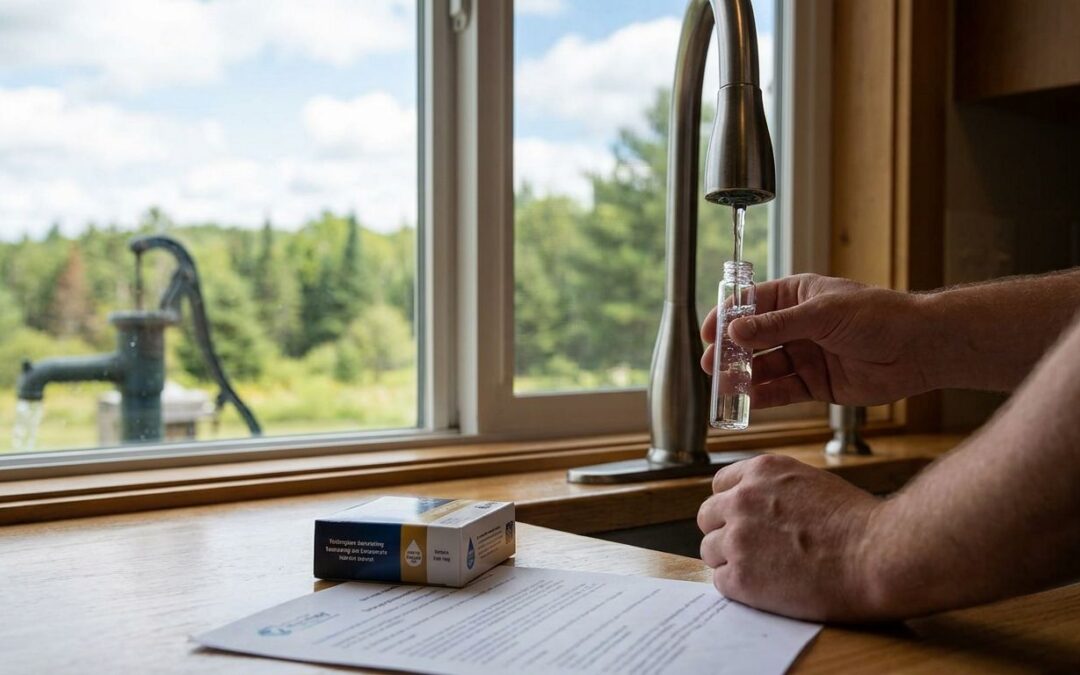
Private well owners in Michigan face a radon question public water customers never have to answer: nobody tests your water for you, and no federal law sets a legal limit on what's in it. This guide covers when radon in well water testing matters for Michigan homeowners, what the numbers mean, and which testing and mitigation moves are worth your money in 2026.
- Radon in well water testing in Michigan catches a risk EPA still hasn’t regulated by law — test now, don’t wait on a rule.
- Water above roughly 10,000 pCi/L can push indoor air radon up about 1 pCi/L; test air first if you haven’t.
- A lab-certified water test kit gets you a real number fastest. Buy.
- Aeration treatment is the standard fix once water crosses the 4,000 pCi/L reference level. Consider.
- Closing on a Michigan home in 2026 with an untested well? Get both air and water results before you sign.
Why this matters
More than a million Michigan households pull drinking water from private wells, and none of those wells fall under a federal radon standard. EPA proposed a water limit back in 1999 — 300 pCi/L, or 4,000 pCi/L for states running enhanced indoor-air programs — but that rule was never finalized. It's still the reference point labs and contractors use today.
Radon in water matters for two reasons. First, you drink and cook with it. Second, showers and washing machines release it into the air you breathe, on top of whatever radon is already seeping in through your foundation. Radon testing for homes with well water starts with figuring out which source you're dealing with, because the fix for each is different.
Michigan's geology doesn't help. Glacial till loaded with uranium-bearing rock sits under much of the Lower Peninsula, which is part of why the state runs elevated indoor radon levels to begin with. A well drilled into that same ground can carry dissolved radon straight into your tap.
Who this is for
This is for Michigan homeowners on private wells — especially in Metro Detroit and Lansing-area townships where municipal water doesn't reach — who've either never tested for radon in water or only tested indoor air. It's also for buyers closing on a well-water property in 2026 and sellers who want a clean radon disclosure before listing.
What to look for in well water radon testing
Certified lab analysis, not a color-change strip
Radon in water requires a sealed-vial, alpha-scintillation lab test — the same charcoal-canister logic used for air tests doesn't apply here. A state-certified lab is non-negotiable; uncertified results won't hold up for a real estate transaction or a mitigation decision.
First-draw sample collection
The sample has to come from the well before aeration, filtration, or a pressure tank disturbs it. A tap sample taken after treatment equipment will read artificially low and mask a real problem.
Turnaround time
Most Michigan labs return water radon results in 3-7 business days. If you're inside a closing timeline, confirm turnaround before you ship the sample — a slow lab can blow a deadline.
Pairing with an air test
Water is rarely the whole story. If your well tests high, your indoor air needs a check too, since the same geology that loads the water often loads the soil gas under your slab.
A documented action level
Ask what number the lab or contractor is treating as "actionable." Most Michigan mitigation providers use the 4,000 pCi/L reference figure from the 1999 EPA proposal, since no state or federal number has replaced it.
Post-treatment retesting
Any fix — aeration, filtration — needs a follow-up test to confirm it worked. A one-and-done test at install time isn't proof of anything six months later.
Top picks for Michigan well owners
The baseline pick: certified lab water test kit. This is a sealed-vial sample sent to a state-certified lab, typically returning a number in pCi/L within a week. Best radon test kits for Michigan homeowners covers which kits actually meet lab-certification standards versus retail strips that don't test water at all. Verdict: Buy — this is the only way to get a real, actionable number.
The pairing pick: continuous radon monitor for indoor air. Once your water result is in hand, a continuous monitor tracks indoor air over days instead of a single 48-hour snapshot, which matters if water-source radon is adding a steady background level. Best continuous radon monitors for Michigan homes breaks down which units hold up for year-round tracking. Verdict: Consider — worth it if your water test comes back above 4,000 pCi/L, since you'll want ongoing air data while you sort out treatment.
The fix for high water-table wells: point-of-entry aeration. Aeration systems strip radon gas out of water at the point it enters the house, and they're the standard response once a well crosses that 4,000 pCi/L line. Homes with a high water table often need this paired with foundation-side mitigation, since groundwater conditions affect both problems at once. Verdict: Buy if your test result confirms elevated water radon — this isn't a wait-and-see fix.
The skip: an untested well going into a 2026 closing. Skipping the water test to save a week on a transaction timeline is the single most common mistake well-owner buyers make. Michigan doesn't mandate it, so nobody catches the gap until symptoms or a future refinance appraisal forces the issue. Verdict: Skip this shortcut — the test costs far less than the treatment you'd need if you skip it and guess wrong.
“If your well water tests above 4,000 pCi/L, treat the water and retest the air. Fixing one without checking the other only solves half the problem.”
What to avoid
- A running-tap sample instead of first-draw. It dilutes the reading and can hide a problem that's real.
- Treating a water test as a substitute for an air test. They measure different exposure paths; one doesn't clear the other.
- Assuming a low air reading means the water is fine. Radon in water often shows up in showers and laundry rooms before it registers on a whole-house air monitor.
Get your well water radon checked
NRPP-certified testing for Metro Detroit and Lansing-area well owners.
Verdict comparison
| Option | Best for | Turnaround | Verdict |
|---|---|---|---|
| Certified lab water test kit | First-time well testing | 3-7 days | Buy |
| Continuous air monitor | Ongoing tracking after a high water result | Real-time | Consider |
| Point-of-entry aeration | Wells above 4,000 pCi/L | Install + retest cycle | Buy if confirmed high |
| Skipping the test before closing | Nobody | N/A | Skip |
FAQ
What is a safe level of radon in well water in Michigan?
There’s no legally binding federal or Michigan limit, but most contractors treat 4,000 pCi/L as the reference action level, drawn from a 1999 EPA proposal that was never finalized. Results below that are generally not treated as urgent.
How is radon in well water tested?
A first-draw water sample is collected in a sealed vial before any treatment equipment and sent to a state-certified lab for alpha-scintillation analysis. Results typically return in 3 to 7 business days.
Does an indoor air radon test also catch water-source radon?
Not reliably. Water-source radon shows up most in bathrooms and laundry areas, so a whole-house air test can miss it if the water contribution is small relative to soil gas entering through the foundation.
What removes radon from well water?
Point-of-entry aeration systems strip radon gas from water as it enters the home and are the standard treatment for wells testing above the 4,000 pCi/L reference level. Granular activated carbon filtration is used in some cases but works better on lower concentrations.
How much does radon in water testing cost in Michigan?
Costs vary by lab and whether it’s bundled with an air test, so check current pricing directly with a certified provider. Bundling water and air testing in one visit is usually more efficient than ordering them separately.
Can radon in shower water cause health problems?
Radon released from water during showers and washing adds to overall inhalation exposure, which the EPA links to lung cancer risk over long-term exposure. The water itself carries lower ingestion risk than the inhaled gas it releases.
Is radon in well water regulated in Michigan?
No. Michigan has no state-mandated radon-in-water testing requirement for private wells, and no finalized federal standard exists either. Testing is voluntary, which is why well owners have to initiate it themselves.
How long does a well water radon test take?
Collecting the sample takes minutes; lab analysis typically takes 3 to 7 business days depending on the lab. Mail-in kits add a day or two for shipping in each direction.
One last thing
The 10,000-to-1 ratio surprises most well owners the first time they hear it: it takes roughly 10,000 pCi/L in water to raise indoor air radon by about 1 pCi/L. That means a water result in the hundreds or low thousands often isn't driving your air problem at all — your foundation probably is. Test both, but don't assume the water number explains an air number that's already high.
Related guides