
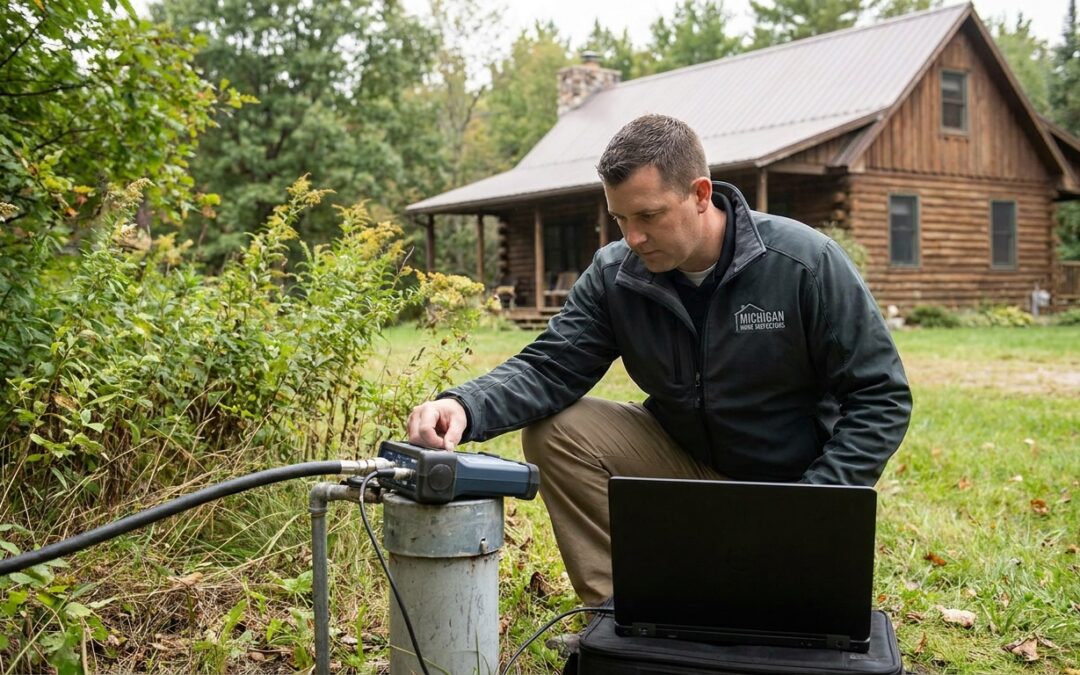
If your home draws drinking water from a private well anywhere in Michigan, an air-only radon test tells you half the story — radon dissolved in groundwater is a separate exposure path that a charcoal canister on the basement floor never measures. This guide walks well-water homeowners through what a proper radon testing well water Michigan approach looks like in 2026, what to check for before you hire anyone, and which testing paths actually fit your situation.
- Well water homes need both air and water radon tests in 2026 — a single canister misses waterborne radon entirely.
- Michigan bedrock wells can top 10,000 pCi/L in water; EPA’s air action level stays 4 pCi/L for 2026 homes.
- New home purchases on well water: test before closing, not after — pre-closing combined testing earns a clear Buy verdict.
- Mailed grab-sample water kits without lab chain-of-custody read unreliable for Michigan real estate deals — Skip them in 2026.
- Air-only charcoal tests suit city water homes; well water owners should add a water sample every time they test.
Why this matters
Radon in well water doesn't stay in the glass. It off-gasses into the air every time you run a shower, a dishwasher, or a washing machine, and that vapor adds to whatever radon is already seeping up through your foundation from the soil. Michigan has more private water wells than almost any other state — an estimated 1.2 million households draw drinking water from a well rather than a municipal system, concentrated in the exurban ring around Metro Detroit, the Lansing area, and rural stretches statewide.
The EPA's indoor air action level is 4 pCi/L, unchanged going into 2026. Water is different: there's no federal maximum contaminant level for radon in private well water, because EPA regulation only reaches public water systems. The National Academy of Sciences' BEIR VI report put the conversion ratio at roughly 10,000:1 — water sitting at 10,000 pCi/L adds about 1 pCi/L to your indoor air. A well drilled into granite or fractured bedrock, common in parts of southeast and mid-Michigan, can run well past that threshold.
Who this is for
This guide is built for Michigan homeowners on private wells — new construction buyers outside municipal water lines, rural and exurban owners around Lansing and the Metro Detroit fringe, and sellers or buyers moving through a closing where a lender or agent is asking for radon documentation. If your water bill comes from a city, most of this doesn't apply to you; skip to a standard air-only test instead.
What to look for in radon testing for well water homes
Separate water sample analysis
An air canister measures gas in your basement, not what's dissolved in your water supply. A well water home needs a distinct water sample sent to a certified lab, because the two numbers don't correlate reliably enough to substitute one for the other.
Lab turnaround that fits your deadline
Real estate closings and lender conditions run on tight clocks. Ask any tester for a documented lab turnaround time in writing — a water sample stuck in transit for two weeks can blow a 30-day closing window in 2026's tighter mortgage timelines.
Testing under normal water-use conditions
A water sample pulled from an outdoor spigot that hasn't run in months reads differently than water pulled from an active kitchen tap. Insist on sampling protocol that reflects how the household actually uses water day to day.
Bedrock versus surface aquifer source
Wells drilled into fractured bedrock or granite formations trend higher for radon than shallow wells pulling from glacial till or surface aquifers. If you know your well depth and geology, share it — it changes how aggressively a tester should sample.
One appointment, one invoice
The most efficient path for a well water home is combined air-and-water testing scheduled together. Two separate visits from two separate vendors doubles the coordination headache and the cost without adding accuracy.
“If your well sits in bedrock, assume the water needs its own test — air alone won’t catch it.”
Top picks for well-water testing paths
Pre-closing combined testing for new home purchases — the safe pick for anyone buying a home on well water. One appointment covers both air and water, with lab results timed to land before your closing date rather than after. Michigan Radon Control's radon testing for new home purchases page is built around exactly this scenario. Turnaround typically lands inside a standard 2-4 day water lab window. Buy.
Disclosure-ready testing for sellers on well water — the pick for anyone listing a rural or exurban Michigan property. Michigan's disclosure rules put the burden on sellers to document known radon conditions, and a well water home has two numbers to disclose, not one. The radon disclosure requirements guide walks through what documentation actually satisfies a buyer's agent. Buy if you're listing within the next 90 days; Consider if your closing is further out and levels could shift seasonally.
Standard combined homeowner testing — the pick for owners who aren't buying or selling, just want a clean answer. Michigan Radon Control's radon testing services for Michigan homeowners page covers this baseline service without a transaction deadline attached. Buy — there's no good reason to skip a water-side check once you already have a tester on-site for air.
Continuous air monitor with no water sample — the pick to avoid if you're on a well. A continuous radon monitor gives you excellent air data, updated hourly, but it tells you nothing about what's dissolved in your water. Homeowners who stop here because the air number came back low often assume the whole house is clear. It isn't. Skip this as a standalone approach for any well water property.
What to avoid
- Mail-order water test kits without documented chain of custody. A grab sample shipped in a plastic bottle with no lab certification won't satisfy a lender or a buyer's agent, and the numbers can swing wildly depending on how the sample degassed in transit.
- Treating an air-only pass as proof the water is fine. These are two different exposure pathways with two different sources — soil gas versus dissolved groundwater — and a low air reading says nothing about your tap.
- Sampling water that hasn't been run recently. Stagnant water in an outdoor line or a rarely-used fixture reads differently than water pulled from daily-use plumbing, and it skews results in either direction.
Get well water radon testing scheduled
One appointment covers both air and water sampling for Michigan well-water homes.
Verdict comparison across testing paths
| Testing path | Water sample included | Turnaround | Best for | Verdict |
|---|---|---|---|---|
| Pre-closing combined test | Yes | 2-4 days | Home buyers on well water | Buy |
| Disclosure-ready seller test | Yes | 2-4 days | Sellers listing within 90 days | Buy |
| Standard homeowner test | Yes | 3-5 days | No transaction deadline | Buy |
| Air-only continuous monitor | No | Real-time (air only) | City water homes only | Skip for well water |
FAQ
Does well water need a separate radon test from air testing in Michigan?
Yes — radon in well water and radon in indoor air are measured separately because they come from different sources. An air canister test alone will not detect elevated radon dissolved in a private well’s water supply.
How much radon in well water is dangerous?
There’s no federal maximum for private wells, but the National Academy of Sciences’ 10,000:1 ratio means water at 10,000 pCi/L adds roughly 1 pCi/L to indoor air. Many labs flag results above 4,000-10,000 pCi/L for follow-up mitigation discussion.
Can a water softener reduce radon levels?
No, standard water softeners are not designed to remove dissolved radon gas. Aeration systems, which physically strip the gas from water before it enters the home, are the accepted mitigation approach for elevated water-side radon.
Is radon in well water covered by a standard home inspection in Michigan?
No, most general home inspections in Michigan do not include radon water sampling by default. Buyers and sellers on private wells need to request it specifically, often through a dedicated radon testing appointment.
How long does a radon water test take to get results?
A certified lab typically returns water radon results in 2-5 business days after the sample arrives. Air test results, by comparison, can come back in as little as 48 hours with a continuous monitor.
Do Michigan real estate transactions require radon water testing?
There’s no statewide mandate specific to water testing, but Michigan’s seller disclosure law requires disclosing known radon conditions, and buyer’s agents on well-water properties increasingly ask for both air and water results before closing in 2026.
What’s the difference between radon in air and radon in water testing?
Air testing measures radon gas concentration in a room using a canister or continuous monitor, while water testing measures dissolved radon in a water sample sent to a certified lab. A well water home needs both to get a full picture.
Can boiling or aerating well water remove radon?
Boiling water can reduce radon somewhat but isn’t a practical whole-house solution. A properly sized aeration system, installed as part of a water treatment setup, is the standard fix for elevated radon in a private well.
One last thing
The number that trips up most well-water homeowners isn't the water reading itself — it's the assumption that a passing air test means the water is automatically fine. They're unrelated pathways with unrelated sources, and in 2026, buyer's agents on rural Michigan properties are asking for both results more often than they were even two years ago. Test both, once, in the same visit, and you won't be scrambling for a second appointment three days before closing.
Related guides
- Radon mitigation systems for Lansing area homes
- Radon testing guidance for Michigan real estate agents