
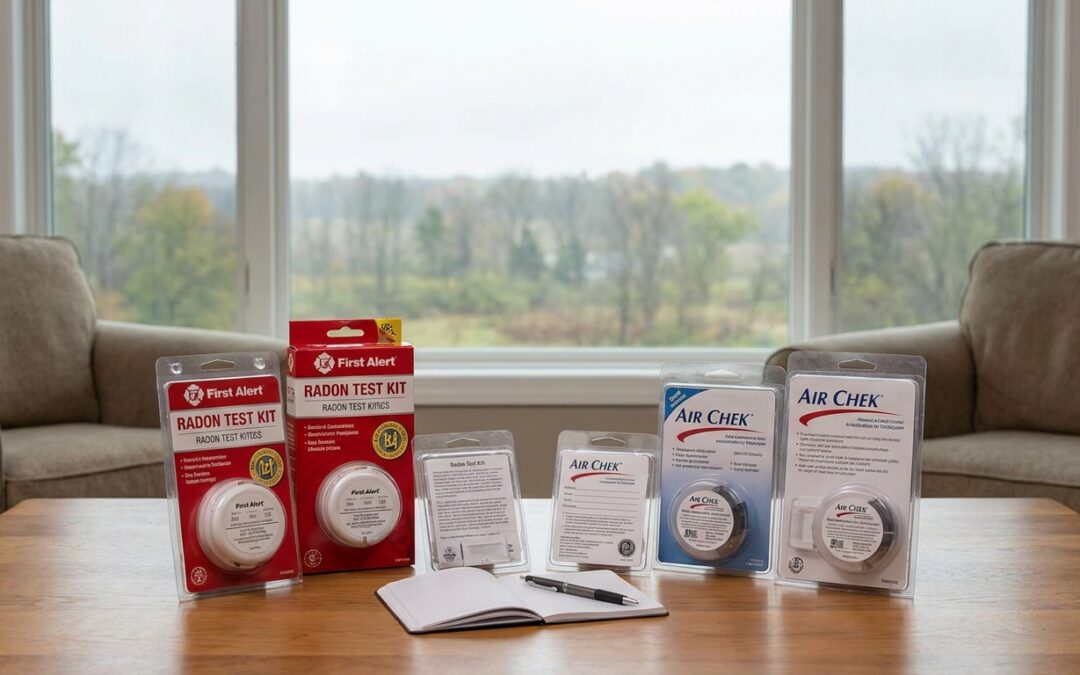
Radon test kits range from a basic charcoal canister you pick up at a hardware store to a full NRPP-certified inspection with a continuous monitor — and for Michigan homeowners sitting on radon-prone glacial till, picking the wrong one wastes weeks you don't have before a closing deadline or before winter locks your windows shut.
- Short-term charcoal test kits are the fastest radon test kit Michigan homeowners can run, done in 48 hours, but they’re for screening, not closings.
- Long-term alpha track detectors give the most accurate year-round baseline for anyone keeping a home past 2026 — Buy if you’re not selling.
- For a home sale or purchase, an NRPP-certified professional test beats any store-bought kit because most Michigan lenders and title companies require a certified result.
- EPA’s action level is 4 pCi/L — a result at or above that number means it’s time for mitigation, not a second test kit.
- Continuous digital monitors are the best middle ground for homeowners who want ongoing data without hiring a pro every year.
Why this matters
Michigan sits on glacial till loaded with uranium-bearing rock, which is exactly the geology that produces elevated indoor radon. That's not a scare line — it's the reason state and county radon maps show large stretches of Metro Detroit, Lansing, and the surrounding counties with average readings above the EPA's 4 pCi/L action level. A radon test kit is the only way to know what's happening inside your specific house, because radon levels vary block to block and even room to room.
The test you choose changes what you can do with the result. A charcoal kit tells you if you have a problem right now. A long-term detector tells you what you're breathing across a heating season. Only a test run through radon testing services for Michigan homeowners carries the certification that real estate transactions, some lenders, and Michigan's disclosure rules expect. Pick based on what you're actually deciding — sell, stay, or renovate — not just on price.
How this list was ranked
Each test type here is ranked on four factors: how fast you get a usable number, how closely that number matches EPA-recommended testing protocol, whether the result holds up in a real estate transaction, and how well it fits a Michigan home's seasonal radon swings — levels typically run higher in winter when houses are sealed tight. Short-term kits and long-term detectors both follow published EPA testing guidance; the professional pick reflects standard NRPP protocol for continuous monitoring. Nothing here is a paid placement — the ranking reflects what each method is actually built to do, not a sales pitch for one box over another.
The ranked list
1. Short-term charcoal canister kit — the fastest read
A charcoal canister sits in your lowest livable level for 2 to 7 days, then goes to a lab for analysis. It's the cheapest way to get a first number and the closest thing to an instant answer a homeowner can run without equipment. The catch: short-term results swing with weather, so a single test during a mild stretch can understate a real problem. Use it as a screening tool in early 2026, not as your only data point if the number comes back close to 4 pCi/L. Verdict: Buy for a first look, especially if you've never tested this house before.
2. Long-term alpha track detector — the accurate baseline
This passive detector stays in place for 90 days to a full year and gives you an average that smooths out day-to-day and seasonal swings. It's the method EPA recommends when you're not in a rush and want to know your actual annual exposure, not a snapshot. For a Michigan home where winter heating season drives levels up, a long-term test catches what a 48-hour kit misses. Verdict: Buy if you plan to stay in the house past 2026 and want a number you can trust for a mitigation decision.
3. Continuous digital radon monitor — the real-time option
These battery-powered units display hourly and daily readings on a screen and log data over weeks or months, so you can watch how levels respond to a closed door, a running furnace, or a new sump pump. They cost more upfront than a disposable canister but never need mailing to a lab. The tradeoff is accuracy varies by unit and calibration, so a monitor is a good ongoing check, not a certified pass/fail result. Verdict: Consider if you already tested once and want to track trends without repeat lab kits.
4. Mail-in lab test kit through a state or county program
Some Michigan county health departments distribute discounted or free short-term test kits seasonally, with results processed through an accredited lab. It's functionally the same charcoal-canister method as option one, just distributed through a public program instead of a retail shelf. Availability depends on your county and the time of year, and turnaround can run slower than a retail kit during high-demand testing months. Verdict: Consider if your county currently offers one — otherwise skip the wait and buy a retail short-term kit.
5. NRPP-certified professional test — the one that closes deals
A certified technician places a continuous radon monitor for at least 48 hours under controlled conditions — closed-house protocol, calibrated equipment, chain-of-custody documentation — and delivers a result that meets Michigan's radon disclosure expectations for home sales. This is the only option on this list that satisfies most lenders, title companies, and real estate contingencies outright. If you're buying, selling, or need a number that will hold up if it's ever challenged, this is the test, not a DIY kit. Compare options at best radon testing companies near you in Michigan before a closing date forces a rushed decision. Verdict: Buy for any real estate transaction or any result near the 4 pCi/L line that needs a second, unimpeachable opinion.
Need a certified radon test in 2026?
Get an NRPP-certified result Michigan lenders and title companies accept.
Comparison table
| Test type | Duration | Accuracy for decisions | Real estate acceptable | Best for |
|---|---|---|---|---|
| Charcoal canister kit | 2-7 days | Screening only | Rarely | First-time check |
| Alpha track detector | 90 days-1 year | High annual average | Sometimes | Long-term homeowners |
| Continuous digital monitor | Ongoing | Good for trends | No | Tracking changes over time |
| Mail-in lab kit (county program) | 2-7 days | Screening only | Rarely | Budget screening |
| NRPP-certified professional test | 48+ hours | Certified result | Yes | Home sales, closings, high readings |
Where to test
- Test the lowest livable level first. Radon concentrates in basements and slab-level rooms, so that's where any kit — DIY or professional — needs to sit.
- Retest before you act on a borderline number. A result between 2 and 4 pCi/L deserves a second test, ideally a longer one, before you decide there's no issue.
- Skip DIY kits entirely if a sale is already in motion. Michigan's radon disclosure requirements and most purchase agreements expect a certified test, and a DIY result can trigger a redo that delays closing.
FAQ
What’s the best radon test kit for a Michigan homeowner just checking for the first time?
A short-term charcoal canister kit is the best starting point — it’s the fastest radon test kit Michigan homeowners can run, giving a screening result in 2 to 7 days. If the number comes back near or above 4 pCi/L, follow up with a longer test or a certified professional reading.
Is a DIY radon test kit accurate enough for a home sale?
No — most Michigan lenders, title companies, and purchase agreements expect an NRPP-certified professional test for real estate transactions. A DIY kit can still tell you your baseline, but it typically won’t satisfy disclosure or financing requirements.
How much radon is too much in a Michigan home?
The EPA action level is 4 pCi/L. A result at or above that number means mitigation is recommended, not just another test.
How long does a radon test take?
Short-term charcoal kits take 2 to 7 days, with 48 hours as the practical minimum for a usable reading. Long-term alpha track detectors run 90 days to a full year for a more accurate seasonal average.
Do radon levels change by season in Michigan?
Yes — levels typically run higher in winter when homes are sealed tight and heating systems pull more air through the lowest level. A test run only in summer can understate winter exposure, which is why a long-term detector or a follow-up test matters.
Can I use a continuous digital monitor instead of a certified test?
A continuous monitor is useful for tracking trends over weeks or months, but it doesn’t carry the certification most real estate transactions require. Use it for ongoing awareness, not as a substitute for a professional test before a sale.
Where can I get a free or low-cost radon test kit in Michigan?
Some Michigan county health departments distribute short-term test kits seasonally at reduced cost or free, processed through an accredited lab. Availability varies by county and time of year, so a retail kit is a faster option if none is currently offered.
What happens if my radon test comes back above 4 pCi/L?
A result at or above the EPA action level of 4 pCi/L means it’s time to plan mitigation, not retest indefinitely. A certified technician can confirm the reading and recommend a mitigation system sized to your home’s foundation type.
One last thing
A single short-term test only tells you about the days it ran. Michigan homes tested in summer routinely read lower than the same house tested in January, which is exactly why a borderline result deserves a second, longer look before 2026 heating season locks you into a false sense of security either way.
Related guides
- Radon testing for new home purchases in Michigan
- Michigan's radon disclosure requirements when selling
- How to maintain your radon mitigation system