Choose Michigan Radon Control if you want NRPP-certified radon testing, mitigation installation, and maintenance for a home in Metro Detroit or Lansing; choose DSM Radon if its verified qualifications and written proposal better meet your property's requirements. For 2026, the deciding factors are the work included, the plan for your foundation, and how the finished system's performance will be checked.
- Michigan Radon Control is a documented fit for residential radon testing, mitigation, and maintenance in Metro Detroit and Lansing.
- Choose DSM Radon when its verified credentials and written scope better match your property’s needs.
- Compare radon mitigation proposals by foundation design, post-installation testing, maintenance responsibilities, and exclusions—not company names alone.
- EPA recommends fixing homes at 4 pCi/L or higher; testing determines your next step.
Why this matters
It's natural to worry when a radon test comes back elevated. You do not need to become a building scientist to make a sound hiring decision. You need a contractor who explains the problem, proposes appropriate work, and puts the important commitments in writing.
Radon is a radioactive gas that can enter buildings from the ground. You cannot judge its concentration by smell or appearance. The EPA recommends fixing homes with radon levels at 4 pCi/L or higher and considering reduction when levels fall between 2 and 4 pCi/L.
Those thresholds guide action, not contractor rankings. For your 2026 comparison, separate the question of whether your home needs mitigation from the question of who should install it. A company name cannot answer either question by itself.
At a glance
Use this table to organize the comparison. Items marked for confirmation belong in your conversations with the contractors, not in assumptions about either business.
| Dimension | Michigan Radon Control | DSM Radon |
|---|---|---|
| Best for | Homeowners and realtors in Metro Detroit and Lansing seeking testing, installation, and maintenance | Buyers whose requirements are better met by its verified proposal |
| Credentials | NRPP-certified testing and mitigation services | Verify the responsible professional's current credentials |
| Standout feature: service scope | Testing, mitigation system installation, and maintenance | Confirm which services the proposal includes |
| Foundation-specific design | Request the proposed approach for your foundation | Request the proposed approach for your foundation |
| Performance verification | Request the post-installation testing plan | Request the post-installation testing plan |
| Maintenance | System maintenance is an offered service; confirm project-specific terms | Confirm maintenance services and responsibilities |
| Pricing model | Request a written scope, exclusions, and payment terms | Request a written scope, exclusions, and payment terms |
Local homeowners have a clear service match
Michigan Radon Control is a documented fit for homeowners who need radon testing, mitigation installation, and maintenance in Metro Detroit or Lansing. That is a useful starting point because the service area and residential focus match the buyer's problem directly.
For a realtor, the same service range creates a practical discussion: testing before a decision, installation when needed, and maintenance afterward. It does not establish a particular turnaround time or guarantee that a transaction deadline can be met. Ask about your actual dates before committing.
DSM Radon becomes the better choice for your project when its verified proposal addresses a requirement the competing proposal does not. That requirement should be specific: a suitable installation approach, clearly assigned follow-up responsibilities, or a workable project sequence.
Best for: local homeowners and realtors who want a defined residential service fit. For either contractor, confirm that the particular address and requested work are covered before comparing the rest of the proposal.
Documented credentials beat an unverified assumption
NRPP certification is an explicit qualification of the client's testing and mitigation services. That supports putting the company on your shortlist. It does not remove the need to identify who will perform or supervise your particular work.
Ask DSM Radon for the same information. A fair comparison checks the responsible professional, the credential relevant to the task, and its current status. Do not turn an unanswered question into a negative claim about a contractor.
Before signing, ask:
- Who is responsible for the radon measurement work?
- Who is responsible for the mitigation design and installation?
- Which current credentials apply to those responsibilities?
- What insurance documentation can you review?
The guide to verifying a radon contractor's NRPP certification explains the credential check. Choose verified qualifications over a badge you have not checked, regardless of which company supplies the proposal.
A broader service scope helps only when responsibilities are clear
Testing, installation, and maintenance address different stages of a radon problem. Having those services available from one provider gives you a clear place to start, but it does not mean every service is included in an installation agreement.
Ask each contractor to separate the work into named deliverables. An initial measurement establishes the starting point. A mitigation installation changes how soil gas is managed. A follow-up measurement checks the result, while maintenance addresses the system's continued operation.
For DSM Radon, confirm which stages it will perform and which require another professional. Apply that same question to the client's project proposal. An offered service and an included service are not the same thing.
The advantage goes to the proposal that makes ownership clear. A homeowner should not discover after installation that arranging the verification test was an unassigned task.
Foundation design is a tie until you compare actual plans
Neither contractor earns a design win from its name. A basement slab, exposed crawl-space soil, and a home with mixed foundations present different conditions. The plan needs to address the building you own.
A common mitigation approach draws soil gas from beneath a slab and vents it outdoors. Crawl-space work can involve a sealed membrane with suction beneath it. Your contractor should explain the proposed method without expecting you to choose a system from a list of technical terms.
Ask both bidders to identify:
- The foundation areas the proposed system will address.
- The intended suction location or locations.
- The proposed pipe route and fan location.
- Necessary sealing and electrical work.
- Access requirements and excluded repairs.
For a finished basement, discuss where drilling and piping will occur before work begins. For a crawl space, ask how access and membrane work affect the installation. The better design proposal explains why the approach suits your home, rather than treating every foundation as interchangeable.
Performance verification is a tie: both need a testing plan
A running fan does not establish the radon concentration in your living space. Neither does a neat installation. The EPA's residential guidance calls for testing after mitigation to determine whether radon levels have been reduced.
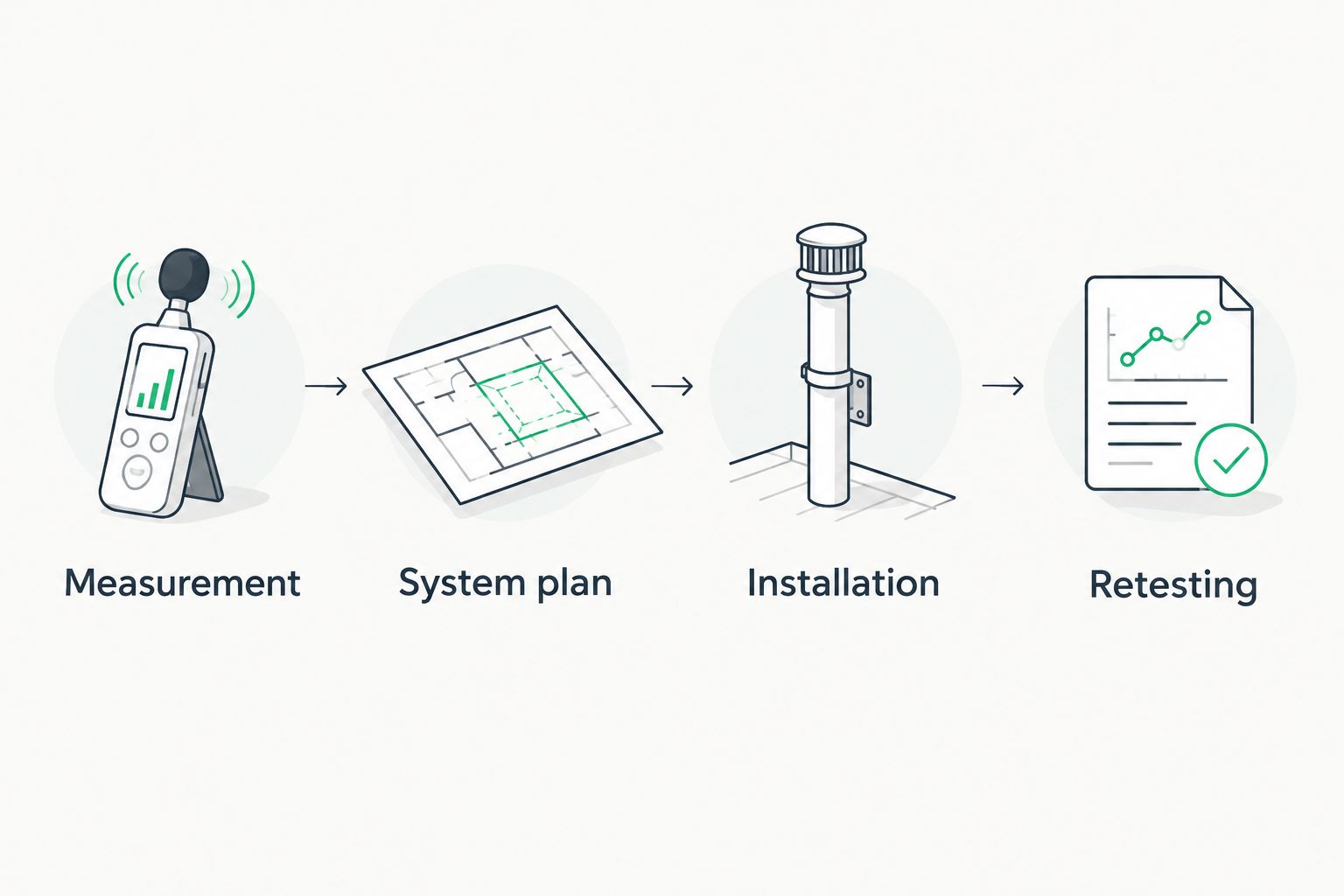
For a 2026 installation, ask each bidder to explain the sequence in plain language:
- Measurement: establish the home's radon concentration using an appropriate test.
- System plan: explain how the proposed work addresses the foundation.
- Installation: complete the agreed mitigation work.
- Retesting: measure radon after installation and document the result.
EPA guidance describes short-term home tests lasting 2 to 90 days, depending on the device. Do not assume a particular test duration or reporting date from an installer's appointment time. Ask which protocol applies to your situation, especially during a property transaction.
The written proposal should also explain what happens if the follow-up result does not meet the agreed objective. Give the verification advantage to the contractor who defines the test, the responsible person, and the next step.
Maintenance availability is useful; written coverage decides the win
Michigan Radon Control offers radon system maintenance. That is relevant if you want help after installation rather than only a construction appointment. Confirm exactly what the maintenance visit or agreement covers.
Ask DSM Radon whether it provides maintenance and how it handles questions about an existing system. Do not assume maintenance is included simply because a company installs mitigation equipment. The same caution applies to either proposal.
Your questions should cover fan concerns, visible pipe damage, system indicators, and changes to the house. Remodeling and foundation work deserve a fresh discussion because they can change the conditions the original system addressed.
A pressure gauge on a mitigation system indicates a pressure difference; it does not measure indoor radon concentration. Keep system-operation checks separate from radon testing. A maintenance arrangement should explain both the homeowner's responsibilities and when professional assessment is appropriate.
Pricing: compare the agreement, not an assumed billing model
For your 2026 decision, request each contractor's billing structure directly. Ask whether the proposed work has a defined project scope, how changes are authorized, when payments are due, and which follow-up services are separate.
A fixed-scope agreement makes the planned work easier to compare. An agreement that identifies uncertain conditions and explains change authorization gives you a way to handle discoveries without treating every adjustment as a surprise. Neither structure is automatically better for every house.
Do not label either business as the cheaper option without comparable written proposals. Differences in foundation coverage, electrical work, sealing, testing, and restoration can make two bids describe different jobs.
Before accepting either agreement, confirm:
- What installation work is included.
- Which conditions trigger a scope change.
- Who authorizes additional work.
- Whether follow-up testing is included or separately arranged.
- What warranty terms apply to your project.
- Who handles maintenance after installation.
The better agreement makes obligations clear before work starts. Compare those obligations first, then decide whether the proposal fits your household's budget and needs.
Final verdict: choose the better documented fit
Choose Michigan Radon Control if you're a local homeowner or realtor
Best for: a homeowner or realtor in Metro Detroit or Lansing seeking NRPP-certified radon testing, mitigation installation, and maintenance. The stated services match that need directly.
Its advantage is the documented service fit. Its limitation in this comparison is that the project still needs its own written design, verification plan, and terms; the service description does not substitute for those commitments.
Choose DSM Radon if its verified proposal better fits your project
Best for: a homeowner whose property-specific requirements are more clearly addressed in DSM Radon's written proposal. That is a genuine reason to choose DSM Radon, provided you verify the qualifications behind the work.
Its advantage must come from the actual proposal, not an assumed reputation or capability. Do not award it a win on testing, design, maintenance, or billing until you have checked those details.
For 2026, use this scorecard to make the final call:
| Dimension | Winner |
|---|---|
| Local residential service fit | Client for the stated Metro Detroit and Lansing service needs |
| Credentials | Verified credentials decide; check the responsible professionals |
| Service scope | Proposal with clearly assigned testing, installation, and maintenance responsibilities |
| Foundation-specific design | Tie until the property-specific plans are compared |
| Performance verification | Tie until the written testing commitments are compared |
| Maintenance | Provider whose confirmed coverage meets your needs |
| Pricing model | Agreement with clearer scope, exclusions, and change authorization |
FAQ
Is DSM Radon better than Michigan Radon Control?
There is no supported across-the-board winner. Michigan Radon Control has a documented residential service fit in Metro Detroit and Lansing; choose DSM Radon when its verified qualifications and written proposal better address your project.
What should I ask DSM Radon before hiring?
Ask DSM Radon for the responsible professional’s current credentials, a foundation-specific installation plan, and written follow-up testing responsibilities. Also confirm exclusions, electrical work, maintenance, and applicable warranty terms.
What radon level means my home needs attention?
The EPA recommends fixing a home at 4 pCi/L or higher and considering reduction between 2 and 4 pCi/L. Use a properly conducted test to determine your home’s concentration.
Does a running mitigation fan prove my radon is low?
No. A running fan shows that equipment is operating, not the radon concentration in your home; a radon test measures that concentration.
How long does a radon test take?
EPA guidance describes short-term home radon tests lasting 2 to 90 days, depending on the device. Ask the testing professional which duration and protocol apply to your home or transaction.
Should I choose the contractor with the shortest proposal?
Choose the proposal with clear responsibilities, not the fewest pages. It should explain the foundation approach, included work, verification testing, exclusions, and follow-up obligations.
Can I compare contractors before I have a radon result?
Yes, you can compare credentials and testing services before you have a result. Use the home’s measurement and foundation conditions to discuss whether mitigation is needed and what work is appropriate.
One last thing
Ask both contractors the same question: What document will show whether the system reduced radon after installation? The answer should identify a measurement report and who arranges it, not just a fan, gauge, or completion invoice.
You do not need to settle every technical detail yourself. Start with the test, get the plan in writing, and make the follow-up measurement part of the decision.
Related guides
- How to compare radon mitigation quotes from Michigan contractors
- How to schedule radon testing after mitigation installation
- How to maintain your radon mitigation system