

For radon testing in Michigan in 2026, get a written quote for the test method, measurement period, and report you need rather than budgeting from a generic statewide figure. Check whether laboratory analysis, device pickup, and any follow-up measurement are included. Testing measures radon; mitigation is separate work to reduce it.
- How much does radon testing cost in Michigan? Compare written quotes for the same testing scope.
- Michigan Radon Control provides NRPP-certified radon testing for homeowners and realtors in Metro Detroit and Lansing.
- EPA recommends fixing homes at radon levels of 4 pCi/L or higher.
- Check laboratory analysis, reporting, and follow-up terms before choosing a radon test.
How much does radon testing cost in Michigan in 2026?
Your useful budget number is a written quote for your property and purpose. A homeowner checking everyday exposure needs a different testing plan from a buyer working against an inspection deadline. Compare the work included, not just the final figure.
Start by deciding what you need the result to establish. This guide to testing your home for radon explains the process before you choose a method.
Use the following breakdown when you request a quote. These are items to clarify, not a claim that every provider bills each item separately.
| Quote component | What to ask | What the answer tells you |
|---|---|---|
| Measurement | Which device and testing period does the quote cover? | Whether providers are proposing comparable tests |
| Setup and collection | Who places the device and retrieves it? | Which tasks remain your responsibility |
| Laboratory analysis | Is analysis included when the device needs a lab? | Whether the kit purchase covers the completed result |
| Written report | What information will the report contain? | Whether the documentation fits your purpose |
| Follow-up | What happens if the test is invalid or needs confirmation? | Whether another measurement requires separate authorization |
| Mitigation | Is any reduction work included? | Whether you are comparing testing alone or a broader project |
Keep the original quote and the finished report together. That makes it easier to check what you ordered, understand what was measured, and plan the next step without confusing testing with repairs.
Why this matters
It is completely natural to worry about radon, especially when a home purchase or a child's bedroom is involved. A test gives you something concrete to act on. Radon has no smell or color, so a normal-looking basement cannot tell you its concentration.
For your 2026 planning, the EPA's A Citizen's Guide to Radon provides the residential action framework: fix a home when its radon level is 4 pCi/L or higher, and consider fixing it between 2 and 4 pCi/L. The unit pCi/L means picocuries per liter of air.
Those values guide action; they do not turn a single measurement into a permanent safety guarantee. Radon levels change. You need a properly conducted test and a clear explanation of what the result means for your home.
DIY short-term testing: best for an initial home check
A short-term test is useful when you want an initial measurement and can follow the device instructions carefully. EPA describes short-term testing as lasting 2 to 90 days, depending on the device. That category includes different measurement methods, so do not assume every short-term kit uses the same exposure period.
The advantage is control over the setup. The limitation is responsibility for the procedure. You must choose the right location, record the required information, maintain the required conditions, and return a mail-in device as instructed.
Before choosing a kit, check these details:
- Whether laboratory analysis is part of the purchase.
- Whether you must arrange return shipping.
- The device's required exposure period.
- The deadline for returning it after exposure.
- The instructions for interpreting the result and arranging follow-up.
A kit is not a completed test until you receive a valid result. Keep the instructions through the entire process, including mailing and reporting. If your test is for a sale, confirm the transaction's documentation expectations before choosing a homeowner-administered kit.
Professional testing: best for managed setup and documentation
Professional testing puts device placement, measurement procedures, and reporting in the hands of a testing provider. It is a sensible choice when you want help managing the process or need documentation for a real estate decision. Confirm the proposed method before booking.
A continuous radon monitor records readings over time rather than producing only a single end-of-test laboratory result. Ask whether the proposed service uses one and what information appears in the finished report. Do not assume every professional quote includes the same device or report format.
The advantage is that you are not managing the measurement alone. The limitation is that you still need to provide access and follow the testing conditions. Hiring a professional does not remove the need to keep the test environment suitable.
For a 2026 home purchase, tell the provider your inspection deadline at the start. Ask separately about device placement, the measurement period, pickup, and report delivery. A testing window and a reporting deadline are not the same thing.
Long-term testing: best for understanding typical exposure
Long-term testing lasts more than 90 days, according to EPA residential guidance. It is useful when your goal is to understand radon over a longer period rather than meet an immediate transaction deadline. EPA explains that a long-term result is more representative of your home's year-round average than a short-term result.
The advantage is the broader measurement period. The limitation is the wait. A long-term test does not fit a decision that must be made before that period ends.
Follow the device's placement and handling instructions throughout the measurement. Choose a location where the device can stay undisturbed. Tell everyone in the household what it is so someone does not move it while cleaning or rearranging furniture.
Which testing approach fits your situation?
| Testing approach | Best for | Main advantage | Main limitation |
|---|---|---|---|
| DIY short-term test | An initial homeowner check | You manage placement and timing | Setup and handling depend on you |
| Professional testing | Managed measurement and transaction documentation | A provider handles the testing process | Access and testing conditions still require coordination |
| Long-term test | Understanding typical exposure over time | A longer view of radon concentration | It does not answer an immediate deadline |
These options overlap: a professional can conduct short-term testing, and a homeowner can use a long-term device. Choose the measurement period first, then decide who should manage it.
Why radon testing quotes vary
For your 2026 comparison, ask each provider to quote the same scope. The following differences explain why two proposals are not automatically interchangeable; confirm how each provider handles them rather than assuming a particular billing policy.
- Test method: A mail-in device and a professionally managed monitor involve different equipment and handling.
- Measurement period: A short-term measurement and a long-term measurement answer different questions.
- Testing locations: Ask which rooms or areas the proposed plan covers and whether additional locations need separate measurements.
- Setup and retrieval: Clarify whether you handle the device, mail it, or arrange access for a provider.
- Report requirements: A personal home check and a real estate transaction can involve different documentation expectations.
- Follow-up scope: Confirm whether result interpretation, another measurement, or post-mitigation testing belongs to the original agreement.
Do not use square footage alone to compare proposals. Give the provider your home's layout and how you use its lower levels. A basement, crawl space, or separate foundation area is information for designing the test, not a reason to guess a surcharge.
How do I get a useful radon testing quote?
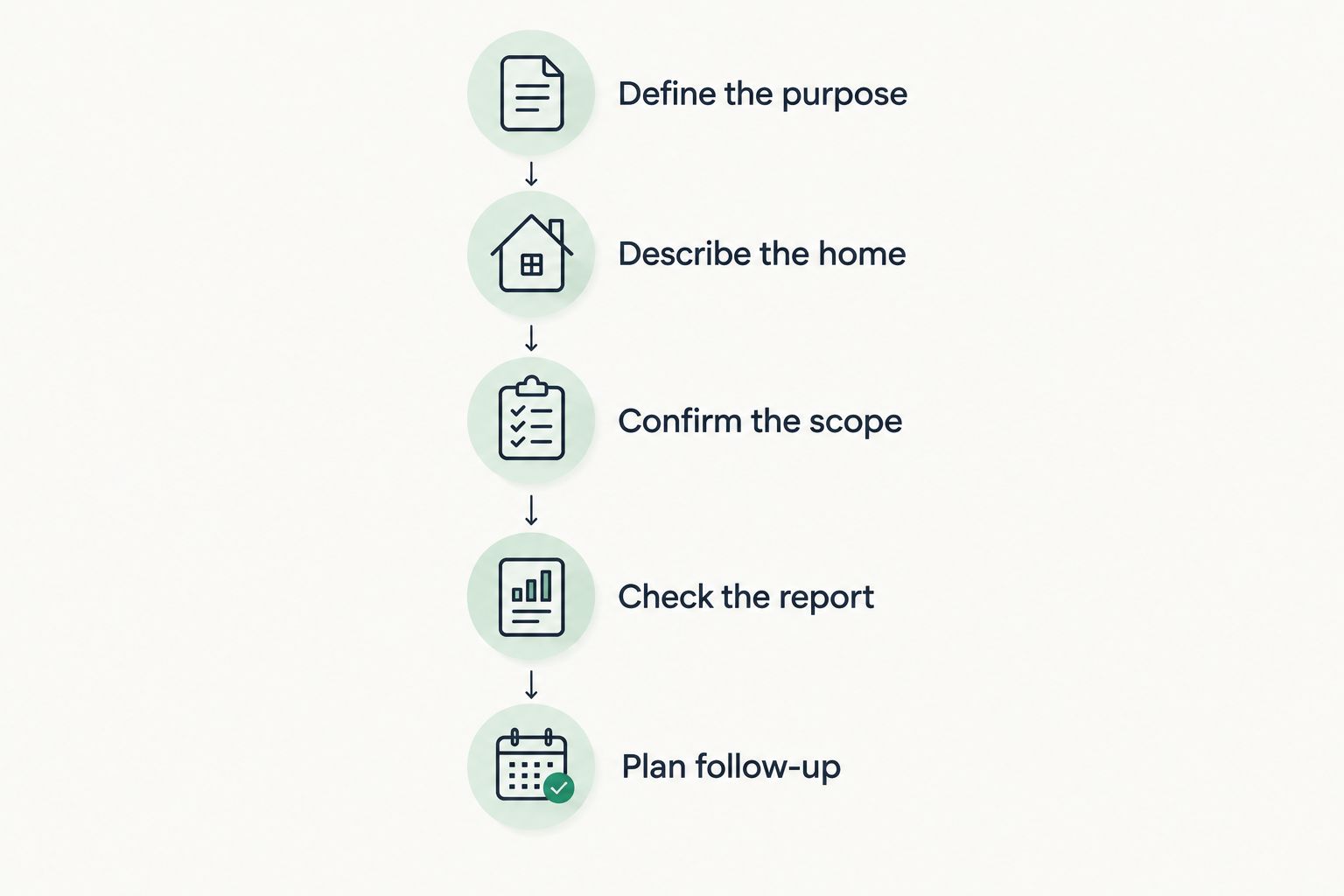
Describe the decision you need to make before asking for a quote. This helps the provider propose a measurement that fits your situation instead of leaving you to sort out mismatched services afterward.
- Define the purpose. Say whether you are checking your own home, buying or selling, or verifying a mitigation system. Include any deadline.
- Describe the home. Identify the foundation areas, the lowest level you use, and any existing radon system. Explain access restrictions or planned construction.
- Confirm the scope. Ask for the test method, measurement period, placement plan, and responsibilities for setup and collection in writing.
- Check the report. Ask what documentation you receive and when it will be delivered. Confirm who explains a result that needs action.
- Plan follow-up. Ask how an invalid test, a confirmation test, or post-mitigation measurement would be handled before authorizing additional work.
When you compare responses, mark any unanswered questions. Request clarification before booking rather than assuming a missing item is included. You should be able to explain what each proposal buys in one plain sentence.
Michigan Radon Control is best suited to homeowners and realtors seeking NRPP-certified radon testing in Metro Detroit and Lansing. The company also provides mitigation installation and system maintenance. Its stated service area is the practical boundary: homeowners elsewhere should confirm coverage before planning an appointment.
You can request a radon testing estimate from Michigan Radon Control and describe your property and testing purpose. Confirm the measurement method, report, and follow-up scope before authorizing the service.
Request a radon testing estimate
Describe your home, testing purpose, and deadline so you can confirm the right scope.
How long does a radon test take?
2 to 90 days is EPA's short-term testing category, while long-term testing runs for more than 90 days. Your chosen device determines the actual measurement period. Add any device return, laboratory processing, or report preparation to your schedule.
For a short-term test lasting less than 4 days, EPA advises keeping windows and exterior doors closed, except for normal entry and exit, for at least 12 hours before testing begins. Follow the provider's and device manufacturer's complete instructions during the test as well. Do not shorten the exposure period to meet a closing deadline.
Does a high radon result mean I need another test?
4 pCi/L is EPA's residential action level, but the follow-up decision also depends on the initial test and how it was conducted. EPA recommends following a short-term result at or above that level with either a short-term or long-term test. The urgency and initial reading help determine the appropriate follow-up.
Ask your testing provider to explain the next step rather than choosing another device at random. A confirmation measurement and a test after mitigation serve different purposes. Keep each report identified by date, location, and whether the system was operating.
Does testing include radon mitigation?
4 pCi/L or higher calls for fixing the home under EPA guidance; testing itself does not perform that work. A measurement establishes the concentration. Mitigation is a separate project designed to reduce it.
Before approving mitigation, confirm the proposed system, installation scope, and verification plan. After installation, a radon measurement checks the result. A running fan or a pressure-gauge reading alone does not measure the radon concentration in your indoor air.
FAQ
How much does radon testing cost in Michigan in 2026?
Get a written quote for the test method, measurement period, and report your Michigan property needs. Confirm whether laboratory analysis, collection, and follow-up measurements are included before booking.
What’s the best radon test for a Michigan home purchase?
Choose a test that meets your transaction’s measurement and documentation needs within the inspection deadline. Professional testing provides managed setup and reporting; confirm the proposed method and delivery schedule before authorizing it.
Is a DIY radon test better than professional testing?
A DIY test fits a homeowner who can manage placement and handling, while professional testing fits someone who wants the process managed. Neither approach excuses incorrect placement or failure to follow testing instructions.
How long does a short-term radon test run?
EPA defines short-term radon testing as 2 to 90 days, depending on the device. Use the device’s required exposure period and account separately for any laboratory processing or report delivery.
What radon level means I should fix my home?
EPA recommends fixing a home at 4 pCi/L or higher and considering mitigation between 2 and 4 pCi/L. Follow the recommended testing sequence and have your provider explain the result and next step.
Can Michigan Radon Control test a home before a sale?
Michigan Radon Control provides NRPP-certified radon testing for homeowners and realtors in Metro Detroit and Lansing. Share the inspection deadline and confirm the testing method, access arrangements, and report requirements.
Does Michigan Radon Control also install mitigation systems?
Michigan Radon Control provides radon mitigation system installation and maintenance as well as testing. Confirm the installation scope and post-installation measurement separately from the original testing service.
Do I need to test after a radon mitigation system is installed?
Yes, a post-installation radon test checks whether the system has reduced the indoor concentration. A fan running or a gauge showing pressure does not replace an air measurement.
One last thing
Protect the test conditions before worrying about the quote comparison. An invalid measurement cannot answer your question, regardless of who conducted it. Give household members the instructions before placement, keep the device undisturbed, and record any problem during the measurement.
For your 2026 testing plan, write down the test purpose, device location, exposure dates, and next action alongside the report. That simple record makes the result easier to use during a home sale, a mitigation project, or a later check of your indoor air.
Related guides
- How to prepare your basement for a radon test
- How to read your radon test results
- How to schedule radon testing after mitigation installation