
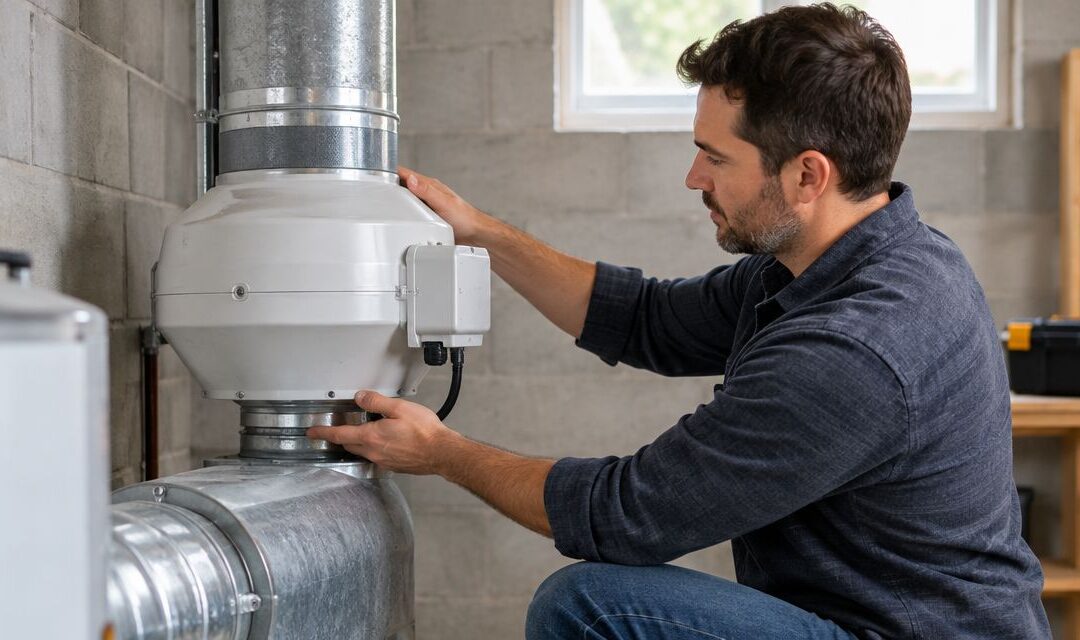
Choose a radon fan by matching its airflow and suction performance to your home's measured soil conditions, foundation layout, and vent-pipe resistance—not by square footage alone. The fan must maintain suction beneath the foundation, fit a compliant installation, and produce a verified reduction in indoor radon after installation.
- How to choose a radon fan: match the fan curve to measured airflow and suction needs, not house size.
- High-airflow and high-suction fans solve different problems; neither is automatically the better choice.
- Michigan Radon Control provides NRPP-certified radon mitigation services for Metro Detroit and Lansing homeowners.
- A pressure gauge shows system pressure, not indoor radon levels; confirm performance with a radon test.
Why this matters
It's completely natural to worry about choosing the wrong equipment when your family's indoor air is involved. You do not need to become a fan engineer. You need a contractor who can explain the measurements behind the selection.
A running fan is not proof that a system controls radon. Start by understanding how to read a radon mitigation system's pressure gauge, then keep pressure readings separate from radon test results.
For a home project in 2026, the practical goal is unchanged: select equipment that works with the foundation and verify the result indoors. A larger motor is not a substitute for that process.
How do you choose the right radon fan for your home?
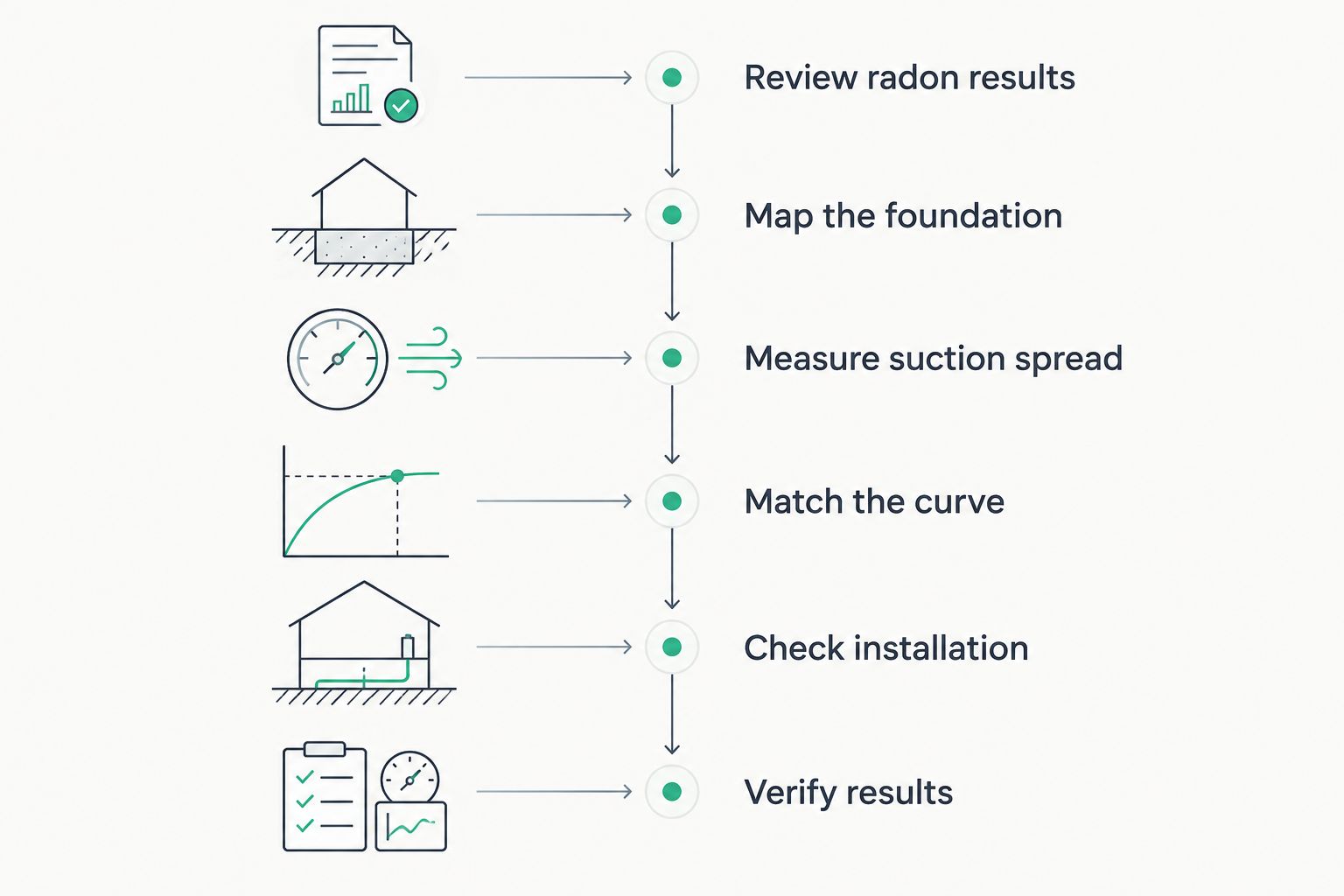
Choose the fan after diagnosing the foundation and piping—not before. Ask your mitigation professional to walk through these steps and document the selection.
1. Review radon results
Bring your radon report, including the test location, duration, and result. The result establishes the indoor radon problem, but it does not directly specify the fan's airflow or suction requirement.
EPA homeowner guidance recommends fixing homes with radon levels at or above 4 pCi/L and considering mitigation between 2 pCi/L and 4 pCi/L. Those are radon concentrations, not fan-sizing categories. A higher radon reading does not automatically call for a higher-powered fan.
2. Map the foundation
Identify the basement slab, crawl space, additions, and any separate foundation sections. Footings and isolated slabs can interrupt the path through which suction spreads beneath a home.
A fan connected beneath the original basement does not automatically control a later addition. Ask whether the design reaches each relevant foundation area and whether additional suction points are needed. This question matters more than the home's total floor area.
3. Measure suction spread
A mitigation professional can perform pressure-field testing to check whether suction at the proposed extraction point reaches other areas beneath the slab. In plain language, this checks whether the system can pull from the places it needs to reach.
Loose material beneath a slab allows air to move differently from compacted material. The measurements help distinguish a system that needs more airflow from one that needs greater suction against resistance. Ask for the reasoning, not just a model name.
4. Match the curve
A fan curve shows how much air a fan moves at different pressures. Airflow is commonly expressed in cubic feet per minute, while static pressure is commonly expressed in inches of water column.
Compare airflow at the required pressure, not maximum airflow in unrestricted air. Maximum airflow and maximum suction describe different ends of a performance curve; the installed fan does not deliver both maximums simultaneously. Ask the contractor to identify the expected operating point on the selected fan's curve.
5. Check installation
Confirm that the selected fan is intended for radon mitigation and suitable for its installation location. Pipe connections, mounting orientation, electrical supply, service access, and condensate management all need attention.
Fan placement also affects safety. EPA homeowner guidance places radon fans outside living space, such as outdoors or in an appropriate attic location, rather than in a basement. Have the installer explain how the proposed location and exhaust arrangement meet applicable requirements.
6. Verify results
Record the system's normal pressure reading after commissioning. Then complete a post-mitigation radon test using the applicable testing instructions and protocol.
An active soil-depressurization fan normally runs 24 hours per day. Sound, vibration, and a pressure reading help you recognize operating changes, but none measures indoor radon. For a 2026 installation or replacement, make the follow-up test part of the plan before approving the work.
Which radon fan performance profile fits your home?
The descriptions below explain performance profiles, not fixed product tiers. Manufacturers use different model names, so compare published fan curves rather than assuming that similar labels mean similar performance.
| Performance profile | Best for | Main advantage | Main limitation |
|---|---|---|---|
| Higher airflow | Systems that need substantial air movement at lower resistance | Moves more air when the extraction path permits it | Maximum airflow does not establish performance against high resistance |
| Higher suction | Systems that need greater pressure against restricted airflow | Maintains suction where resistance limits air movement | Does not fix disconnected foundation areas by itself |
| Intermediate performance | Systems whose measured needs fall between the other profiles | Matches applications needing both airflow and pressure | Still requires diagnostic measurements and curve comparison |
Higher-airflow fans: best for lower-resistance extraction
A higher-airflow fan fits a system whose diagnostics show that substantial air movement is needed and achievable. Permeable material beneath the slab is one condition that influences this choice.
The limitation is resistance. A prominent maximum-airflow figure tells you little about performance once connected to restrictive piping or soil. Choose this profile only when the measured operating conditions support it.
Higher-suction fans: best for restricted extraction
A higher-suction fan fits a system that needs greater pressure to draw air through resistant material. The relevant evidence is measured pressure and airflow, not simply a high indoor radon result.
Greater suction at the pipe does not prove that pressure reaches every slab section. If a footing isolates part of the foundation, the design needs attention. Choose this profile for a documented pressure requirement, not as a universal upgrade.
Intermediate-performance fans: best for measured middle-ground needs
An intermediate-performance fan fits when its curve matches the system's required combination of pressure and airflow. It is not automatically the safest compromise between other models.
Its advantage is an appropriate match where the diagnostics support it. Its limitation is the same as every other profile: a suitable fan cannot compensate for an incomplete system layout. Choose the measured fit, not the middle option by default.
Why radon fan requirements vary
The same fan does not suit every foundation. These factors explain why a contractor needs more than a home's address and square footage:
- Material beneath the slab: Gravel, sand, and compacted soil offer different resistance to moving air. This affects the balance between airflow and suction.
- Foundation divisions: Footings, additions, and separate slabs affect how far suction spreads. Additional extraction points can be part of the solution.
- Pipe resistance: Pipe diameter, length, fittings, and routing affect the pressure the fan must work against. Evaluate the installed route, not an unrestricted-air rating.
- Air leaks: Unsealed slab openings or sump covers can admit air into the system and change its operating conditions. Inspect these before treating a larger fan as the answer.
- Installation location: Exterior exposure, attic access, vibration transmission, and condensate drainage affect equipment suitability and installation details.
How do you compare noise and electricity use?
Compare noise and electrical demand only after confirming that each candidate meets the system's performance needs. A quiet fan that does not control radon is not a successful choice.
Ask whether a sound rating describes comparable operating conditions. Mounting, pipe vibration, and proximity to bedrooms also affect what you hear inside. A newly noisy system deserves inspection rather than an automatic switch to a smaller fan.
For a 2026 equipment comparison, request electrical-input information for the proposed model and operating conditions. Do not assume that motor size alone describes actual consumption. The guide to how much electricity a radon mitigation fan uses explains the operating considerations.
Keep the active mitigation fan running continuously. Do not use a timer to reduce runtime; the system relies on ongoing operation to maintain suction.
Can you replace a radon fan with the same model?
The same model is a reasonable starting point when the existing system previously controlled radon and its design remains unchanged. Confirm the exact model, connections, installation suitability, and current manufacturer documentation before replacement.
Do not assume the old selection was correct simply because it has been there for years. An addition, foundation work, altered piping, or a history of elevated post-mitigation results calls for reassessment. After replacement, establish the normal operating reading and verify indoor radon again.
Does a stronger radon fan always work better?
No. A stronger fan does not automatically improve control if the underlying problem is a disconnected slab section, leaking cover, obstruction, or unsuitable extraction point.
More suction on the gauge is not a score to maximize. Ask what diagnostic finding supports a change and how the contractor will verify success. Fix the identified system problem rather than selecting the largest available motor.
What should you ask a radon contractor before approving a fan?
You deserve a clear explanation without technical overload. Use these questions when reviewing a proposal in 2026:
- What measurements support this fan selection?
- How will suction reach the separate foundation areas?
- Where does the expected operating point sit on the fan curve?
- Where will the fan and exhaust be installed?
- How will the installation limit vibration and manage condensation?
- What pressure reading should I record after commissioning?
- Who will arrange the post-mitigation radon test?
Michigan Radon Control is suited to Metro Detroit and Lansing homeowners seeking NRPP-certified radon mitigation services. The company provides testing, system installation, and maintenance. Those services address the full system; selecting equipment still requires information about your particular home.
A professional assessment adds coordination compared with buying a replacement fan yourself. Its purpose is to connect the equipment choice to foundation conditions, installation requirements, and measured results—not to make the decision sound complicated.
Request a radon system assessment
Discuss radon testing, mitigation installation, or system maintenance for your home.
FAQ
How do I know what size radon fan I need?
Choose a radon fan using measured airflow and suction requirements, foundation layout, and pipe resistance. Square footage and indoor radon concentration alone do not establish the correct fan size.
What radon level means I should consider mitigation?
EPA homeowner guidance recommends fixing homes at or above 4 pCi/L and considering mitigation between 2 pCi/L and 4 pCi/L. These concentrations guide mitigation decisions, not the selection of a particular fan.
Should my radon fan run all day?
An active soil-depressurization fan normally runs 24 hours per day. Turning it off interrupts the suction the system uses to draw soil gas toward the exhaust.
Does the pressure gauge tell me my radon level?
No, the pressure gauge does not measure indoor radon. It helps indicate system operation; a radon test is needed to assess indoor concentration.
Can I use a bathroom exhaust fan for radon mitigation?
No, a bathroom exhaust fan is not a substitute for a fan designed for radon mitigation. Use equipment intended for the application and selected for the system’s pressure and airflow requirements.
Do I need another radon test after replacing the fan?
Yes, verify indoor radon after replacing the fan. A normal-looking pressure reading confirms neither the indoor concentration nor the effectiveness of the replacement.
Can Michigan Radon Control help with an existing system?
Michigan Radon Control provides radon system maintenance as well as testing and mitigation installation for homeowners and realtors in Metro Detroit and Lansing. Describe the existing system and your latest test results when requesting an assessment.
One last thing
Before a 2026 fan replacement, photograph the existing fan label and pressure gauge, and save your latest radon report. Give those records to the contractor, but do not treat an old gauge reading as the target for a different fan.
The useful handover is simple: the selected model, the reason it fits, the normal operating reading, and the follow-up test result. Michigan Radon Control radon mitigation services cover testing, installation, and maintenance; your records connect those stages over the life of the system.
Related guides
- How to tell if your radon mitigation fan needs replacing
- How to schedule radon testing after mitigation installation
- How to maintain your radon mitigation system