No. In 2026, Michigan does not require a state-issued, radon-specific license for radon mitigation contractors. That does not exempt installation work from applicable construction, electrical, or local permit requirements. Before hiring, verify the responsible professional’s radon mitigation certification, insurance, and plan for testing after installation.
- Michigan has no state-issued radon mitigation contractor license; certification and applicable trade requirements are separate.
- For a licensed radon mitigation contractor Michigan search, verify mitigation credentials rather than relying on advertising language.
- Michigan Radon Control provides NRPP-certified radon services for homeowners and realtors in Metro Detroit and Lansing.
- Require a written installation scope and post-installation radon test; credentials alone do not establish system performance.
Why this matters
It’s completely natural to worry about choosing the right person to work on your home. The word licensed sounds reassuring, but it only helps when you know who issued the license and what work it covers.
Michigan’s Department of Environment, Great Lakes, and Energy, or EGLE, distinguishes national radon certification from state licensing. For your 2026 contractor search, start with how to verify a radon mitigation contractor’s NRPP certification, then check the separate requirements for your installation.
Choose verified radon mitigation qualifications, not an unexplained license claim. You should receive clear answers before signing an agreement.
Does Michigan require radon mitigation contractors to be licensed?
Michigan does not issue a dedicated radon mitigation contractor license. EGLE’s radon guidance directs consumers toward qualified radon professionals, including professionals certified through recognized national certification programs.
A national credential, a trade license, an insurance policy, and a permit answer different questions. None replaces the others.
| Credential or document | What it establishes | Best for checking | What it does not establish |
|---|---|---|---|
| NRPP mitigation certification | Radon mitigation qualifications under that certification program | Radon-specific professional qualifications | State trade licensing, insurance, or your home’s final radon level |
| NRSB mitigation certification | Radon mitigation qualifications under that certification program | An alternative national certification pathway | Permission to perform every part of an installation |
| Applicable trade license | Authorization within the license’s defined scope | Regulated construction or electrical work | Radon-specific training by itself |
| Local permit or inspection | Local authorization or review for covered work | Compliance with applicable project requirements | Proof that indoor radon has been reduced |
| Insurance documentation | Coverage described by the policy | Checking the contractor’s stated coverage | Technical competence or a guaranteed outcome |
The practical distinction is simple: Michigan’s lack of a radon-specific license is not permission to ignore other rules. Ask the contractor which credentials apply to the work proposed for your property.
National radon certification: check mitigation qualifications
The National Radon Proficiency Program, or NRPP, and the National Radon Safety Board, or NRSB, maintain certification programs and professional directories. Certification provides a radon-specific qualification to check when Michigan does not offer a dedicated state radon license.
Check the credential category. Radon measurement and radon mitigation are different activities. A testing qualification alone does not establish a mitigation qualification.
For your 2026 review, ask for the responsible professional’s full name, certification number, credential category, and current status. Match those details against the issuing organization’s directory rather than accepting a logo on an estimate.
Certification is useful evidence, but it has limits. It does not show how the contractor will route your piping, address your foundation, handle electrical work, or verify the finished system. Those details belong in the project proposal.
Trade licenses and permits: check the actual installation work
A radon installation involves more than identifying a qualified radon professional. The proposed work can also involve electrical connections, building alterations, and local inspection requirements.
Ask your local building department which requirements apply to the specific scope. Describe the work rather than asking only whether a “radon permit” exists. A new electrical connection and a system using an existing suitable power source present different questions for the authority reviewing the project.
Get the division of responsibility in writing. Your agreement should identify who checks requirements, who obtains required permits, and who performs any work requiring a trade license.
The guide to whether a radon mitigation system needs a permit in Michigan explains the distinction further. For a 2026 installation, confirm the requirements with the authority responsible for your address before work begins.
Why contractor requirements vary
The statewide radon licensing answer stays separate from the requirements of an individual project. These factors determine what else you need to check:
- Credential category: The professional responsible for mitigation needs qualifications relevant to mitigation, not only measurement.
- Electrical scope: Adding or changing electrical wiring raises requirements beyond radon certification.
- Building alterations: The proposed installation determines which construction questions need review.
- Local jurisdiction: The authority responsible for your property determines applicable local permit and inspection procedures.
- Property use: A single-family home, rental property, and regulated facility do not necessarily follow the same project requirements.
- Subcontracted work: Separate businesses can perform different parts of an installation, so identify who is responsible for each task.
Do not accept “Michigan doesn’t license radon contractors” as a complete response to these questions. It answers one question, not the entire project.
How do I check a Michigan radon contractor before hiring?
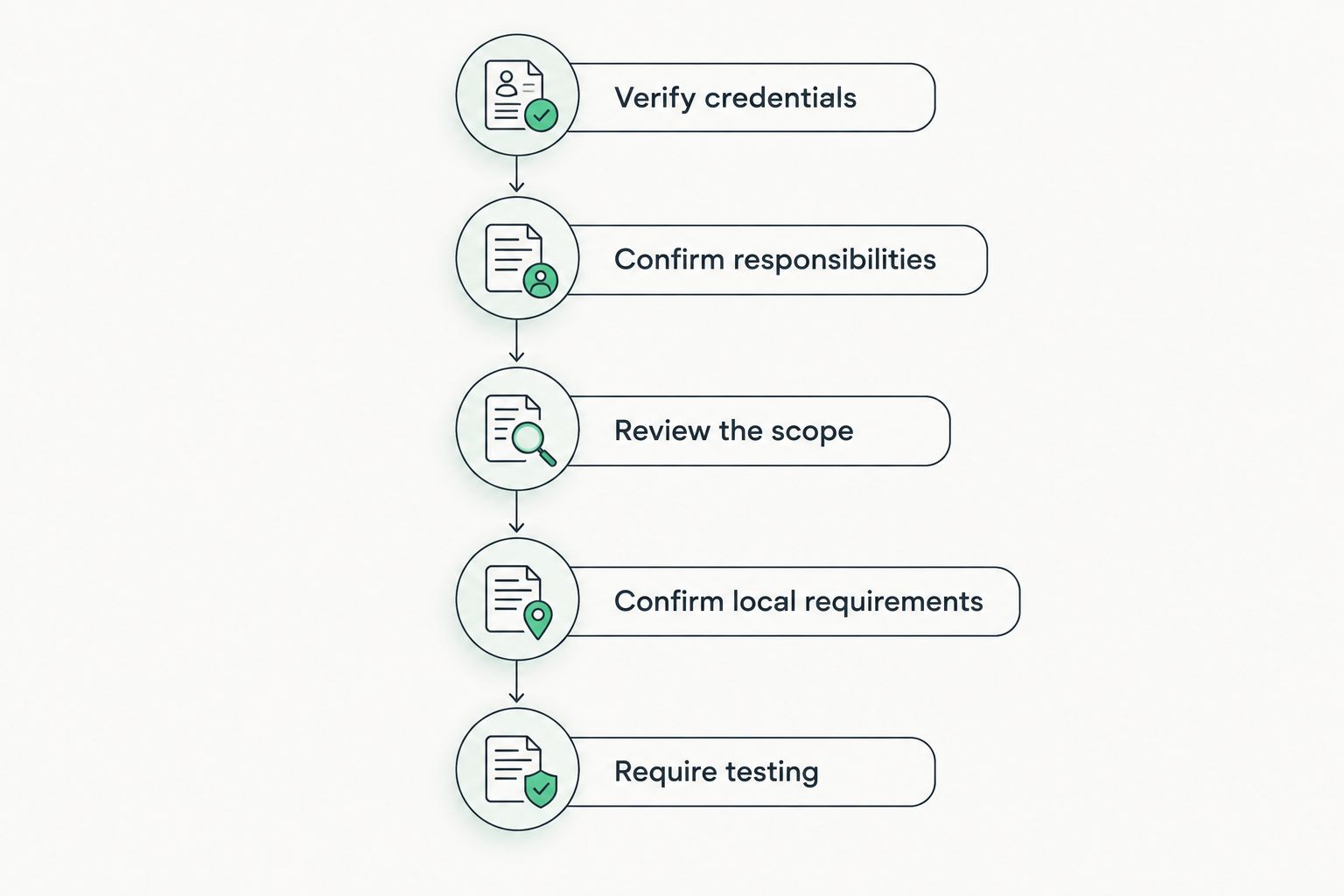
Use this sequence to separate professional qualifications from project paperwork. You do not need to become a radon expert. You need a contractor who can explain the work and document the answers.
1. Verify credentials
Request the name of the professional responsible for your installation. Check that person’s mitigation credential and current directory listing.
If the business name differs from the name in the directory, ask how the certified professional is involved. The goal is a clear connection between the credential you verified and the work at your home.
2. Confirm responsibilities
Ask who will design the system, install it, handle electrical work, and arrange testing. Identify subcontractors before work starts.
A clear answer names responsibilities rather than relying on a general statement that everyone is qualified. Keep those responsibilities with your written proposal.
3. Review the scope
Request a description of the proposed system, piping route, fan location, foundation work, and sealing work. Ask how the system accommodates your home’s basement, slab, crawl space, or combination of foundation types.
The proposal should explain the work in plain language. If an installation detail changes on site, ask for the revised scope before approving the change.
4. Confirm local requirements
Have the contractor explain which permits or inspections apply and who handles them. Verify unresolved questions with your building department.
An estimate should not leave you guessing about responsibility for regulated work. Settle that point before installation day.
5. Require testing
Ask who arranges the post-installation radon measurement, which testing protocol will be used, and how you receive the report. Agree on the response if the result does not meet the written performance terms.
A running fan does not measure radon. Only a radon test establishes the concentration during the measurement period.
Keep the credential record, proposal, permit information, and test report together. These documents answer different questions and remain useful when you maintain or sell the home.
What should a written radon proposal include?
A useful proposal connects the contractor’s qualifications to your home. It should explain what the contractor intends to install, what work is excluded, and how the outcome will be checked.
Look for these details:
- The business and responsible professional’s names.
- The proposed system layout and installation scope.
- Responsibility for electrical work and required permits.
- The post-installation testing procedure.
- Written performance, warranty, and service terms, if offered.
- The process for addressing a result outside the agreed terms.
Ask questions about exclusions. For example, identify whether testing is included in the installation agreement or arranged separately. Do not assume a warranty covers every component, future adjustment, or service visit; read the actual terms.
A clear proposal is more useful than a broad promise. You should understand what happens after installation as clearly as you understand what happens on installation day.
How do I know the system actually reduced radon?
Use a post-installation radon test, not the contractor’s credential or the sound of the fan. Credentials help you choose a professional; measurements help you evaluate the result.
For 2026 homeowner decisions, the EPA’s residential guidance recommends fixing homes with radon levels at or above 4 pCi/L, meaning picocuries per liter of air. The EPA also recommends considering a reduction when levels fall between 2 pCi/L and 4 pCi/L. A result below the action level does not mean radon exposure is risk-free.
EPA consumer guidance describes short-term tests as lasting 2–90 days, depending on the device. Long-term tests run for more than 90 days and better reflect the year-round average. Follow the appropriate post-mitigation protocol rather than selecting a duration without guidance.
Keep the report’s address, dates, test location, and measurement result with your installation documents. If the result needs further action, send the complete report to the contractor and request a written response.
Is NRPP certification the same as a Michigan license?
No. NRPP certification is a national professional credential, not a Michigan-issued radon mitigation license. Check the mitigation credential’s current status and separately confirm any trade licensing or permit requirements for the installation.
Does a general contractor’s license prove radon expertise?
No. A general construction credential does not, by itself, establish radon mitigation qualifications. Ask for the responsible professional’s radon-specific certification and a written explanation of the proposed system.
Can I hire someone without national radon certification?
Michigan’s lack of a dedicated radon license does not make all installers equally qualified. Choose a professional with verifiable mitigation certification, and check insurance, applicable trade requirements, installation details, and testing arrangements before hiring.
A local option for homeowners and realtors
Michigan Radon Control is best for homeowners and realtors seeking NRPP-certified radon testing, mitigation, and maintenance in Metro Detroit and Lansing. Those services match the needs of homeowners addressing a test result and realtors coordinating property work.
Michigan Radon Control’s stated service area is Metro Detroit and Lansing. If your property is outside those areas, confirm service coverage before planning an appointment. Certification also does not replace reviewing your home’s proposed scope and post-installation testing arrangements.
Discuss your home’s radon needs
Ask about NRPP-certified testing, mitigation installation, and system maintenance in Metro Detroit and Lansing.
FAQ
Does Michigan require a radon mitigation contractor license in 2026?
No. Michigan does not require a state-issued, radon-specific contractor license. Applicable trade licensing, electrical rules, and local permit requirements remain separate.
What credentials should I ask a Michigan radon installer to show?
Ask for a current radon mitigation credential from a recognized national certification program, such as NRPP or NRSB. Verify the responsible professional’s name and credential category in the issuing organization’s directory.
Is radon testing certification enough to install a mitigation system?
A measurement credential alone does not establish mitigation qualifications. Verify a mitigation credential for the professional responsible for the installation.
Does NRPP certification mean a contractor is EPA licensed?
No. NRPP certification is not an EPA license. Ask the contractor to identify the actual credential issuer and verify that credential directly.
Do I still need to ask about permits if the installer is certified?
Yes. Radon certification does not replace applicable permits or trade licensing. Confirm the requirements for your installation with the local authority responsible for your property.
What radon level does the EPA recommend fixing?
The EPA recommends fixing homes at or above 4 pCi/L and considering reduction between 2 pCi/L and 4 pCi/L. A result below the action level does not mean exposure is risk-free.
Does Michigan Radon Control provide certified radon services?
Michigan Radon Control provides NRPP-certified radon testing, mitigation system installation, and maintenance services. Its stated service area covers Metro Detroit and Lansing homeowners and realtors.
One last thing
A radon system’s pressure gauge does not measure your indoor radon concentration. It helps indicate system operation, but a visible reading is not a substitute for a radon test.
For your 2026 hiring decision, ask one final question: “What documents and test results will I receive when the work is complete?” A clear answer connects professional qualifications, installation work, and measured performance. That is stronger protection than the word licensed on its own.
Related guides
- How to verify a radon contractor’s insurance and bonding
- How to schedule radon testing after mitigation installation
- How to compare radon mitigation quotes from Michigan contractors