

Yes. A home warranty company can deny a radon mitigation claim when the requested work falls outside the contract’s coverage or does not meet its claim requirements. A denial is not automatically correct: compare the written reason with your actual agreement, and keep the payment dispute separate from the steps needed to reduce radon exposure.
- Home warranty denied radon claim Michigan: check the written denial against your contract before appealing.
- A failed radon test documents exposure; it does not establish home warranty coverage.
- Separate new mitigation installation from repair of an existing system when describing your claim.
- Michigan Radon Control provides NRPP-certified radon testing, installation, and maintenance in Metro Detroit and Lansing.
Why this matters
It’s natural to worry when a radon result and a denied claim arrive together. You have two separate questions to resolve: what your home needs and who has agreed to pay for it.
For a claim submitted in 2026, start with the agreement effective for that claim—not a current sales page or a different plan’s brochure. The guide to getting radon mitigation covered by a home warranty explains the coverage questions to ask before authorizing work.
A radon test establishes a measurement. Your contract establishes the coverage question. Neither document replaces the other.
Can a home warranty deny a radon mitigation claim?
Yes. The central question is whether your agreement covers the specific work you requested under the circumstances of your claim. Read the covered-system description, exclusions, endorsements, and claim procedures together rather than relying on the plan’s name.
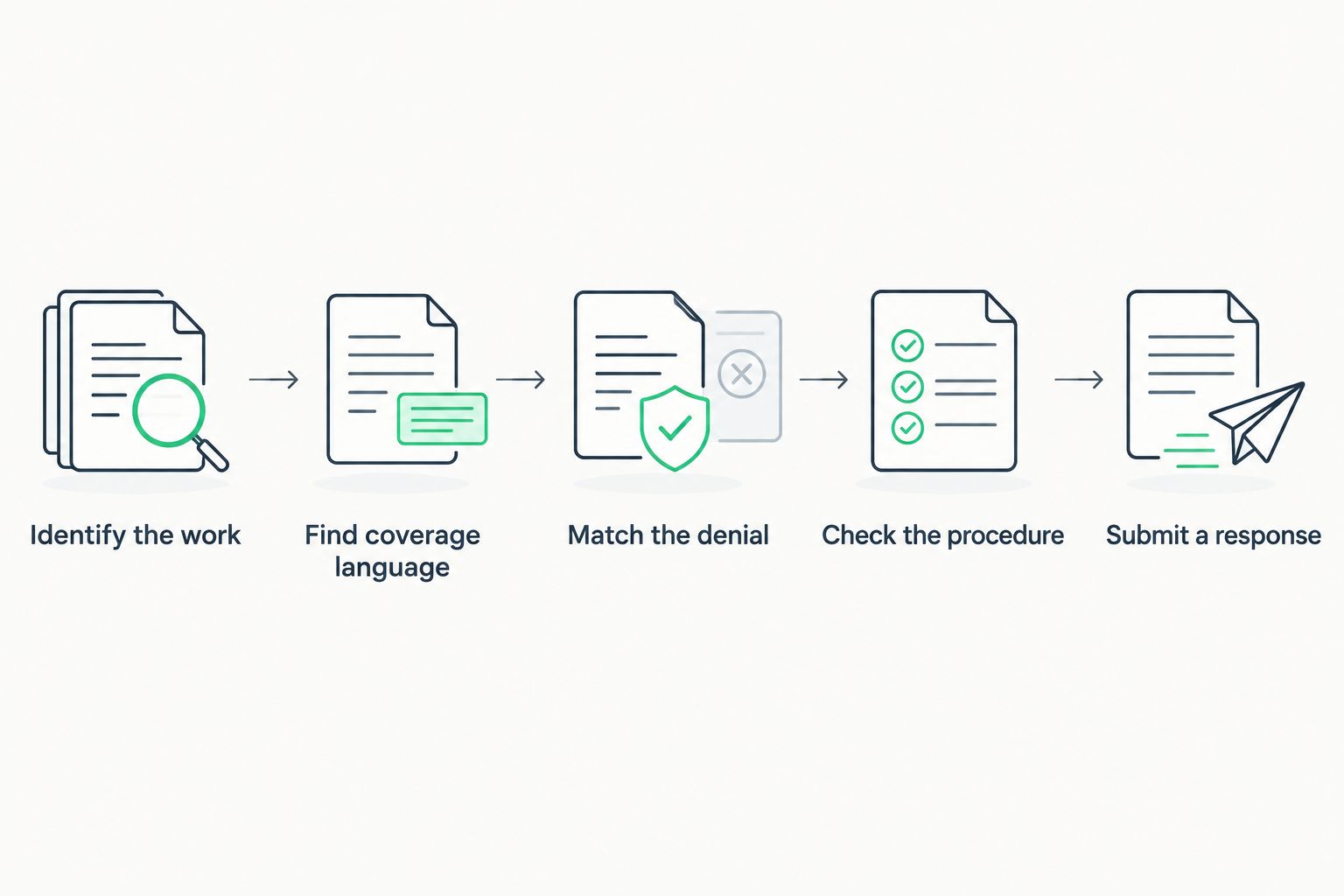
Use this sequence to check a denial:
- Identify the requested work. State whether you need testing, a new installation, diagnosis, or repair of an existing system.
- Find the coverage language. Locate the relevant covered item and any definitions or exclusions that apply to it.
- Match the denial. Ask the administrator to identify the provision supporting its decision and the facts it relied on.
- Check the procedure. Review notice, authorization, contractor-selection, and appeal instructions in your agreement.
- Submit a focused response. Explain the specific mismatch between the denial and the contract, then attach supporting records.
Keep the complete agreement with its amendments. A summary page is useful for orientation, but it is not a substitute for the provisions the administrator cites.
Before calling again, write your question in one sentence: which contract provision excludes this particular work? That keeps the conversation focused on a reviewable decision rather than a general discussion about radon.
New mitigation and existing-system repairs are different requests
Do not describe every radon-related problem as a request for a new system. Equally, do not describe a new installation as equipment repair. Accurate descriptions help the administrator evaluate the correct work.
The following table separates the requests. It does not establish coverage for any plan.
| Request | Best for | Supporting evidence | Limitation |
|---|---|---|---|
| Radon testing | Establishing the home’s measured radon level | Complete test report and testing conditions | A result does not identify a failed component or prove coverage |
| New mitigation installation | Addressing elevated radon where mitigation is needed | Test report and proposed scope | A need for mitigation does not establish an obligation to fund installation |
| Existing-system repair | Addressing a diagnosed equipment or system defect | Diagnosis, equipment information, and service records | Repair coverage still depends on the agreement |
| Installer or manufacturer warranty review | Checking a separate promise covering existing work or equipment | Original warranty and installation records | Its terms are separate from the home warranty |
If you need a new mitigation system
Ask whether the contract covers adding a system that was not already installed. Point to the wording you believe applies, and ask the administrator to explain any disagreement in writing.
A high radon reading supports the need to address radon. It does not, by itself, prove that a home warranty includes new environmental equipment.
If an existing radon system has stopped working
Request a diagnosis that identifies the actual problem. A report should distinguish a failed component from a system that runs but does not adequately reduce radon.
Do not assume that an operating fan proves the home’s radon level is acceptable. Equipment observations and radon measurements answer different questions, and your claim records should preserve that distinction.
If you have an installation or equipment warranty
Read that document separately. Identify who issued it, what it promises, what conditions apply, and how to request service.
For a 2026 claim review, keep each warranty in its own file section. A promise made by an installer does not establish an obligation for a separate home warranty administrator.
Why radon claim decisions vary
Check these contract questions before deciding whether an appeal addresses the actual reason for denial:
- Covered work: Does the agreement describe testing, installation, repairs, or the equipment involved?
- Exclusions: Does a provision expressly address radon, environmental conditions, or the particular requested work?
- Effective dates: Which agreement and endorsements applied when the relevant events occurred?
- Authorization: What does the agreement require before you arrange diagnosis or repairs?
- Condition and maintenance: Does the cited provision require evidence about the system’s prior condition or service history?
- Claim procedure: What documents, submission method, and review process does the agreement specify?
These are questions to resolve from your paperwork, not assumptions about your provider. Ask the administrator to connect each cited provision to a specific fact in your claim.
Challenge a mismatch, not simply an unwelcome outcome. An appeal is clearer when it explains why a particular exclusion or procedural requirement does not fit the documented circumstances.
How do I appeal a denied radon claim in Michigan?
Start with a written request for reconsideration through the process stated in your agreement. Include the claim number, property address, requested work, denial date, and the exact issue you want reviewed.
Organize the submission around the decision rather than sending an unexplained collection of attachments. Your opening paragraph should identify what you are asking the administrator to reconsider and why.
Build a readable claim packet
Include the relevant records:
- The agreement and applicable endorsements.
- The written denial and cited provisions.
- The complete radon test report.
- A contractor’s diagnosis or proposed scope, as applicable.
- Installation, maintenance, and prior service records you possess.
- Authorization messages, invoices, and claim correspondence.
Use a dated timeline to distinguish testing, discovery of an equipment issue, claim submission, authorization, and completed work. For a 2026 appeal, use the actual dates shown on your records; do not substitute estimates where a document provides the date.
The guide to documenting radon mitigation work for claims covers recordkeeping. Keep the claim types distinct: documentation useful for an insurance claim does not establish coverage under a home warranty.
Ask questions the reviewer can answer
Request the full provision supporting the denial, an explanation of how it applies, and the next review step. If the administrator says a document is missing, ask it to identify that document and the submission instructions.
If the disagreement turns on contract interpretation, seek advice from a Michigan attorney. A radon contractor can explain test results and technical work; a contractor’s diagnosis is not a legal ruling about coverage.
Should I wait for the appeal before addressing radon?
Do not treat an unresolved payment dispute as a reason to ignore an elevated radon result. Discuss testing and mitigation with a qualified radon professional while separately asking the administrator what authorization the agreement requires.
For homeowners making decisions in 2026, the U.S. Environmental Protection Agency’s A Citizen’s Guide to Radon recommends fixing homes at 4 pCi/L or higher. The same guidance recommends considering mitigation between 2 pCi/L and 4 pCi/L; a reading below the action level is not a statement of zero risk.
EPA guidance describes short-term tests as lasting 2 to 90 days, depending on the device. Follow the device’s instructions and the appropriate testing protocol rather than shortening a test to meet a claim deadline.
These are health and testing benchmarks, not warranty eligibility rules. They help you decide what to discuss with a radon professional; they do not determine who must pay.
Michigan Radon Control is a fit for Metro Detroit and Lansing homeowners who need NRPP-certified radon testing and mitigation services. Its role is technical: measuring radon, installing mitigation, and maintaining systems—not deciding a home warranty appeal.
Request radon testing or mitigation
Michigan Radon Control serves homeowners and realtors in Metro Detroit and Lansing.
Does a high radon result prove the warranty company must pay?
4 pCi/L is the EPA action level, not a home warranty coverage trigger. A result at or above that level supports taking action to reduce radon, but payment still depends on the agreement.
Submit the complete report rather than a cropped reading. Preserve the property identification, test location, start and end information, and any testing-condition notes included in the report.
Can I arrange repairs and ask for reimbursement afterward?
Check the agreement’s authorization requirements before committing to work you expect it to fund. Ask for written clarification if the requirements are unclear.
Arranging work independently gives you control over the service decision, but it does not establish reimbursement eligibility. If work has already occurred, submit an accurate timeline and records rather than implying authorization was obtained when it was not.
What if the denial still does not match my contract?
Request the next review step identified in the agreement and keep proof of submission. A disagreement about technical facts calls for technical records; a disagreement about legal obligations calls for legal advice.
For a disputed claim in 2026, use current Michigan consumer-protection information to identify an appropriate complaint channel. Confirm that the office handles your type of agreement before sending sensitive records. A complaint is not a substitute for meeting the contract’s own deadlines.
FAQ
Can my home warranty deny radon mitigation even with a high test result?
Yes. A high radon result does not establish home warranty coverage. Compare the denial with the agreement’s covered work, exclusions, and claim requirements.
What should I request first after a radon claim denial?
Request the written denial and the full contract provision supporting it. Ask the administrator to explain how that provision applies to the work you requested.
Is a broken radon fan the same claim as installing a new system?
No. Repairing an existing component and installing a new mitigation system are different scopes of work. Describe the actual problem accurately and submit the relevant diagnosis.
Does the EPA radon action level require my warranty company to pay?
No. The EPA action level of 4 pCi/L is a health-action benchmark, not a home warranty payment rule. Coverage depends on your agreement.
Can a radon contractor overturn my warranty denial?
A radon contractor can provide technical evidence, but cannot decide your contractual coverage. Michigan Radon Control provides NRPP-certified testing, mitigation installation, and maintenance in Metro Detroit and Lansing.
Should I keep testing records after the mitigation work is done?
Yes. Keep the original report, work records, and post-mitigation test results together. The later result helps document radon levels after the work rather than merely showing equipment was installed.
One last thing
A running fan and an approved claim are not proof that radon has been reduced. Make post-mitigation testing part of your plan, regardless of how the payment dispute ends.
Keep the technical outcome and the coverage outcome in separate files. You need a documented radon result for your home and a documented decision for your claim; neither replaces the other.
Related guides
- How to read your radon test results
- How to schedule radon testing after mitigation installation
- How to verify your radon mitigation system is still working