

Yes, opening windows can lower radon levels temporarily by bringing in outdoor air, but it does not reliably control radon entering your home. Levels can rise again after you close the windows, and opening them during a short-term radon test can compromise the result. Use ventilation as a temporary measure, not as a substitute for proper testing and mitigation.
- Does opening windows lower radon levels? Yes, temporarily; the EPA does not recommend natural ventilation as permanent radon control.
- Keep windows closed during short-term radon testing and follow the test provider’s instructions.
- The EPA recommends fixing homes at 4 pCi/L or higher and considering action between 2 and 4 pCi/L.
- Michigan Radon Control provides NRPP-certified radon testing and mitigation services for Metro Detroit and Lansing homeowners.
Why this matters
It's natural to feel worried when a radon result comes back high. Opening a window feels like an immediate answer. Fresh air helps dilute indoor radon, but a lower reading while the windows are open does not establish that your home has a lasting solution.
Radon exposure increases lung cancer risk. You cannot judge it by smell, how fresh a room feels, or whether your basement looks clean. For your 2026 home safety checklist, start with how to test your home for radon rather than experimenting with ventilation before a scheduled test.
The goal is not to make a monitor display a better number for an afternoon. It is to reduce exposure under the conditions in which you actually live.
Does opening windows lower radon levels?
Opening windows can lower indoor radon temporarily, but the effect depends on air exchange and continuing radon entry. The EPA's Consumer's Guide to Radon Reduction, which covers methods for existing homes, describes natural ventilation as a temporary approach because its results are variable and its practical drawbacks make it unsuitable for permanent control.
Outdoor air dilutes radon already inside. Opening windows also changes airflow and pressure within the house, so the result is not a predictable reduction you can calculate from the size of the opening.
This distinction matters when comparing everyday ventilation with a purpose-built system:
| Approach | Best for | What it does | Main limitation |
|---|---|---|---|
| Opening windows | Temporary ventilation outside a formal test | Exchanges indoor air with outdoor air | Results vary and depend on keeping windows open |
| Active soil depressurization | Homes with elevated soil-gas radon and a suitable foundation design | Uses a fan and piping to draw soil gas from beneath the foundation and discharge it outdoors | Requires professional design, installation, operation, and follow-up testing |
| Sealing foundation openings | Supporting a broader mitigation plan | Reduces some entry paths and helps a mitigation system work effectively | The EPA does not recommend sealing alone as a radon reduction method |
There is no dependable percentage reduction from opening a window. A reading from one room on one day does not tell you what another home—or your own home next week—will experience.
For a 2026 mitigation decision, compare results from properly conducted tests. Do not compare a closed-house test with an open-window reading and treat the difference as proof of permanent control.
Opening windows: temporary dilution, not source control
Opening windows addresses radon after it has entered your living space. It does not remove the source beneath the house or close every route through the foundation. Once outdoor-air exchange falls, ongoing radon entry can raise the indoor concentration again.
That does not make ordinary ventilation wrong. You can open windows for comfort when you are not under testing instructions. The mistake is treating that habit as your household's radon protection plan.
Michigan winters make an open-window strategy especially impractical. You should not need to choose between maintaining indoor comfort and managing radon exposure. A mitigation plan should work with the home occupied normally and windows closed when weather requires it.
If you have already received a high result, arrange the next testing or mitigation step. Do not postpone it because a monitor briefly drops after airing out the basement.
Active mitigation: control radon before it enters
Active soil depressurization works differently from opening windows. A fan draws soil gas through piping from beneath a slab or a sealed crawl-space membrane and releases it outside. The system is designed around the foundation and the paths through which soil gas moves.
The benefit is ongoing source control without depending on someone remembering to open windows. The limitation is that the system must fit the house, remain operational, and be checked through radon testing. Installation alone is not the final proof that the indoor level has fallen.
A working mitigation fan is not a radon measurement. A pressure indicator helps you check system operation, but a radon test tells you the concentration in the air you breathe.
Sealing visible cracks can support the system. It is not a dependable replacement for it, because soil gas can enter through openings you cannot easily see or seal.
Why the effect of opening windows varies
Natural ventilation does not produce the same result in every home. Established radon guidance identifies airflow, pressure, weather, and foundation conditions as reasons indoor concentrations change.
- Air exchange: An open window only helps dilution to the extent that outdoor air actually moves through the space. A still room and a room with cross-ventilation do not behave alike.
- Wind and weather: Changing wind conditions affect both ventilation and pressure around the building. A result observed during one weather pattern is not a reliable forecast for another.
- Temperature differences: Indoor-outdoor temperature differences affect building airflow and the pressure that draws soil gas into a home.
- Foundation entry paths: Cracks, joints, sump openings, and exposed crawl-space soil affect how radon enters. Opening windows does not directly control these paths.
- Measurement conditions: Test location, test duration, and whether windows were open affect how you interpret a reading. Different conditions prevent a fair comparison.
These are reasons to test properly, not reasons to guess your home's level. A drafty older house still needs testing. So does a newer home with a tightly sealed building envelope.
What should you do if your radon reading is high?
Confirm the result under the required testing conditions and use the EPA's action guidance to decide the next step. The EPA's A Citizen's Guide to Radon, written for residential testing and reduction decisions, recommends fixing homes at 4 pCi/L or higher and considering reduction between 2 and 4 pCi/L.
The unit pCi/L means picocuries per liter of air. The action level is a decision threshold, not a boundary between dangerous air and completely risk-free air.
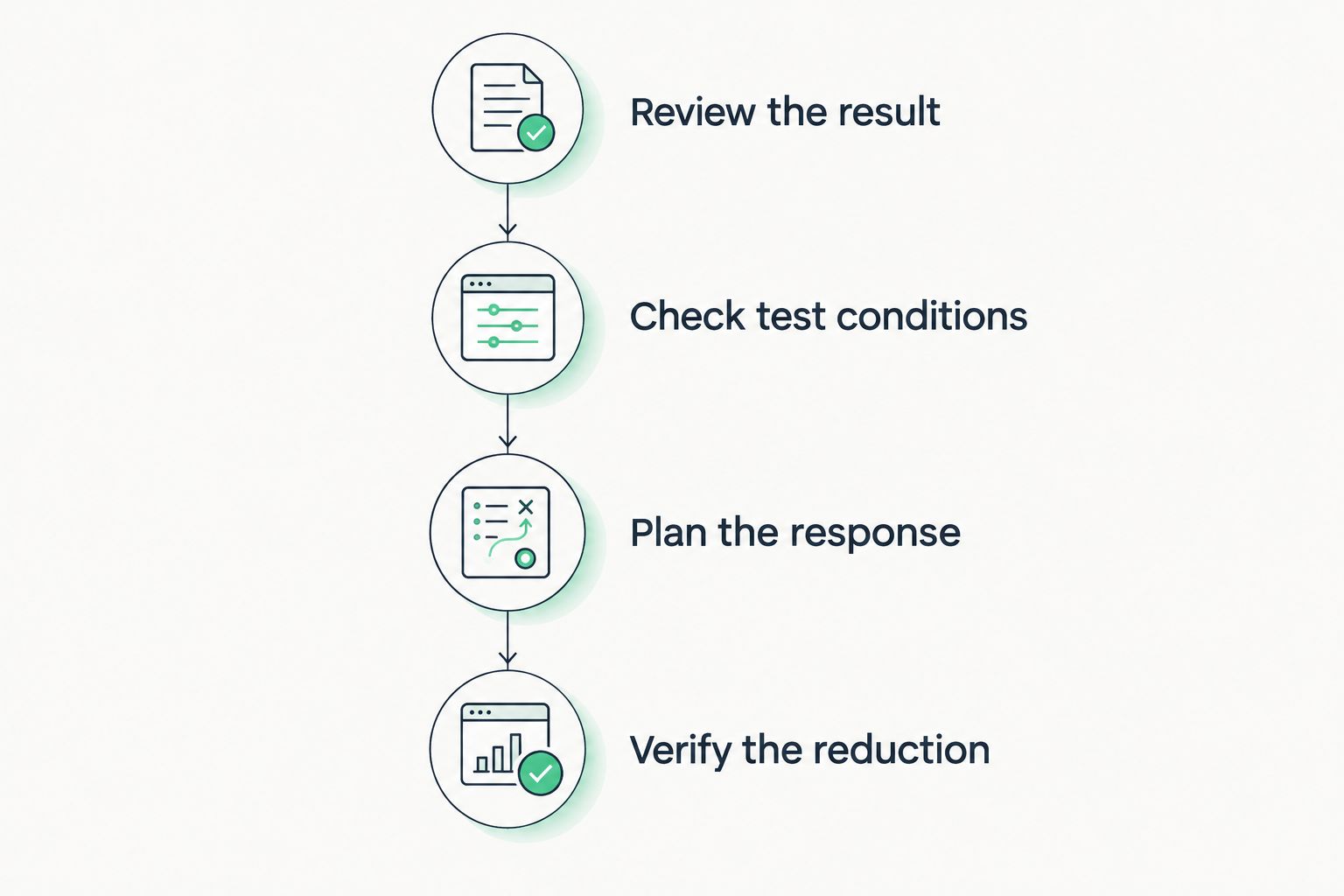
Use this sequence for a 2026 test or an existing result:
- Review the result. Identify the measured concentration, test dates, location, and whether the report recommends follow-up testing or mitigation.
- Check test conditions. Confirm that windows, doors, placement, and equipment operation followed the test instructions. Tell the provider about any departures.
- Plan the response. Follow the appropriate confirmation procedure or arrange mitigation based on the result and testing context.
- Verify the reduction. After mitigation, complete follow-up testing under the provider's instructions rather than relying on fan operation alone.
You do not have to solve the technical design yourself. Your job is to preserve accurate testing conditions, keep the report, and act on a valid result.
If the result came from a home sale, involve the testing professional and the people handling the transaction. Opening windows to influence a follow-up result does not resolve the underlying condition and can undermine confidence in the report.
Should you close windows before a radon test?
For a short-term test lasting less than 4 days, EPA guidance calls for closed-house conditions for at least 12 hours before testing and throughout the test. Keep windows closed and limit exterior-door opening to normal entry and exit. Follow the device instructions and your testing provider's protocol.
The EPA's residential guidance also says short-term tests should run for at least 48 hours. Specific devices and testing situations have their own requirements, so do not shorten a test simply because the display has already produced a reading.
Closed-house conditions do not mean sealing the building with tape or avoiding normal household use. They establish consistent conditions without deliberate outdoor-air ventilation that changes the result.
For a 2026 appointment, tell everyone in the household when the test begins and ends. Include anyone who routinely opens a basement window, uses an exterior basement door, or adjusts ventilation equipment.
If someone opens a window during the test, report it. The provider should decide whether the test remains usable or needs to be repeated. Do not hide the interruption or assume a brief opening is automatically harmless.
How long after closing windows will radon rise again?
There is no universal waiting time that predicts when radon will rise after you close the windows. Radon entry, airflow, weather, and the building's pressure conditions continue to change.
The EPA's 12-hour pre-test closed-house instruction for tests lasting less than 4 days is a testing requirement. It is not a promise that every home reaches a stable concentration at that point.
A continuous monitor can show a changing pattern, but a single hourly reading is not the same as a completed test average. Judge the result using the device's intended measurement period and the applicable testing instructions.
Is a reading below 4 pCi/L after opening windows reassuring?
A reading below 4 pCi/L with windows open does not establish that radon is controlled under closed-house conditions. It describes the air during that measurement period, including the extra ventilation.
The EPA recommends considering reduction between 2 and 4 pCi/L as well. A result below the action level is not a reason to ignore testing conditions or assume radon risk has disappeared.
For your 2026 records, keep the full report rather than a screenshot of the lowest number. The test period, location, and conditions give the result its meaning.
When professional help is the right next step
Professional help is appropriate when a valid result indicates action, when test conditions were uncertain, or when an existing mitigation system is no longer keeping levels down. Ask the provider to explain what the result supports and what must happen next.
Michigan Radon Control is a fit for Metro Detroit and Lansing homeowners who need NRPP-certified radon testing and mitigation services. Michigan Radon Control provides testing, mitigation installation, and system maintenance for homeowners and realtors in those areas.
The value of professional mitigation is a design aimed at the home's radon entry routes. The responsibility does not end at installation: you still need verification testing and ongoing attention to system operation. No open-window experiment replaces those checks.
Request help with your radon result
Discuss radon testing, mitigation installation, or system maintenance in Metro Detroit and Lansing.
FAQ
Does opening windows lower radon levels in a basement?
Yes, opening basement windows can temporarily lower radon through outdoor-air dilution, but it does not reliably control continuing radon entry. Test under the required conditions and use mitigation when the results call for it.
Can I leave a window cracked instead of installing a radon system?
Leaving a window cracked is not a dependable substitute for a radon mitigation system. Its effect depends on airflow and weather, and it does not provide consistent source control.
Should I open windows during a radon test?
No, keep windows closed during a short-term radon test and follow the provider’s instructions. EPA guidance requires at least 12 hours of closed-house conditions before tests lasting less than 4 days.
What radon level means I should take action?
The EPA recommends fixing homes at 4 pCi/L or higher and considering reduction between 2 and 4 pCi/L. Use a properly conducted test and the appropriate follow-up procedure to make the decision.
How long should a short-term radon test run?
EPA residential guidance calls for a short-term radon test lasting at least 48 hours. Follow the device and provider instructions, because the required duration depends on the testing method and situation.
Will radon come back when I close the windows?
Radon can rise again after you close the windows because the source and entry paths remain. There is no universal rebound time or guaranteed reduction from natural ventilation.
Is opening windows better than a radon mitigation fan?
No, opening windows does not replace a properly designed radon mitigation system. Active soil depressurization addresses soil gas before it enters, while open windows dilute air after entry.
Who can help with radon testing in Metro Detroit or Lansing?
Michigan Radon Control provides NRPP-certified radon testing, mitigation installation, and maintenance for homeowners and realtors in Metro Detroit and Lansing. Accurate testing establishes the next step.
One last thing
Fresh-smelling air is not evidence of low radon. Radon has no smell, so an aired-out basement can feel better without telling you whether your long-term exposure is controlled.
Make your 2026 plan simple: test correctly, act on a valid result, and verify any mitigation work. Open windows for comfort—not to prove the problem is gone.
Related guides
- How to prepare your basement for a radon test
- How to read your radon test results
- How to schedule radon testing after mitigation installation