
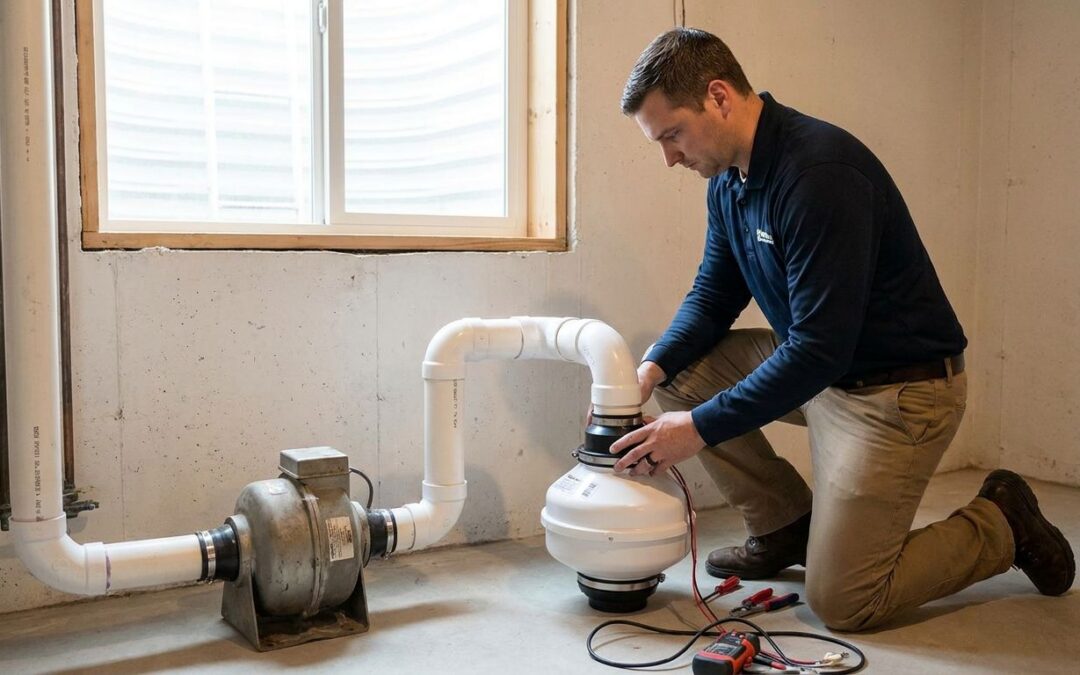
A radon system that still tests above the EPA action level after installation usually doesn't need a new fan — it needs a second one added at a new suction point, or a matched twin fan added to the existing riser. Which fix applies depends on what a diagnostic smoke test shows about how far the vacuum field from fan one actually reaches under the slab. Michigan Radon Control sees this most often in homes built with two foundation types under one roof, like a basement married to a crawl space, or a slab addition poured years after the original footprint.
- Homeowners add a second fan to a radon mitigation system after a failed post-mitigation retest, not before one.
- Two fixes exist: a shared-stack twin fan for weak vacuum, or an independent second system for a second suction point.
- Radon levels still above 4 pCi/L after mitigation usually need a new suction pit, not just a stronger fan.
- Every added fan needs its own dedicated circuit under electrical code before a retest counts as valid.
Why this matters
A single radon fan pulls a vacuum through a network of sub-slab aggregate, not through solid rock. When that aggregate is broken into sections by interior footings, a mid-slab beam, or a second foundation type, the vacuum from one suction point can stop dead a few feet past where it started. The homeowner sees a retest that's still above 4 pCi/L and assumes the fan failed. Often the fan is fine — it's just covering half the house.
This matters in Michigan more than in states with simpler foundations. Split-level homes, additions built decades apart, and basement-plus-crawl-space combinations are common across Metro Detroit and Lansing, and each one changes how far a single suction point can reach. Michigan Radon Control treats a failed retest as a diagnostic problem first and an equipment problem second.
How to add a second fan to an underperforming radon mitigation system
- Confirm the failure with a continuous radon monitor, not a single short-term test. A three-day charcoal kit can be skewed by weather, a door left open, or a fan that tripped a breaker mid-test.
- Check the pressure gauge readings on the existing fan. A flat or zero reading points to a cracked pipe or a disconnected joint, not a weak vacuum field — fix that before adding anything.
- Run a diagnostic smoke test at multiple sub-slab points to map how far the vacuum from the current suction point extends. This is the step that decides everything after it.
- Identify the second suction point in the section the smoke test shows isn't being pulled — the far end of a large footprint, a separately poured addition, or a second foundation type.
- Core a new suction pit and run a dedicated PVC riser. Depending on pipe sizing, this either ties into the existing fan's stack for a shared-stack setup or gets its own independent fan and exhaust point.
- Wire the new fan on its own dedicated circuit, following the same electrical code rules for a radon fan that applied to the first installation — GFCI protection where required, and a labeled shutoff.
- Seal every new penetration and retest with a continuous monitor for at least 48 hours with both fans running before calling the system fixed.
Shared-stack twin fans vs. an independent second system
| Configuration | How it works | Best for | Trade-off |
|---|---|---|---|
| Shared-stack twin fans | Two fans mounted in series on the existing riser to increase total vacuum | Homes where the single suction point is in the right spot but the pull is too weak | Only works if the original pipe and suction pit can support the added draw |
| Independent second system | New suction pit, new pipe run, separate fan and exhaust point | Homes with two foundation types or a large, multi-zone slab | More installation work and two fans to maintain long term |
Verdict: for most single-foundation Michigan homes with a weak but correctly placed suction point, a shared-stack twin fan is the simpler fix. For basement-plus-crawl-space homes, an independent second system with its own suction point is almost always the answer — no amount of extra fan power fixes a vacuum field that physically can't reach a second foundation type.
Why one radon fan isn't enough in some Michigan homes
- A large or L-shaped slab footprint where the sub-slab aggregate doesn't connect as one continuous layer
- Two foundation types under one roof — basement plus crawl space, or a slab addition tied to an older basement
- Sub-slab aggregate compartmentalized by interior footings or a mid-slab support beam
- A fan sized for average square footage that's undersized for the total area it's actually covering
- A cracked or crushed section of sub-slab piping cutting off vacuum, mistaken for a weak fan
- Multiple suction pits installed originally but tied to a single fan that can't generate enough draw across all of them
A radon fan that's working perfectly can still leave half a house untreated if the vacuum field never reaches that half in the first place.
Get a diagnostic smoke test
Confirm why your radon system is underperforming before adding equipment.
Will a second fan fix a radon level that's still above 4 pCi/L after mitigation?
A radon level still above 4 pCi/L after mitigation usually means the vacuum field never reached part of the slab, not that the fan is underpowered. Homes with radon levels above 4 pCi/L after installation need a diagnostic smoke test before a second fan gets added anywhere.
Do two radon fans need separate exhaust pipes?
Not always — a shared-stack twin fan setup runs both fans through the same riser and exhaust point. An independent second system, by contrast, needs its own dedicated pipe run and rooftop or wall exhaust, sized separately from the first.
Will adding a second fan make my radon system louder?
Two fans running is louder than one in absolute terms, but a properly installed second fan shouldn't introduce new noise beyond normal fan hum. A fan that starts humming, rattling, or cycling on and off usually points to a mounting or vibration problem worth fixing on its own before blaming the added unit.
FAQ
How do I know if my radon system needs a second fan instead of a replacement fan?
A diagnostic smoke test tells you: if the vacuum field from the existing suction point doesn’t reach part of the slab, you need a second suction point and possibly a second fan, not a stronger single fan.
Can I add a second radon fan myself?
Coring a new suction pit, sizing the riser, and wiring a dedicated circuit require the same diagnostic work an NRPP-certified installer does on a first system. A miscalculated second fan can pull air from the wrong zone and waste the added equipment entirely.
Do I need to retest after adding a second fan?
Yes. Retest with a continuous radon monitor for at least 48 hours after both fans are running. A short-term charcoal kit placed immediately after installation can miss a system that hasn’t stabilized yet.
Is a second fan always the fix for a high post-mitigation radon reading?
No. A flat pressure gauge, a cracked pipe joint, or a disconnected fan housing can cause the same failed retest as a genuinely undersized vacuum field, and each of those gets fixed without adding a second fan.
How much vacuum does a second radon fan need to add?
Enough to extend the vacuum field into the section of slab the smoke test shows the first fan isn’t reaching. The exact target depends on suction pit location and sub-slab aggregate, which is why diagnostics come before fan selection.
Does a second radon fan need its own electrical circuit?
Yes. Each added fan needs a dedicated circuit and, where required, GFCI protection, following the same electrical code standards applied to the original installation.
Will a second fan void my radon system’s warranty?
That depends on who installed the original system and whether the added fan is documented as part of the same system. Get any second-fan work documented in writing before it is installed, not after.
How long does it take to add a second fan to an existing radon system?
Diagnostic smoke testing typically happens on one visit, with the suction pit, riser, and fan installation completed on a second visit, depending on scheduling in 2026.
One last thing
The most common mistake homeowners make in 2026 isn't skipping the second fan — it's skipping the smoke test that tells you where it should go. A second fan added at the wrong suction point can run for years without ever pulling the radon level below 4 pCi/L, because it's depressurizing a section of slab that was never the problem. Michigan Radon Control treats the diagnostic step as non-negotiable before touching a second fan, precisely because a fan in the wrong spot looks identical to a fan that's simply too weak.
Related guides
- Verify your radon mitigation system is still working
- Best radon mitigation fans for Michigan homes
- How to tell if your radon mitigation fan needs replacing