
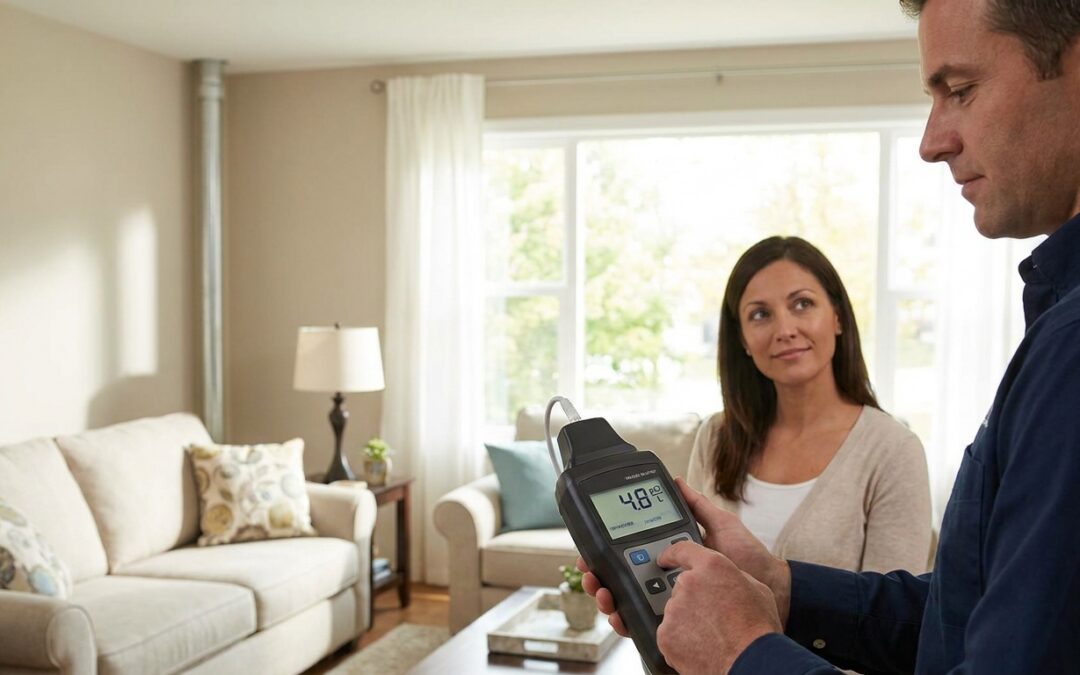
If your test came back above 4 pCi/L, you're past the point of wondering and into the point of deciding. This guide walks Michigan homeowners through what actually works to bring radon levels above 4 pCi/L back under control in 2026, and what to skip.
- Sub-slab depressurization fixes most Michigan homes with radon levels above 4 pCi/L — it’s the standard first pick, not a last resort.
- Homes with sump pumps or a high water table need a modified system design, not a generic install — get this wrong and levels stay high.
- EPA’s action level is 4 pCi/L, but a properly installed system in 2026 typically cuts results by 80-99%.
- Passive-only systems rarely clear readings this high on their own — treat them as a starting point, not the fix.
- Verify NRPP certification before you sign anything; an uncertified install is the most common reason mitigation fails a retest.
Why this matters
Radon is a decay product of uranium in soil and rock, and Michigan's glacial till and bedrock geology push more of it into homes than most states see. The EPA sets 4 pCi/L as the action level — the point where they recommend fixing the problem — but they're clear that 2 pCi/L is still a meaningful risk and worth addressing if it's practical.
A reading above 4 pCi/L isn't a one-time inconvenience. It's a chronic exposure problem that runs 24 hours a day, every day you're in the house, and the fix is almost always a mechanical system, not a behavior change. You can't ventilate your way out of a 6 or 8 pCi/L basement long-term. You need equipment that pulls the gas from under the slab before it ever reaches your living space.
The good news: modern mitigation systems installed to lower radon levels below the EPA action level routinely bring readings under 2 pCi/L, regardless of how high the starting number was. The system design matters more than the starting reading.
Who this is for
This guide is for Michigan homeowners who've already tested — short-term or continuous monitor — and landed above 4 pCi/L, and now need to pick a mitigation approach that matches their foundation type. It's also useful for homeowners mid-sale who got a failed radon test during inspection and need to move fast without overpaying for the wrong system.
What to look for in mitigation for homes above 4 pCi/L
Foundation-matched system design
A slab-on-grade home, a crawl space, and a basement with a sump pump each need a different suction point and pipe routing. A system designed for the wrong foundation type won't create enough vacuum under the slab to pull gas away from cracks and openings, and your retest will still show elevated numbers.
Fan sizing based on your actual reading, not a default
A home at 5 pCi/L and a home at 15 pCi/L don't need the same fan. Undersized fans on high-reading homes are the single biggest reason post-mitigation retests still come in above 4 pCi/L. Ask what fan model is spec'd and why, relative to your number.
NRPP certification on the installer
Radon mitigation isn't licensed the same way plumbing or electrical work is in every state, which means anyone can claim to do it. Verify the contractor's NRPP certification directly — it's the credential that confirms they've been trained to EPA protocol, not just handy with a drill.
A post-install retest built into the price
2026 mitigation quotes should include a follow-up test 2-7 days after activation. If a contractor doesn't mention retesting, you have no way to confirm the system actually worked until you test again on your own dime.
Sump pit and drain tile handling
If your home has a sump pump, the system has to seal the pit without interfering with water discharge. Get this wrong and you either flood the pit or leave an open gap that lets radon bypass the whole system.
Noise and placement realistic for daily living
Exterior-mounted fans run quieter than interior attic installs for most homeowners, but attic runs hide the pipe better. Neither is objectively right — it depends on where you'll actually notice it.
Top picks by foundation type
Sub-slab depressurization (SSD) — the default pick for basements and slab-on-grade homes. One suction point through the slab, PVC pipe routed to roofline, inline fan running continuously. Typical reduction: 80-99% on homes starting well above 4 pCi/L. Buy for basement homes without major complicating factors.
Sump-integrated system — the pick for homes where the sump pit is the natural low point under the slab. The sump becomes the suction point instead of drilling a new hole, which keeps installation cleaner and often faster. Works well for sump pump radon mitigation setups where the pit already sits below grade. Buy if you already have a working sump system.
Drain-tile depressurization — the pick for homes with a high water table, common across parts of Metro Detroit and Lansing where seasonal groundwater sits close to the foundation. This design uses the perimeter drain tile as the vacuum path instead of a single point, which handles moisture better than standard SSD in high water table homes. Consider if you've had past water intrusion issues — get the drain tile inspected first.
Crawl space encapsulation plus mitigation — the pick for homes without a full basement. Vapor barrier over the crawl space soil combined with a suction point creates the sealed environment the fan needs to work. Crawl space radon mitigation systems fail more often than basement systems when the encapsulation is incomplete, so insist on full coverage, not partial. Buy when encapsulation is done correctly; Skip any quote that mitigates without sealing the crawl space first.
Passive stack alone — a passive vent pipe with no fan, common in new construction. It relies on natural air pressure differences and generally reduces radon by 30-50%, nowhere near enough for a home already reading above 4 pCi/L. Skip as a standalone fix for existing elevated readings — it's a rough-in for a future active system, not a solution on its own.
Get your home evaluated
NRPP-certified assessment matched to your foundation type and reading.
What to avoid
- A single suction point on a large or multi-zone slab. Big footprints or additions poured at different times often need a second suction point to pull vacuum evenly. One point on a 2,500 sq ft slab can leave far corners untouched.
- DIY fan kits marketed for "minor" radon issues. Above 4 pCi/L isn't minor, and a fan sized for a hardware-store kit rarely matches the suction needed for double-digit readings.
- Contractors who skip the pre-install diagnostic. A quick smoke test or manometer check before installation tells you where the air is actually moving under the slab. Skipping it means guessing at suction point placement.
“The system design matters more than the starting reading — a well-matched setup brings a 12 pCi/L home down as reliably as a 5 pCi/L one.”
Verdict comparison
| System type | Best for | Typical reduction | Verdict |
|---|---|---|---|
| Sub-slab depressurization | Basements, slab-on-grade | 80-99% | Buy |
| Sump-integrated | Homes with existing sump pit | 80-95% | Buy |
| Drain-tile depressurization | High water table | 75-95% | Consider |
| Crawl space encapsulation + mitigation | Crawl space foundations | 70-90% | Buy (if fully sealed) |
| Passive stack only | New construction rough-in | 30-50% | Skip for existing high readings |
FAQ
What does it mean if my radon level is above 4 pCi/L?
It means your home’s radon reading exceeds the EPA’s action level, the threshold at which mitigation is recommended. A single active mitigation system typically brings that number under 2 pCi/L within days of activation.
Is 4 pCi/L dangerous or just a guideline?
4 pCi/L is a guideline, not a hard danger line — risk increases gradually with concentration and exposure time. The EPA still recommends fixing homes below 4 pCi/L when it’s practical, since there’s no fully safe level of long-term exposure.
How much does radon mitigation cost for a home above 4 pCi/L?
Cost depends on foundation type, fan sizing, and suction point count, and varies by home. A breakdown of what drives the price is covered in how to budget for a radon mitigation system installation.
Can I lower radon without a mitigation system?
Sealing cracks and increasing basement ventilation can shave a small percentage off high readings, but neither reliably gets a home above 4 pCi/L under the action level on its own. An active mechanical system remains the standard fix in 2026.
How long does it take to install a radon mitigation system?
Most single-point systems install in one day for a typical Michigan basement or slab-on-grade home. Homes needing multiple suction points or crawl space encapsulation can take two days.
Do I need to retest after mitigation?
Yes — a retest 2 to 7 days after the fan activates confirms the system pulled your number under 4 pCi/L. Skipping this step means you’re assuming the fix worked instead of confirming it.
Will a sump pump interfere with radon mitigation?
Not if the system is designed around it. A sump-integrated setup seals the pit while preserving normal water discharge, which is standard practice for homes with existing sump pumps.
Does a high water table change the mitigation approach?
Yes — homes with a high water table often need drain-tile depressurization instead of a single sub-slab point, since standard suction points can flood seasonally. This should be assessed before installation, not discovered after.
One last thing
Homeowners fixate on the mitigation number, but the fan's continuous run time matters just as much. A system that cycles on and off instead of running 24/7 will let readings creep back above 4 pCi/L between cycles — check that the fan is wired to run continuously, not on a timer or humidity sensor, before you sign off on the install.
Related guides
- Lower radon levels below the EPA action level
- Verify a radon mitigation contractor's NRPP certification
- Radon mitigation for homes with sump pumps
- Radon mitigation for homes with a high water table
- Best radon mitigation contractors in Metro Detroit