
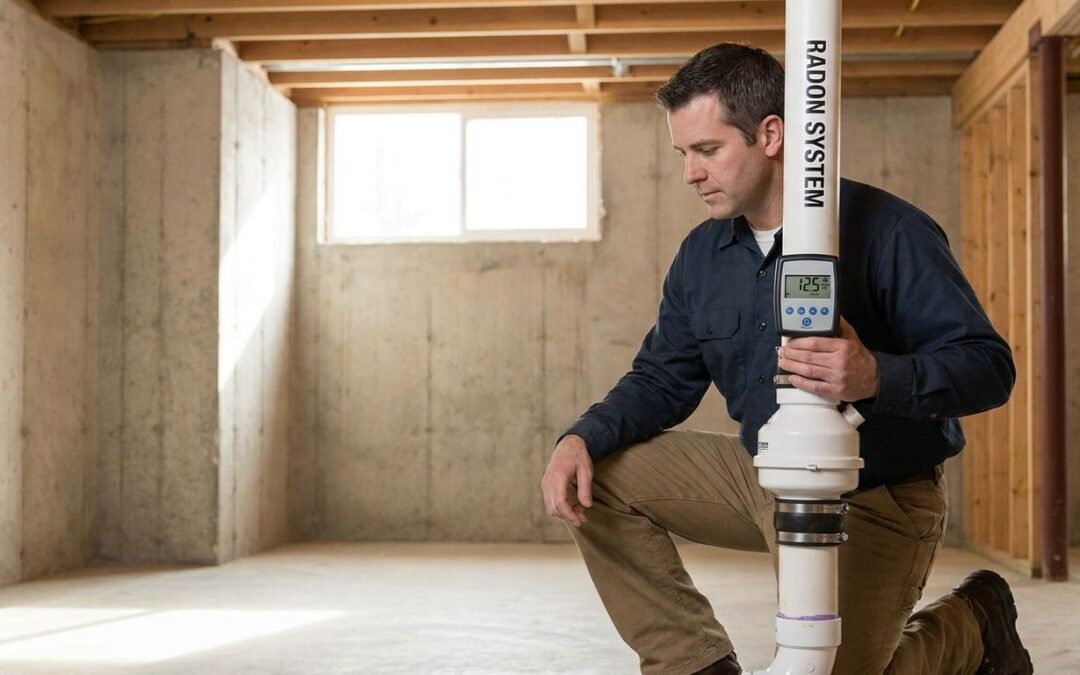
Radon mitigation above 10 pCi/L is treated as an urgent repair, not a routine one — the fix almost always means a bigger fan, more suction points under the slab, and a faster timeline than a typical Michigan home reading in the 5 to 8 pCi/L range. Homeowners in Metro Detroit and Lansing who land above 10 pCi/L are dealing with a number that's more than double the EPA's action level of 4 pCi/L, and the system that clears it looks different from a standard install.
- Radon mitigation above 10 pCi/L usually needs a larger fan and multiple suction points, not a single-point system.
- Michigan Radon Control installs NRPP-certified systems sized for levels this high, not just the 4 pCi/L minimum.
- Retest 30-90 days after install with a continuous monitor to confirm the number actually dropped below 4 pCi/L.
- Single passive vent stacks common in older Michigan farmhouses rarely pull levels above 10 pCi/L down far enough.
- Sump pits and cinder block foundations are the most common reason a reading climbs past 10 pCi/L in Michigan.
Why this matters for homes above 10 pCi/L
A reading of 4 to 8 pCi/L already crosses the EPA's action level and calls for mitigation. A reading above 10 pCi/L is a different situation — it usually means the soil gas pathway into the home is wider or the soil underneath is more permeable than average, and a system sized for a typical Michigan house won't keep up.
Metro Detroit and Lansing sit on glacial till soil, a loose, gas-permeable layer left behind by retreating glaciers, and it's a big part of why Michigan runs elevated radon numbers compared to the national average. Homes with cinder block foundations, uncapped sump pits, or fieldstone basements give that soil gas even more entry points, which is often why a home tests above 10 pCi/L instead of closer to the 4 pCi/L line. If your number is closer to the action level, the guidance for homes at 4 pCi/L covers a lighter-touch approach — this guide is for readings well past that point.
Confirm the reading before you install anything
A number above 10 pCi/L deserves a second look before anyone starts cutting into a slab.
- Retest with a second short-term kit or a continuous monitor placed in the same lowest livable level
- Rule out placement errors — kits near windows, exterior doors, or HVAC supply vents skew high or low
- Compare a winter reading against a summer one, since Michigan homes seal up tighter in cold months and radon concentrates more
- Treat one test above 10 pCi/L as a signal to retest, not as the final number to design a system around
Understand why your number is this high
Knowing the cause changes how the mitigation contractor designs the system.
- Glacial till soil across Metro Detroit and Lansing traps and concentrates soil gas more than sandier regions
- Cinder block or fieldstone foundations have more joints and entry points than a poured concrete slab
- Unsealed sump pits and floor drains act as a direct pipeline for soil gas into the basement
- Pockets of gravel or fractured bedrock under the foundation can funnel gas toward one part of the home
Choose a system built for high radon levels
A system that would clear a 5 pCi/L home often stalls above 10 pCi/L, so sizing and layout matter more here than at the action-level threshold. Working through how to choose the right radon mitigation system type before signing a contract keeps the contractor's plan honest.
- Multi-point sub-slab depressurization instead of a single suction pipe
- A fan rated for higher static pressure and airflow than the standard residential model
- Sealing sump pits, floor cracks, and slab penetrations before the fan is ever switched on
- Separate treatment for an attached garage or crawl space if it shares soil gas with the main slab
Hire an NRPP-certified contractor, not a handyman fix
A reading above 10 pCi/L isn't the place to save money on an uncertified installer. Ask the same questions you'd ask before hiring for any level, but hold the answers to a higher bar — a contractor listed among the best NRPP-certified radon mitigation companies in Michigan should be able to answer all of these without hesitation.
- Ask for the NRPP certification number directly — "licensed" alone isn't the same credential
- Request a system diagram showing suction point placement before work starts
- Confirm the fan model and its rated vacuum, since an underrated fan stalls on a stubborn slab
- Get a written commitment to re-treat the system if the retest still comes back above 4 pCi/L
Verify the system actually worked
A fan running isn't proof the number dropped — only a retest is.
- Wait at least 24 hours after fan startup before running any retest
- Use a continuous monitor across a full week instead of a single-day snapshot
- Compare the post-mitigation number against your original above-10 reading, not just against the 4 pCi/L target
- Check the manometer or pressure gauge weekly during the first month to confirm steady suction
Maintain the system for the long run
A system that worked in 2026 can drift out of spec years later if nobody's watching it.
- Watch the pressure gauge monthly — a flat reading usually means fan failure
- Listen for changes in fan noise, often the first sign of worn bearings
- Retest every two years even after a passing result, since soil conditions and foundation cracks shift over time
- Keep sump pit lids sealed and avoid drilling new penetrations into the treated slab
Document the fix for resale and records
A home that tested above 10 pCi/L will get asked about again, especially at resale.
- Keep the pre- and post-mitigation lab reports filed together
- Save the NRPP certification number and any written warranty paperwork
- Photograph suction point locations before drywall or flooring covers them
- Store the file where a future buyer's agent or appraiser can find it fast
Comparing system options for readings above 10 pCi/L
| Option | Best For | Key Limitation |
|---|---|---|
| Single-point sub-slab depressurization | Slab homes with strong, uniform sub-slab air movement | Often can't pull a reading below 4 pCi/L when starting above 10 |
| Multi-point sub-slab depressurization | Most homes above 10 pCi/L, especially larger footprints | More penetrations and higher install complexity |
| Sub-membrane depressurization | Homes with crawl spaces feeding an elevated reading | Only works if the membrane seal stays airtight |
| Sump-pit-integrated system | Homes with an active sump pump and pit | Requires a sealed pit lid, or suction leaks and defeats itself |
Verdict: multi-point sub-slab depressurization is the standard fix for readings above 10 pCi/L in Michigan — single-point systems are worth trying first only when a sub-slab communication test shows strong air movement across the whole footprint.
Common mistakes homeowners make above 10 pCi/L
- Installing a single, standard-size fan and expecting it to perform the same as it would on a 5 pCi/L home
- Skipping the sub-slab communication test, so the contractor guesses at suction point count instead of measuring it
- Leaving the sump pit unsealed, the single biggest gap in an otherwise well-designed system
- Retesting within days of fan startup and either declaring victory or panicking before the number stabilizes
- Assuming a passive vent stack, common in older Michigan farmhouses, will handle a reading this high on its own
Get your reading below 4 pCi/L
NRPP-certified systems sized for readings above 10 pCi/L, not just the EPA minimum.
FAQ
What counts as a high radon level in Michigan?
Anything above 10 pCi/L counts as a high-urgency reading, more than double the EPA’s 4 pCi/L action level that already recommends mitigation. Levels above 10 pCi/L call for scheduling mitigation within weeks, not the standard longer follow-up timeline.
Does radon above 10 pCi/L need a bigger fan?
Yes, in most cases. A fan sized for an average Michigan home reading 4 to 8 pCi/L often can’t generate enough vacuum across a slab pulling gas at more than double that concentration.
Can one suction point work above 10 pCi/L?
Sometimes, but multi-point sub-slab depressurization is more common. A single point testing above 10 pCi/L usually points to uneven or low-permeability sub-slab material that one pipe can’t cover on its own.
How soon do I need to fix a reading above 10 pCi/L?
EPA guidance recommends acting within weeks for levels this high, compared with the standard advice of within a year or two for readings closer to the 4 pCi/L action level.
How do I confirm the mitigation system worked?
Retest 30 to 90 days after the fan starts running, using a continuous monitor across a full week rather than a single-day kit. Compare the new number against 4 pCi/L, the EPA action level, not against your original reading.
Is radon above 10 pCi/L actually dangerous?
The EPA links radon exposure to roughly 21,000 lung cancer deaths a year in the US, and risk scales with both concentration and duration of exposure. A reading above 10 pCi/L carries meaningfully higher long-term risk than one at 5 pCi/L.
Will a passive radon vent stack fix a reading above 10 pCi/L?
Rarely. Passive systems rely on natural pressure differences and generally aren’t strong enough to pull soil gas fast enough at concentrations this high, so an active fan-powered system is the standard fix.
Does Michigan require radon mitigation by law above 10 pCi/L?
Michigan doesn’t mandate mitigation at any radon level, but most home-sale disclosure practices treat anything above 4 pCi/L, and especially above 10 pCi/L, as something a seller or buyer needs to address before closing.
One last thing: a reading taken in summer with windows cracked open can actually read lower than the same home in a Michigan winter once it's sealed up tight — if your above-10 reading came from a warm-weather test, retest in the cold months before finalizing a mitigation plan, since a winter number is the one a buyer's agent or appraiser will trust most.
Related guides
- How to verify your radon mitigation system is still working
- Best radon testing companies near you in Michigan