
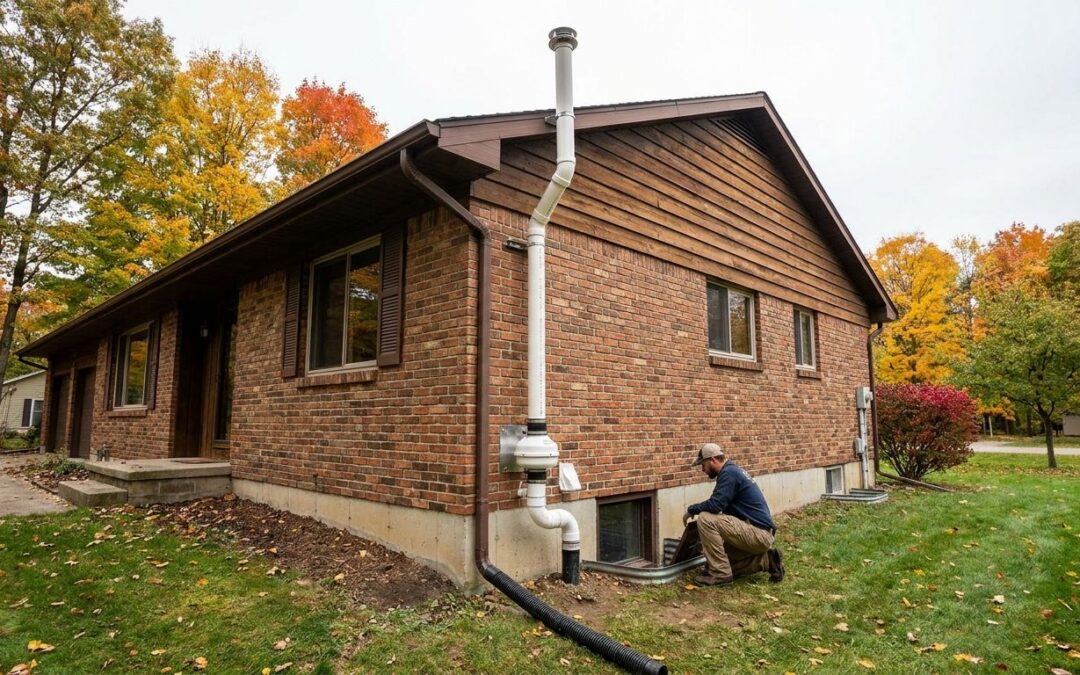
Hybrid slab-and-crawl foundation radon mitigation in Michigan means running two connected suction systems instead of one, because a poured slab and a dirt-floor crawl space pull soil gas through completely different paths into the same house. Split-level ranches, additions built over an unexcavated crawl space, and homes with a finished basement plus a separate crawl under a sunroom or garage all fall into this category, and each foundation type needs its own suction point to get below the EPA action level.
- Radon mitigation hybrid foundation Michigan projects need at least two suction points, not one universal system.
- Test the slab zone and the crawl zone separately before you assume a single reading covers the house.
- A sealed crawl space without an active fan traps moisture and does nothing for radon levels.
- Michigan Radon Control designs dual-zone systems that carry a 5-year warranty on parts and labor.
Why radon mitigation matters for hybrid slab-and-crawl homes
A slab and a crawl space behave differently underground. The slab traps gas under a solid concrete layer that only leaks through cracks, control joints, and utility penetrations. The crawl space usually has bare dirt or loose gravel, which is far more porous and lets soil gas move upward almost freely unless a vapor barrier is sealed and connected to a fan.
Michigan's glacial till soil compounds the problem for both zones, because that soil holds uranium-bearing sediment close to the surface across much of the Lower Peninsula. A house with one foundation type gets one radon signature. A hybrid house gets two, and testing only the basement or only the crawl space can miss the zone that's actually driving the number. If you haven't tested each section on its own, start with radon mitigation systems for crawl space homes to understand how the crawl side is measured before combining it with slab data.
Test each foundation zone on its own
Don't rely on a single test canister placed in the basement to represent the whole house. Radon concentrations can differ by a factor of two or more between a slab-covered room and an adjoining crawl space in the same structure.
- Place a short-term test kit in the lowest livable slab-covered room, at least 20 inches off the floor
- Place a second kit in the crawl space access area or the room directly above it
- Keep windows and doors closed for the full 48-hour test window in both zones
- Note the outdoor weather during testing, since wind and barometric pressure swing readings
- Record results separately rather than averaging them into one number
Seal the crawl space before you mitigate
A vapor barrier that isn't sealed at the seams, the foundation wall, and every support pier does almost nothing for radon control. Sealing is the manual step most homeowners can start themselves before a mitigation contractor ever shows up.
- Overlap sheeting seams by at least 12 inches and tape every seam
- Seal the barrier to the foundation wall with mechanical fasteners and caulk, not tape alone
- Wrap and seal around every support pier and plumbing penetration
- Cover any sump pit or floor drain in the crawl space with a sealed lid
- Check for gaps around the crawl space access door or hatch
A sealed crawl space with no active fan traps moisture underneath it, which creates a mold risk worse than the radon problem you started with. That's the point where a licensed contractor becomes the faster path: sealing without a properly sized fan and a pressure field extension test is a common and expensive mistake on hybrid foundations.
Choose the right system type for each zone
Slab sections typically call for sub-slab depressurization drilled through the concrete. Crawl space sections call for sub-membrane depressurization drawn from beneath the sealed vapor barrier. On a hybrid foundation these are usually two separate suction points tied into one exhaust routing plan, sometimes with two fans. Compare the options before you commit to one, and use how to choose the right radon mitigation system type as a reference when a contractor walks you through the diagnostics.
Route the vent pipe across two foundation types
Pipe routing gets more complicated on a hybrid foundation because the pipe has to travel from a below-slab point and a below-membrane point to a shared exhaust termination, usually above the roofline.
- Map the shortest interior chase from each suction point to an exterior wall or attic space
- Keep vertical runs as straight as possible to reduce fan strain
- Terminate the exhaust at least 10 feet from any window or door per code
- Label each pipe run at the fan connection so future service techs know which zone it serves
- Avoid routing both zones through a single undersized fan rated for only one suction point
Budget for a combined system, not two separate quotes
Hybrid foundations cost more to mitigate than a single slab or single crawl space because of the extra suction point, extra pipe run, and sometimes a second fan. Get one integrated quote rather than pricing the slab side and crawl side separately, since a combined design usually shares exhaust routing and reduces total labor. Review how to budget for a radon mitigation system installation before you request estimates so you know which line items to expect.
Verify the system after installation
Every suction point needs its own pressure field extension check, and every zone needs its own post-mitigation retest. A passing reading in the slab zone doesn't confirm the crawl zone dropped below 4.0 pCi/L, and the reverse is true too.
- Check the manometer or pressure gauge on each fan line, not just one
- Retest each zone separately 24 to 90 days after installation
- Confirm negative pressure is measurable at the farthest point in the crawl space, not just near the fan
- Watch for condensation buildup in exhaust pipes during Michigan winters
Get a dual-zone mitigation quote
Michigan Radon Control designs systems sized for both foundation types under one roof.
Comparing mitigation options for hybrid foundations
| Option | Best for | Key limitation |
|---|---|---|
| Sub-slab depressurization (slab zone) | Concrete slab sections with accessible soil below | Doesn't reach gas entering through the separate crawl space |
| Sub-membrane depressurization (crawl zone) | Dirt or gravel crawl space sections | Requires a fully sealed vapor barrier or it underperforms |
| Combined dual-fan system | Hybrid homes needing two independent suction points | Higher install complexity and two fans to maintain long-term |
| Passive stack with future fan option | New additions built over a crawl space | Relies on natural draft alone, often can't reach 4.0 pCi/L without adding a fan |
A combined dual-fan system is the most reliable verdict for most hybrid slab-and-crawl homes in Michigan because it addresses both entry paths independently instead of hoping one suction point pulls double duty.
Common mistakes on hybrid foundations
- Testing only one zone. A single canister in the basement tells you nothing about the crawl space radon level, and vice versa.
- Sealing the crawl space without a fan. An airtight vapor barrier with no active suction traps moisture and skips the actual mitigation step.
- Undersizing the fan for two suction points. A fan rated for one zone strains or fails when it's split across slab and crawl space suction lines.
- Skipping the zone-specific retest. A passing whole-house average can hide a crawl space that's still above 4.0 pCi/L.
- Routing both zones through one undocumented pipe run. Future service techs can't diagnose a fan issue if nothing shows which line serves which zone.
“A sealed crawl space with no fan running isn’t a mitigation system, it’s a moisture trap.”
FAQ
What is a hybrid slab-and-crawl foundation?
A hybrid slab-and-crawl foundation combines a poured concrete slab under part of the house with a dirt or gravel crawl space under another section, common in split-levels and additions. Each section needs separate radon testing and often a separate mitigation suction point.
Can one radon mitigation system cover both a slab and a crawl space?
Usually not with a single suction point. Most hybrid foundations in Michigan need a combined system with two suction points, one for the slab and one for the sealed crawl space, tied into shared exhaust routing.
How much does radon mitigation cost for a hybrid foundation in Michigan?
Cost depends on the number of suction points, fan sizing, and pipe routing distance, and it runs higher than a single-zone system because of the extra suction point. Get a home-specific quote rather than pricing the slab and crawl sides separately.
Is radon more likely to come from the crawl space or the slab side?
Neither side is automatically worse; it depends on soil conditions and how well each zone is sealed. A crawl space with an unsealed vapor barrier often shows higher readings simply because bare soil is more porous than solid concrete.
How long does installation take on a hybrid foundation?
A dual-zone install typically takes longer than a single-zone system because of the extra suction point and pipe routing across two foundation types. Exact timing depends on crawl space access and how the exhaust routes through the attic.
Do I need to test both zones separately?
Yes. A single test placed in only the basement or only the crawl space can miss the zone driving the radon level, since concentrations can differ significantly between the two.
What is the EPA action level for radon in 2026?
The EPA action level is 4.0 pCi/L in 2026, the same threshold that’s been used for years. Any zone testing at or above that level should be mitigated.
Does a hybrid foundation always need two fans?
Not always, but it’s common. Some hybrid systems route two suction points into one properly sized fan, while others need a dedicated fan per zone depending on pipe distance and soil porosity.
One last thing
The crawl space side of a hybrid foundation is the one most homeowners skip testing, because it's out of sight and out of mind compared to a finished basement. That's exactly the zone most likely to get missed during a home inspection in 2026, and it's the zone where a sealed-but-unpowered vapor barrier does the most silent damage by trapping moisture instead of venting gas.
Related guides