
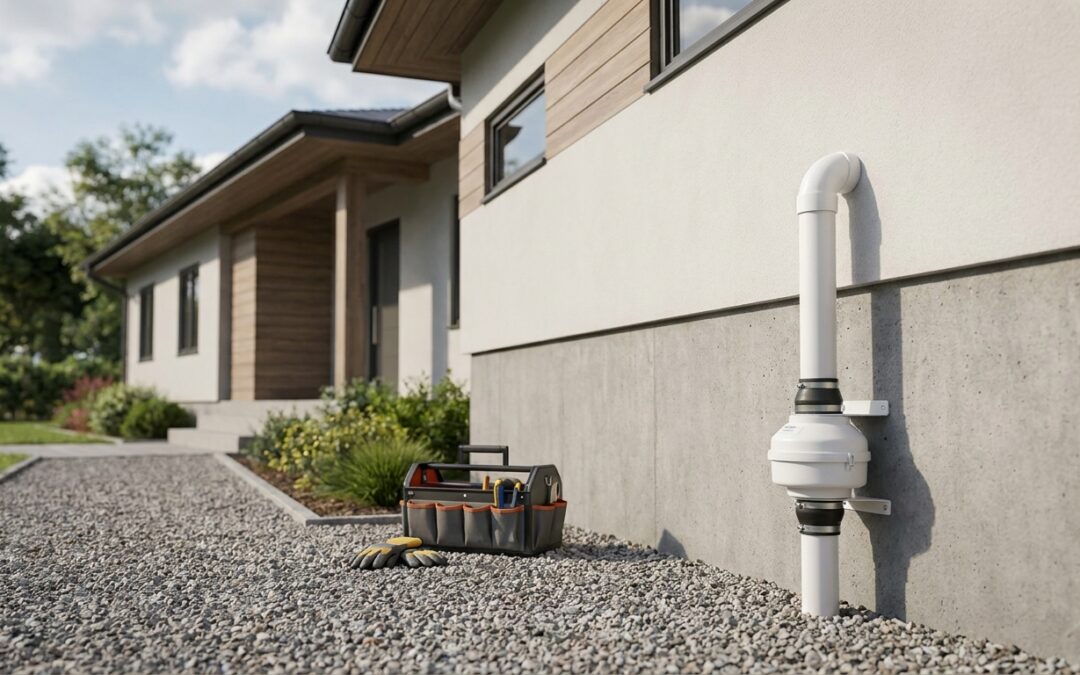
Slab-on-grade homes have no basement or crawlspace to hide a suction pipe in, so every mitigation decision starts with where the fan and pipe actually go. This guide covers radon mitigation slab on grade construction specifically, what works in Michigan homes built straight onto a concrete pad, and which pitches from installers don't hold up once the fan turns on.
- Interior single-point active soil depressurization is the standard radon mitigation slab on grade fix — Buy in 2026.
- Multi-point suction systems earn a Consider only when sub-slab fill is compacted clay or mixed with poured concrete.
- Passive stack pipes without an inline fan rarely hold radon under the EPA’s 4.0 pCi/L action level — Skip.
- Slab core-drilling for the suction point beats trenching along the footing for consistent vacuum.
- Retest every two years after installation to confirm the system still holds levels below 4.0 pCi/L.
Why this matters
Slab-on-grade construction is common across newer subdivisions in Novi, Livonia, and Farmington Hills, where builders pour a single concrete pad instead of digging a basement. That pad sits directly on Michigan's glacial till, the same soil profile that produces some of the highest indoor radon readings in the Midwest. There's no sump pit, no block wall, and no crawlspace vapor barrier to tap into — the suction point has to go straight through the slab itself.
That changes the mitigation math. A basement system routes the pipe through an unfinished sump lid and tucks the fan into a utility corner. A slab home forces the installer to core-drill through finished flooring, find a suction point that reaches uniform sub-slab material, and run pipe through a closet, garage, or exterior wall instead. Michigan Radon Control handles this daily across Metro Detroit and Lansing, and placement is where the gap between a system that actually pulls vacuum and one that just runs shows up.
Who this is for
This guide is for slab-on-grade homeowners in Michigan — post-1990s subdivision buyers, single-story ranch owners, and sellers whose home inspection came back over 4.0 pCi/L with no basement to install into. If your home has a basement or crawlspace, standard sub-slab suction through a sump lid or sealed membrane applies instead; this page is specifically for pads poured straight to grade.
What to look for in radon mitigation for slab-on-grade homes
Suction point placement
On a slab, the suction point has to reach loose sub-slab fill — gravel or sand — rather than compacted native soil, because vacuum only travels efficiently through permeable material. A point drilled into dense clay fill under a slab addition can leave half the pad untouched by suction, even with the fan running full time.
Fan sizing and continuous power draw
Radon fans run 24 hours a day, every day of the year, so sizing matters for both performance and your electric bill. Single-point slab systems typically need smaller fans, in the 60 to 90 watt range, than multi-point systems pulling from two or three locations. Oversizing adds noise near bedrooms without improving the reduction number.
Vent pipe routing above the roofline
Without a basement chase, pipe on a slab home usually runs through a garage, a closet, or up an exterior wall. Michigan code requires the exhaust point to sit above the eave line and away from windows and fresh-air intakes, so the routing decision affects both compliance and resale curb appeal.
System monitoring gauge
A U-tube manometer or digital pressure gauge is how you and any future buyer confirm the fan is actually pulling suction. Without one, a failed fan can run silently for months while radon levels climb back toward the pre-mitigation number.
NRPP certification and post-installation retest
Certification tells you the installer follows EPA protocol for suction point selection and pipe sizing. A confirmed post-mitigation test, run for a minimum of 48 hours, tells you whether the finished radon mitigation slab on grade system actually landed under 4.0 pCi/L — not just that a fan is spinning.
Top picks: system approaches for slab-on-grade homes
Interior single-point active soil depressurization — the standard pick
A single 3 to 4 inch PVC suction point is core-drilled through the slab at a central location and tied to a continuously running inline fan. This approach handles the majority of slab jobs when the sub-slab fill is uniform sand or gravel across the footprint. Michigan Radon Control's NRPP-certified installers use this as the default configuration for a straightforward radon mitigation system installation on a slab home. Buy.
Multi-point active soil depressurization — the upgrade pick
Homes with compartmentalized sub-slab fill — additions poured at different times, or a mix of clay and gravel under different sections of the pad — leave dead zones where a single suction point can't pull vacuum. A second suction point, tied into one fan through a manifold or run on its own fan, closes that gap. It costs more to install and adds a second core-drill hole. Consider when a diagnostic test shows uneven sub-slab communication.
Exterior-mounted active soil depressurization — the tight-space pick
Finished garages and utility rooms in newer construction, common across Novi homeowners, often leave no interior chase for pipe. Running the fan and pipe up an exterior wall instead of through living space solves that, though Michigan winters mean the fan housing needs weatherproofing to avoid ice buildup during hard freezes. Consider for homes without interior routing options.
Passive stack without a fan — the one to skip at install
A passive system relies on stack effect alone to move soil gas up and out, with no fan pulling active suction. Slab homes have shorter vertical stack runs than basement homes, which weakens the natural draft further, and EPA guidance is consistent that passive designs achieve less reliable reduction than fan-driven systems. Skip as a first installation — it only makes sense as pre-plumbing during new construction, to be activated with a fan later if a post-build test comes back high.
What to avoid
- Sealing cracks and joints alone. EPA guidance is clear that sealing without active suction rarely holds a slab home under 4.0 pCi/L long-term, because slabs shift seasonally and hairline cracks reopen.
- An undersized single suction point on an oversized slab. A fan sized for a small ranch footprint installed on a 2,400 square foot slab with an addition will starve before it reaches the far end of the pad.
- Skipping the post-mitigation retest. A system that isn't verified with a follow-up test is a guess, not a fix — see what a proper installation day involves before you sign off on one in how to prepare your home for a radon mitigation system.
“If the fan runs but the manometer needle doesn’t move, the system isn’t pulling suction — it’s decoration.”
Verdict comparison
| System | Suction points | Best for | Verdict |
|---|---|---|---|
| Interior single-point ASD | 1 | Uniform sub-slab fill, standard footprint | Buy |
| Multi-point ASD | 2+ | Compartmentalized or mixed fill | Consider |
| Exterior-mounted ASD | 1 | Finished garages, no interior chase | Consider |
| Passive stack, no fan | 1 | Pre-plumbed new construction only | Skip |
Get a slab-specific mitigation quote
NRPP-certified suction point placement for Michigan slab homes.
FAQ
What is the best radon mitigation system for a slab-on-grade home?
Interior single-point active soil depressurization is the standard fix for radon mitigation slab on grade homes in 2026, using one core-drilled suction point tied to a continuously running fan. Multi-point systems only make sense when sub-slab fill is compartmentalized or uneven.
Can you install a radon mitigation system without a basement?
Yes, a slab-on-grade radon mitigation system core-drills the suction point directly through the concrete pad instead of through a sump lid. The fan and pipe route through a garage, closet, or exterior wall since there’s no basement chase to use.
Is a passive radon system enough for a slab home?
A passive stack without a fan is usually not enough for a slab home, since slab homes have shorter stack runs than basement homes and produce a weaker natural draft. An active fan-driven system reliably holds levels under the EPA’s 4.0 pCi/L action level; a passive one often doesn’t.
Where does the fan get placed on a slab-on-grade home?
The fan typically mounts in an unfinished space like a garage or utility closet, with pipe running up an exterior wall or through a chase to exhaust above the roofline. Placement depends on where the home has unfinished routing available since there’s no basement to hide the run.
How long does slab-on-grade radon mitigation installation take?
Most single-point slab installations complete in a single day, including the core drill, pipe run, fan mounting, and sealing. Multi-point systems or exterior-mounted setups with more complex routing can run into a second day.
How often should a slab radon system be retested?
Retest every two years after installation to confirm the fan and suction point still hold levels below 4.0 pCi/L. A manometer check between retests catches a failed fan sooner than waiting for the two-year mark.
Do slab-on-grade homes need a different radon test than basement homes?
The testing method is the same short-term or long-term test used in any home, but placement matters more on a slab since there’s no below-grade level to test in. Testing happens in the lowest livable area, which on a slab home is the main floor itself.
One last thing
Radon levels in Michigan slab homes tend to peak in January and February, not summer, because winter stack effect pulls more indoor air out through the upper floors and roofline, which increases the negative pressure drawing soil gas up through slab cracks. If your last test was run in July, it likely undercounts what a winter reading in 2026 would show. A properly installed active system holds the line either way, but a passive stack or a sealed-only fix is far more likely to fail exactly when heating season starts.
Related guides