
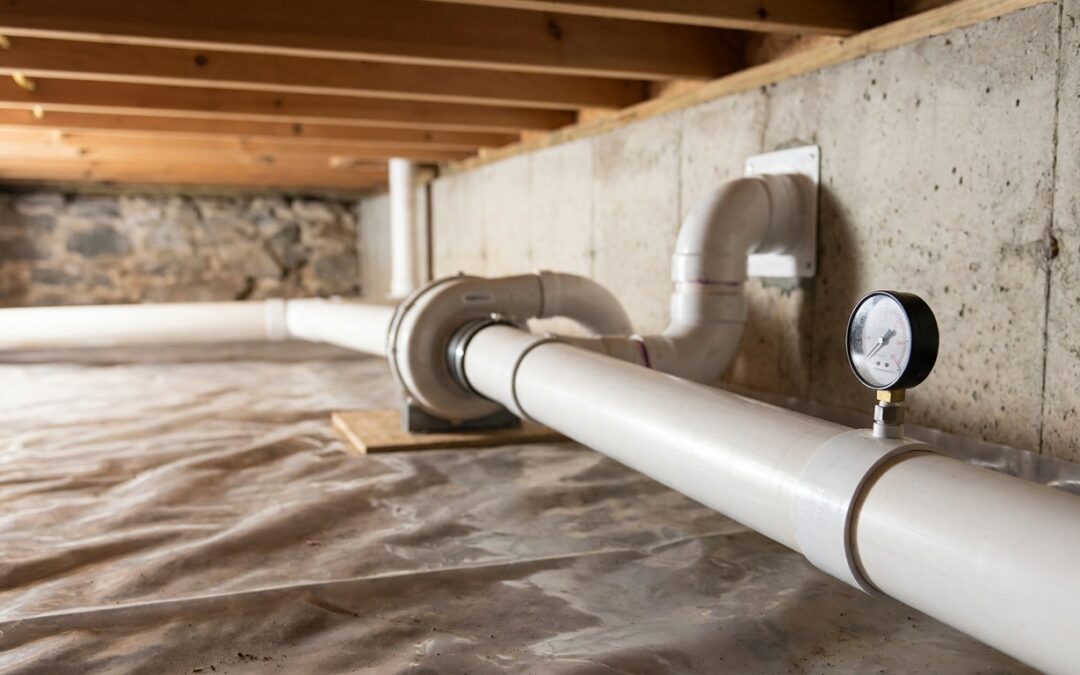
Crawl space foundations trap radon differently than basements or slabs, and a system built for a poured basement often underperforms when you bolt it onto a crawl space. This guide breaks down which radon mitigation crawl space systems actually work, what to avoid, and how to pick the right one for a Michigan crawl space home in 2026.
- Sub-membrane depressurization is the standard fix for radon mitigation crawl space projects in 2026 – Buy.
- Homes with sump pumps can often reuse drain-tile depressurization instead of a new suction pit – Buy.
- Passive encapsulation without a fan only holds below 4 pCi/L – Consider, not a universal fix.
- Slab-on-grade sub-slab systems do not transfer to crawl spaces – Skip if a contractor proposes one.
Why this matters
Crawl spaces sit closer to soil gas than any other foundation type, and dirt floors or loose vapor barriers let radon migrate straight into the living space above. Michigan's glacial soil and fractured bedrock push radon readings higher than the national average, and a crawl space with an unsealed sump pit is one of the fastest paths for that gas to reach the first floor – see how radon mitigation for homes with sump pumps handles that exact scenario.
Most crawl space mitigation failures trace back to one thing: a system designed for a different foundation type installed without adjustment. A sub-slab system built for a poured basement floor does not seal or depressurize a dirt or gravel crawl space the same way. Get the system type wrong and you can spend $1,200-$2,500 on a fix that still leaves readings above the EPA action level of 4 pCi/L.
Who this is for
This guide is for Michigan homeowners with a crawl space foundation – vented, unvented, or partially encapsulated – who've tested above 4 pCi/L or are evaluating mitigation ahead of a home sale. It also applies to buyers under contract on a crawl space home where a radon test came back elevated during inspection, and to realtors advising clients on what a crawl space system realistically costs and how long it takes to install.
What to look for in a crawl space radon system
Membrane quality and seal integrity
A crawl space system lives or dies on the vapor barrier. Look for 6-mil polyethylene at minimum, 12-20 mil for high-traffic or storage crawl spaces, sealed at every seam, pier, and wall penetration with mastic or foil tape rated for sub-grade use. A membrane with gaps larger than a few inches at the perimeter defeats the whole system.
Fan placement and CFM rating
Undersized fans are the number one reason crawl space systems underperform. A crawl space under 1,500 square feet typically needs 60-80 CFM; larger or leakier spaces need 100+ CFM. Fan location matters too – exterior or attic-mounted units keep noise and radon-laden air out of the living space.
Compatibility with existing sump pumps and drain tile
If the crawl space already has a sump pit or perimeter drain tile, that infrastructure can often double as the suction point, cutting installation time and cost. A contractor who ignores existing drain tile and drills a fresh suction pit anyway is either inexperienced with crawl spaces or padding the invoice.
Vent stack routing and termination height
Michigan code and EPA guidance both require the vent stack to terminate above the roofline or at least 10 feet from any window, and away from areas where people gather. Routing through a garage or exterior wall run adds cost but keeps the stack out of finished living space.
Post-install testing protocol
A finished system means nothing without a post-mitigation test confirming levels below 4 pCi/L, typically run 24-48 hours after activation. A contractor who skips this step or calls the job done without a number in hand hasn't actually verified anything.
Warranty and maintenance access
Fans wear out – most rated for 5-10 years of continuous run time. A system with a U-tube manometer visible from a hallway or basement stairwell lets you check function at a glance instead of guessing.
Top picks for crawl space radon mitigation
Sub-Membrane Depressurization (SMD) – the standard pick for most crawl spaces. A sealed 12-mil or heavier membrane covers the entire crawl space floor, with a suction point pulling air from beneath it via an inline fan running 24/7. EPA data shows SMD systems cut indoor radon by up to 99% when properly sealed. For a full walkthrough of what installation involves, see radon mitigation system installation for Michigan homes. Verdict: Buy for any crawl space testing above 4 pCi/L without existing drain tile.
Drain-Tile Depressurization – the pick for homes with sump pumps. Instead of cutting a new suction pit, the system seals the sump lid and ties the fan into the existing perimeter drain tile loop that already circles the foundation. A single 100 CFM fan can service crawl spaces up to roughly 2,000 square feet through this route, and it's covered in detail on the radon mitigation for homes with sump pumps page. Verdict: Buy if the sump pit and drain tile are already in good working order.
Passive Encapsulation with Stack Vent – the wildcard, and the one contractors oversell most. No fan, just a sealed membrane and a vent stack relying on the stack effect for airflow. It holds reliably only when initial readings sit below 4 pCi/L; above that, passive systems routinely fail to bring levels down. Verdict: Consider only for borderline low readings, Skip for anything testing above 4 pCi/L.
Combination Crawl and Basement System – built for split-level and multi-foundation homes, common across Livonia, Farmington Hills, and similar Metro Detroit layouts. One fan ties into two suction points through a manifold, covering combined foundation footprints of 1,500-3,500 square feet. See how this plays out locally on radon mitigation systems for Livonia homes. Verdict: Buy for split-level or multi-foundation homes where a single-point system won't reach every space.
Exterior Retrofit Fan – for crawl spaces with tight interior clearance or finished storage use. The fan mounts outside the foundation wall, keeping the run through living space under 3 feet instead of 10-plus feet of interior ductwork. Verdict: Consider when interior access is limited or the crawl space is finished for storage.
Get a Crawl Space Radon Estimate
NRPP-certified inspection and mitigation quotes for Metro Detroit and Lansing homes.
What to avoid
- Sub-slab systems borrowed from slab-on-grade jobs. A system designed for poured concrete floors doesn't transfer to a dirt or gravel crawl space – compare the two approaches on radon mitigation for slab-on-grade homes before signing a contract.
- Passive-only systems on homes testing above 4 pCi/L. They look cheaper up front but routinely require a retrofit fan within a year when levels don't drop enough.
- Contractors who skip the pre-install site walk. Crawl space height, existing moisture control, and drain tile condition all change what system fits – see what a proper pre-install check covers on how to prepare your home for a radon mitigation system.
Verdict comparison
| System | Best for | Typical reduction | Fan needed | Verdict |
|---|---|---|---|---|
| Sub-Membrane Depressurization | Standard crawl space, no drain tile | Up to 99% | Yes, 60-100+ CFM | Buy |
| Drain-Tile Depressurization | Homes with existing sump pump | Up to 95%+ | Yes, ~100 CFM | Buy |
| Passive Encapsulation | Borderline readings under 4 pCi/L | Variable, unreliable above 4 pCi/L | No | Consider/Skip |
| Combination Crawl + Basement | Split-level, multi-foundation homes | Up to 99% across both zones | Yes, single manifold fan | Buy |
| Exterior Retrofit Fan | Tight interior access, finished storage | Comparable to SMD | Yes, exterior-mounted | Consider |
FAQ
What is the best radon mitigation system for a crawl space?
Sub-membrane depressurization is the best radon mitigation crawl space system for most Michigan homes in 2026, cutting indoor radon by up to 99% when the membrane is fully sealed. Homes with existing sump pumps can often use drain-tile depressurization instead at lower cost.
Can I use a sub-slab radon system in a crawl space?
No, sub-slab systems are built for poured concrete floors and don’t seal or depressurize a dirt or gravel crawl space the same way. Crawl spaces need a sealed membrane with its own suction point, not a sub-slab retrofit.
Does crawl space encapsulation alone stop radon?
Encapsulation alone only works reliably when radon levels test below 4 pCi/L, since it relies on passive stack effect instead of active fan-driven depressurization. Above 4 pCi/L, most passive systems fail to bring levels down and need a fan added.
How much does radon mitigation cost for a crawl space home?
Crawl space radon mitigation typically runs $1,200-$2,500 depending on square footage, existing drain tile, and vent stack routing in 2026. Homes that can reuse an existing sump pump system tend to land at the lower end of that range.
Can my sump pump be part of the radon system?
Yes, an existing sump pit and drain tile loop can often serve as the suction point for a drain-tile depressurization system, cutting installation time compared to drilling a new pit. The sump lid gets sealed and tied into the fan and vent stack.
How long does crawl space radon mitigation installation take?
Most crawl space installations take one day for a single-point sub-membrane or drain-tile system, longer for combination systems spanning multiple foundation zones. Post-install testing typically runs 24-48 hours after the fan activates.
What radon level requires mitigation in a crawl space home?
The EPA action level is 4 pCi/L, and Michigan crawl space homes at or above that level should move to mitigation. Some homeowners choose to mitigate in the 2-4 pCi/L range as well, particularly ahead of a home sale.
Do crawl space radon fans run all the time?
Yes, radon mitigation fans run continuously, 24 hours a day, for as long as the home is occupied. Most fans are rated for 5-10 years of continuous operation before replacement.
One last thing
The detail most homeowners miss: a vented crawl space and a sealed crawl space need completely different mitigation math. Sealing the vents changes the pressure dynamics the whole system was designed around, so if a previous owner or contractor closed off foundation vents without adjusting the radon system, that's often the reason a home that tested fine two years ago is testing above 4 pCi/L now.
Related guides
- Radon mitigation for homes with sump pumps
- Radon mitigation for slab-on-grade homes
- Radon mitigation system installation for Michigan homes
- How to prepare your home for a radon mitigation system
- Radon mitigation systems for Livonia homes