
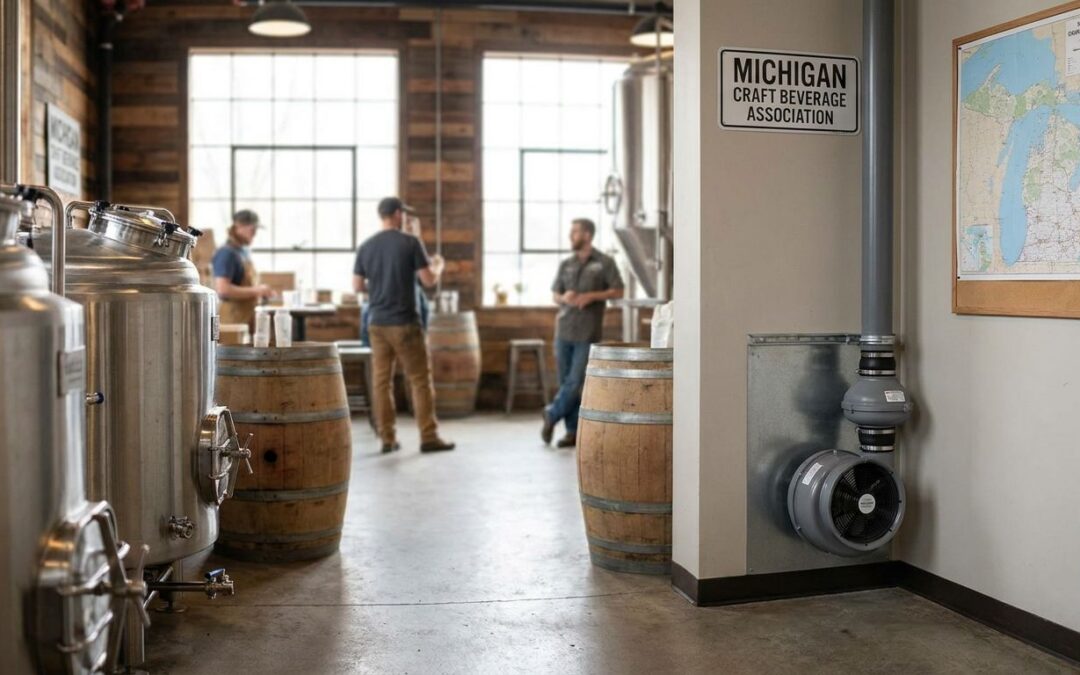
Craft breweries and wineries built into old barns, converted warehouses, or below-grade cellars sit on the same Michigan soil that gives homeowners radon problems — and the stakes are higher when you've got staff working eight-hour shifts near a slab floor and customers sampling in a tasting room built over a crawl space.
- Radon mitigation for breweries and wineries in Michigan starts with sub-slab or sub-membrane depressurization matched to the building type. Buy the system built for your foundation, not a generic residential unit.
- EPA action level is 4.0 pCi/L for any occupied space, including tasting rooms and production floors.
- Root cellars and below-grade barrel rooms need block-wall suction more often than standard sub-slab setups. Verify before installation.
- NRPP-certified installers document fan placement and pressure readings for insurance and liability records — ask for this on every quote.
Why this matters
A brewery or winery isn't a single-family home with one furnace and one basement. You've got production floors on slab, barrel rooms below grade, tasting rooms with public foot traffic, and sometimes an old farmhouse cellar repurposed for storage. Each of those spaces can pull radon gas from the soil differently, and a system sized for a three-bedroom ranch won't handle a 4,000-square-foot production building.
Michigan's glacial till and karst limestone deposits push radon up through soil gas at levels the EPA classifies as elevated risk across most of the state. Radon is the second leading cause of lung cancer in the United States, according to the EPA, and prolonged occupational exposure in a below-grade cellar or production space carries the same risk as residential exposure — arguably more, if staff spend full shifts down there.
Who this is for
This guide is for brewery owners, winery operators, and taproom managers running Michigan facilities built on slab foundations, converted barns, historic farmhouses with root cellars, or pole-barn-style production buildings. If your business occupies a below-grade barrel room, a cellar used for aging or storage, or a taproom built over unfinished crawl space, radon exposure is a building-code and liability issue, not just a homeowner concern.
A commercial radon test is the starting point before any mitigation decision — you need a baseline reading before you spend money fixing a problem you haven't confirmed.
What to look for in radon mitigation for breweries and wineries
Foundation type match
A production floor on solid slab needs sub-slab depressurization; a barrel room dug into a hillside or a farmhouse root cellar often needs block-wall suction instead. Installers who quote one system type regardless of your foundation are guessing, not diagnosing.
Fan capacity for larger square footage
Residential radon fans are rated for typical basement square footage — usually under 2,000 square feet of slab. A 5,000-square-foot production floor needs a higher-capacity fan or multiple suction points, and undersizing the fan is the single most common reason mitigation systems fail to bring commercial spaces under 4.0 pCi/L.
Noise tolerance in occupied spaces
A tasting room with customers seated near an exterior wall notices fan noise a homeowner's basement never would. Fan placement and vibration isolation matter more here than in a residential install — a system that's fine in a crawl space becomes a complaint generator in a public-facing tasting room.
Documentation for insurance and liability
Employers with staff working in below-grade spaces should keep dated pressure gauge readings and post-mitigation test results on file. NRPP-certified installers provide this documentation as standard practice, and it becomes relevant if OSHA or an insurer ever asks about indoor air quality controls.
Retrofit compatibility with existing HVAC
Many breweries run dedicated exhaust for brewing equipment, and a radon fan competing with that airflow can short-circuit both systems. Confirm the mitigation design accounts for existing ventilation before installation, not after.
Budget scaled to square footage, not per-home pricing
Commercial mitigation costs scale with the number of suction points and fan capacity required, not a flat residential rate. Get a budget breakdown built around your actual floor plan before comparing quotes.
Top picks: mitigation approaches for Michigan breweries and wineries
Sub-slab depressurization — the safe pick for production floors. This is the standard approach for any brewery built on a poured slab, pulling soil gas from beneath the concrete through one or more suction points tied to an exterior fan. One spec that matters: suction point spacing typically runs one point per 2,000-2,500 square feet of slab on a system with typical soil permeability, so a 6,000-square-foot production floor generally needs at least three points. Buy — this is the proven default for slab-built facilities in 2026, and it's the system most likely to pass a post-installation retest.
Block-wall suction — the pick for cellars and barrel rooms. Farmhouse root cellars, stone-foundation wineries, and below-grade barrel storage often have hollow block walls that act as a radon pathway independent of the slab. This system draws gas from inside the block cavities rather than beneath the floor. If your building matches the profile covered in radon mitigation for Michigan farmhouses with root cellars, this is worth pricing alongside sub-slab work. Consider — it's the right call for stone or block construction, but it's the wrong system for a poured-slab tasting room.
Sub-membrane depressurization — the pick for pole-barn and dirt-floor storage. Many craft operations store barrels or equipment in converted pole barns with exposed dirt or gravel floors. A heavy-gauge membrane sealed over the exposed soil, tied to a suction fan, controls radon without pouring new concrete. Details specific to outbuilding construction are covered in radon mitigation for Michigan pole barns and outbuildings. Buy if your storage building has an exposed dirt floor — this is far less invasive than a slab retrofit.
Passive stack venting — the wildcard, and mostly a skip for active production spaces. A passive system relies on natural airflow rather than a powered fan, and it can work for lightly occupied storage areas with low soil gas readings. But breweries and wineries generate their own airflow disruption from HVAC, exhaust hoods, and foot traffic, which undermines passive systems more than in a typical home. Skip for any space where staff work full shifts — the EPA action level of 4.0 pCi/L is not a target you want to gamble on with an unpowered system.
Every approach above should come from an NRPP-certified radon mitigation installer familiar with commercial-scale work — residential-only contractors frequently underbid because they haven't priced multi-point suction correctly.
Get a commercial radon quote
Compare mitigation options sized for your production floor, cellar, or tasting room.
What to avoid
- A single residential-sized fan across a multi-thousand-square-foot production floor. It looks like a cost saver on the quote, but undersized fans routinely fail to bring larger spaces below 4.0 pCi/L, and you'll pay for a second install within a year.
- A contractor who skips a pre-installation diagnostic test. Guessing at system type without confirming foundation construction and existing soil gas readings is how you end up with block-wall suction on a slab building or vice versa.
- Ignoring fan placement near tasting room seating. A system that's quiet in an unoccupied crawl space can be a constant low hum next to a customer table — placement planning up front avoids a retrofit later.
Verdict comparison
| Approach | Best for | Fan/suction need | Verdict |
|---|---|---|---|
| Sub-slab depressurization | Poured-slab production floors | One point per ~2,000-2,500 sq ft | Buy |
| Block-wall suction | Root cellars, stone/block barrel rooms | System-specific, per wall cavity | Consider |
| Sub-membrane depressurization | Pole barns, dirt-floor storage | Single fan, membrane-sealed | Buy (for dirt floors) |
| Passive stack venting | Lightly occupied storage only | None (unpowered) | Skip for occupied spaces |
FAQ
What is the EPA action level for radon in a commercial brewery or winery?
The EPA action level is 4.0 pCi/L for any occupied indoor space, and that standard applies equally to a production floor, tasting room, or barrel cellar as it does to a residential basement. Readings above that level call for mitigation.
Is radon mitigation for a brewery different from a home mitigation system?
Yes — commercial spaces usually need higher-capacity fans and multiple suction points to cover larger square footage than a standard residential system is rated for. Foundation type (slab, block wall, dirt floor) also determines which mitigation method applies.
How much does radon mitigation cost for a Michigan brewery or winery?
Cost scales with square footage and the number of suction points required rather than a flat per-building rate. A budget breakdown built around your actual floor plan gives a more accurate number than a generic residential quote.
Do wineries with root cellars need a different mitigation system than a slab production floor?
Often yes. Root cellars and below-grade barrel rooms with block or stone foundations frequently need block-wall suction, while a poured-slab production floor typically uses sub-slab depressurization.
Can radon testing be done in an occupied tasting room?
Yes, radon testing can run in an occupied space as long as doors and windows stay closed per standard testing protocol during the test period. Results reflect actual occupied conditions, which matters more for a public-facing tasting room than a vacant space would.
Who should install radon mitigation systems for a commercial building in Michigan?
An NRPP-certified installer with commercial experience should handle any brewery or winery mitigation project. Residential-only contractors often underbid because they haven’t priced multi-point suction systems correctly for larger buildings.
Does a pole-barn production or storage building need radon mitigation?
If the building has an exposed dirt or gravel floor, yes — soil gas moves through unsealed ground the same way it does under a home’s crawl space. Sub-membrane depressurization is the typical fix for that construction type.
How often should a brewery or winery retest radon levels after mitigation?
Post-installation retesting confirms the system brought levels below 4.0 pCi/L, and periodic retesting afterward catches fan failures or pressure changes over time. Documented pressure gauge checks between retests are standard practice for commercial accounts.
One last thing
The detail most brewery and winery owners miss: radon mitigation systems need periodic verification, not a one-time install-and-forget approach. A fan that fails silently in a barrel room won't trigger an alarm — it just lets soil gas back into a space where staff spend full shifts, and nobody notices until the next test. Building a recheck into your annual facility maintenance schedule, alongside HVAC and fire suppression checks, costs far less than discovering a failed system during an insurance audit.
Related guides
- Radon mitigation for Michigan pole barns and outbuildings
- Radon mitigation for Michigan farmhouses with root cellars
- Best NRPP-certified radon mitigation companies in Michigan
- How to budget for a radon mitigation system installation
- Radon testing for commercial buildings in Metro Detroit