
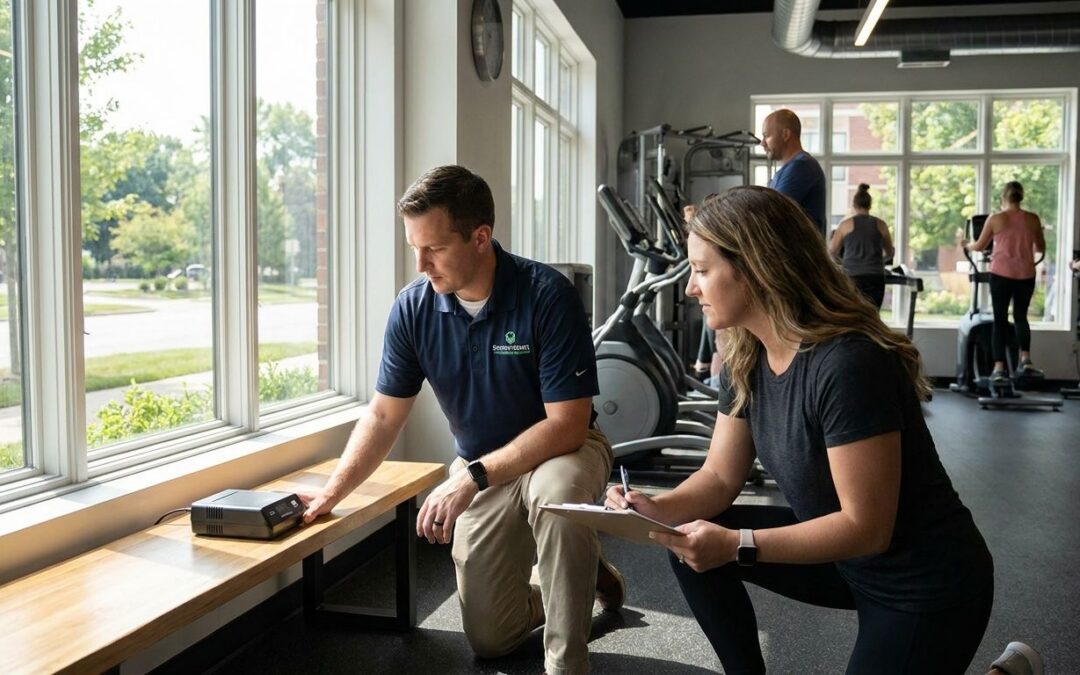
Gym owners in Metro Detroit and Lansing rarely think about radon until a lease renewal, an insurance audit, or a worried staff member forces the question — and by then most operators don't know where to start. This guide walks through what radon testing looks like for a fitness business in Michigan and which mitigation path fits your building.
- Radon testing gym Michigan protocols require 48-hour continuous monitoring in occupied commercial space, not a 2-day charcoal kit meant for homes.
- Most Michigan counties sit in EPA Radon Zone 1, the highest-risk category in the country — gyms built on slab foundations carry real exposure risk.
- Sub-slab depressurization is the standard fix for slab-on-grade studios and typically runs the fan continuously during business hours.
- NRPP-certified testing is the baseline credential to ask for before any gym or studio signs a mitigation contract in 2026.
- Skip landlord-provided test results from a prior tenant — retest after any HVAC or floor-plan change.
Why this matters
Radon is a naturally occurring, odorless gas that seeps up through soil and foundation cracks, and it's classified as a Group 1 carcinogen. In a home, exposure is measured against hours spent sleeping and living there. In a gym, exposure is measured against staff working 8-to-10-hour shifts and members breathing hard on a slab floor for an hour at a time.
Commercial spaces also behave differently than houses. Large HVAC systems, open floor plans, and heavy foot traffic all change how radon accumulates, which is why radon testing for commercial buildings in Metro Detroit follows a different protocol than a homeowner test kit. Michigan Radon Control runs these tests under EPA and NRPP-referenced methodology, not the mail-in kits marketed to single-family homes.
Who this is for
This guide is for owners and operators of CrossFit boxes, yoga studios, strip-mall fitness centers, and multi-location gym chains across Metro Detroit and Lansing — especially anyone leasing space in a converted retail unit, a slab-on-grade strip mall, or a building with a finished basement level used for classes or storage. If you're renewing a commercial lease, buying out a franchise location, or just responding to a member's question about air quality, this is the checklist to work from.
What to look for in radon testing for a gym
Foundation type drives the testing approach
Slab-on-grade construction, common in Michigan strip malls, lets radon migrate directly through floor cracks and utility penetrations under a workout floor. A gym built over a crawl space or partial basement needs a different sensor placement than one sitting flat on a slab. Get this wrong and the reading won't reflect what members actually breathe near the squat racks.
Occupancy hours change the exposure math
A house test measures overnight exposure for two or three people. A gym test needs to account for staff working full shifts plus dozens of members cycling through daily — the exposure clock runs longer and for more individuals, which raises the stakes on getting an accurate number.
HVAC interaction matters more in commercial buildings
Large rooftop units and constant air exchange in a fitness facility can dilute or concentrate radon readings depending on when the system runs. Testing has to happen under normal operating conditions — doors open, HVAC running on its regular schedule — not with the building sealed up like a residential closed-house test.
Certification is non-negotiable
Any contractor doing commercial radon work should carry current NRPP certification, and you should ask to see it before signing anything. Michigan Radon Control's technicians are NRPP-certified, and the list of NRPP-certified radon mitigation companies in Michigan is worth checking against any quote you receive.
Lease terms decide who pays
If you lease your space, your lease may assign radon responsibility to the landlord, or it may be silent on it entirely. Get testing costs and mitigation responsibility clarified in writing before a result comes back above 4.0 pCi/L, the EPA action level.
Multi-location businesses need a testing schedule, not a one-off
If you operate more than one facility, treat radon testing like fire inspections — recurring, documented, and tied to a calendar rather than triggered only by a complaint.
Get your facility tested in 2026
NRPP-certified commercial radon testing across Metro Detroit and Lansing.
Top picks for gym and studio owners
The baseline pick — 48-hour continuous monitor test. Commercial radon testing in Michigan typically runs a continuous monitor for a minimum of 48 hours during normal business operation, capturing HVAC cycling and member traffic rather than a static empty-building reading. This is the starting point for every gym, regardless of foundation type. Verdict: Buy.
The precedent pick — the commercial-vertical playbook. Fitness facilities share more with medical offices than with houses: long occupancy hours, heavy HVAC turnover, and liability exposure to the people inside. The approach used for radon control services for Michigan medical and dental offices — scheduled testing tied to occupancy patterns — transfers directly to a gym setting. Verdict: Buy.
The comparison pick — the school and daycare protocol. Facilities with high youth or vulnerable-population occupancy, like the approach detailed for radon mitigation for daycare centers and schools in Michigan, set a useful bar for gyms running youth fitness or family classes. If your studio hosts kids' programs, match that stricter testing cadence. Verdict: Consider.
The system-selection pick — matching the fix to your foundation. Not every gym needs the same mitigation hardware. A strip-mall studio on a slab needs a different sub-slab layout than a converted basement space, and how to choose the right radon mitigation system type walks through the four main configurations before you commit to a quote. Verdict: Buy if your test comes back above 4.0 pCi/L.
The wildcard — passive monitoring after mitigation. Once a system is installed, a continuous monitor left running for the first year catches fan failures or seal breaks before they become a liability problem. Most gyms skip this step and only find out a fan died when a member asks about the air quality certificate on the wall. Verdict: Consider for locations with high member traffic.
What to avoid
- Relying on a prior tenant's test result. A reading from three years and two build-outs ago tells you nothing about your current floor plan or HVAC setup.
- Using a residential mail-in charcoal kit for a 5,000-square-foot facility. Those kits are calibrated for closed-house conditions in a home, not an open gym floor with constant door traffic.
- Skipping retesting after equipment changes. New HVAC units, added rooftop equipment, or floor modifications can all change how radon moves through a building — retest after any of these.
Verdict comparison
| Approach | Best for | What drives cost | Verdict |
|---|---|---|---|
| 48-hour continuous monitor test | Every gym, first step | Square footage, number of monitor placements | Buy |
| Sub-slab depressurization system | Slab-on-grade strip mall studios | Foundation size, fan placement | Buy if above 4.0 pCi/L |
| Scheduled multi-location testing | Chains with 2+ facilities | Number of locations, testing frequency | Consider |
| Post-mitigation continuous monitoring | High-traffic or youth-program facilities | Monitor hardware, monitoring period | Consider |
FAQ
Does a gym in Michigan legally need radon testing?
Michigan does not mandate radon testing for commercial fitness facilities as of 2026, but landlords, insurers, or franchise agreements sometimes require it. Testing anyway protects staff and members and gives you documentation if a lease or sale question comes up later.
How is radon testing gym Michigan different from a home test?
Gym testing uses a 48-hour continuous monitor run during normal business hours, capturing HVAC cycling and occupant traffic rather than the closed-house conditions used for residential kits. Commercial buildings behave differently under airflow than sealed homes do.
What radon level requires mitigation in a commercial building?
The EPA action level is 4.0 pCi/L for any building type, including gyms and fitness studios. A result at or above that number means a mitigation system should go in.
How much does radon mitigation cost for a fitness studio?
Cost depends on square footage, foundation type, and fan placement, and varies by building. Get a site-specific estimate rather than assuming a home mitigation quote applies to commercial square footage.
Can a landlord refuse to pay for radon mitigation in a leased gym space?
It depends entirely on your lease language. Get radon responsibility spelled out in writing during lease negotiation rather than discovering the gap after a high test result.
How long does a radon mitigation system take to install in a commercial building?
Installation timelines vary by system type and building complexity, and a certified contractor can give a firm schedule after a site visit. Sub-slab systems for slab-on-grade buildings are among the more common configurations for strip-mall studios.
Is radon testing required before opening a new gym location in Michigan?
There’s no statewide mandate specific to fitness businesses, but testing before opening protects you from discovering a problem after members and staff are already using the space daily.
Do continuous radon monitors work in large open gym spaces?
Yes, continuous monitors are standard for commercial square footage precisely because they track fluctuations tied to HVAC cycling and door traffic over 48 hours or longer, which a short-term passive kit can’t capture accurately.
One last thing
Most Michigan counties fall into EPA Radon Zone 1, the agency's highest-risk category nationwide — a fact tied to the glacial soil deposits that cover much of the Lower Peninsula. A gym built on a slab in a strip mall sits closer to that soil than most houses in the same zip code, which is exactly why testing under real operating conditions matters more than a generic assumption based on the neighborhood.
Related guides
- Radon testing programs for Michigan property managers
- Radon mitigation for slab-on-grade homes
- Best continuous radon monitors for Michigan homes
- How to verify your radon mitigation system is still working