
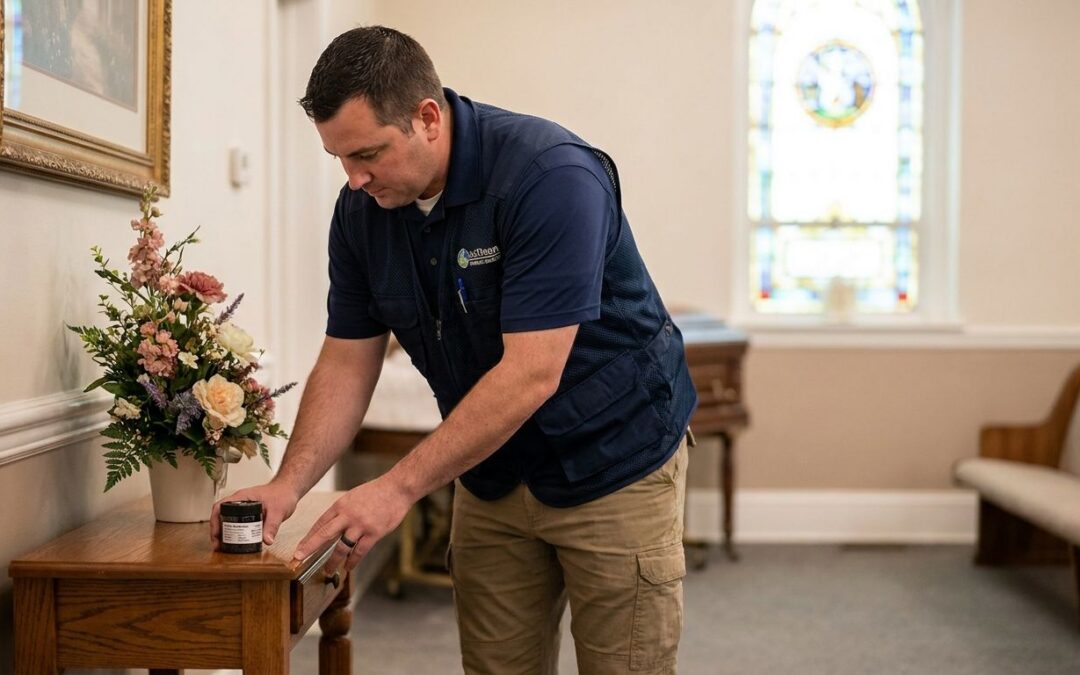
Funeral homes run occupied basements every business day of the year, and Michigan's glacial soil pushes radon into those below-grade spaces harder than most states see. This guide covers what radon testing for funeral home michigan operators actually requires, what separates a real commercial protocol from a leftover residential checklist, and which testing or mitigation option fits an embalming room, a prep room, or a viewing space where staff spend full shifts.
- Radon testing for funeral homes in Michigan starts with a 48-hour short-term test; continuous monitoring documents it better. Buy continuous.
- EPA’s action level is 4 pCi/L, and Michigan’s glacial till geology pushes many basements above it before anyone tests.
- NRPP-certified contractors document results for insurance and staff-safety records. Skip uncertified inspectors for a commercial building.
- Embalming room negative-pressure ventilation can pull more soil gas indoors, so HVAC and mitigation design need to be coordinated.
- Retail DIY kits suit a single-family basement, not a staffed commercial building with liability exposure. Skip for funeral homes.
Why this matters
A funeral home isn't a vacant house sitting on the market for 90 days. It's a staffed commercial building where embalmers, funeral directors, and office staff work eight-hour shifts directly above or beside the soil gas entry points radon uses: sump pits, floor drains, cove joints, and slab penetrations. The EPA's action level is 4 picocuries per liter (pCi/L), and radon exposure is the second leading cause of lung cancer in the U.S. after smoking. That risk compounds with time spent in the space, and funeral home staff often log more basement hours in a year than a typical homeowner does in a decade.
Michigan's own geology raises the baseline. The EPA's Radon Zone map lists numerous Michigan counties, including several across the Metro Detroit and Lansing corridor, in Zone 1 — the highest radon potential category, driven by the glacial till that blankets the state. A funeral home built on a full basement or slab-on-grade foundation in that footprint has real odds of testing above 4 pCi/L, and commercial radon testing in Metro Detroit follows a different protocol than the kind used for a home sale.
Who this is for
This guide is written for funeral home owners, funeral directors, and facility managers responsible for a building where embalming, preparation, and viewing rooms sit at or below grade. If your building has a basement-level prep room, a sump pump, or a slab foundation poured directly on Michigan glacial soil, this applies to you whether the building is 15 years old or a century-old converted residence.
What to look for in radon testing for funeral homes
Commercial-grade testing protocol, not a residential checklist
A funeral home has continuous mechanical ventilation, staff traffic, and negative-pressure exhaust in the embalming room — none of which apply to a closed-house residential test. The contractor needs a protocol built for occupied commercial buildings, not the standard 12-hour closed-house rule used for home sales.
NRPP certification with commercial building experience
Anyone can sell a test kit. NRPP certification means the technician follows EPA measurement protocols and can defend the results if an insurer, an employee, or a regulator ever asks. Ask directly whether the contractor has tested commercial buildings, not just single-family homes, before hiring.
Compatibility with embalming room ventilation
Embalming rooms run negative-pressure exhaust to control formaldehyde fumes. That negative pressure can pull more soil gas — and more radon — into the building than a passive residential basement would see. Mitigation design has to account for that airflow, not fight it.
Documentation you can hand to an insurer or inspector
A staffed commercial building carries liability exposure a vacant house doesn't. Test results, mitigation system specs, and maintenance logs need to be organized enough to hand over during an insurance review or a workplace safety inquiry without scrambling.
A maintenance plan built for continuous occupancy
A mitigation fan in a funeral home runs every day, all year, unlike a system in a house that sells and changes hands. Fan life and system checkups need a maintenance cadence built around continuous duty, not a five-year forget-it warranty alone.
Top picks: testing and mitigation options for funeral homes
The baseline check — 48-hour short-term test. A charcoal canister or short-term electronic test run over 48 hours gives a fast read on whether a building needs a closer look. It's the right first move before committing budget to anything else. Verdict: Consider as a starting point, not a final answer for a staffed commercial building.
The audit-ready option — 90-day to 1-year continuous monitor. Continuous monitoring captures seasonal swings in a way a two-day snapshot can't, which matters when embalming room exhaust runs on a variable schedule. This is the option that produces a record you can actually hand to an insurer in 2026 or beyond. Verdict: Buy for any funeral home planning to keep documentation on file long-term.
The permanent fix — sub-slab depressurization. When a test comes back above 4 pCi/L, a sub-slab depressurization system is the standard mitigation response, and how to choose the right radon mitigation system type breaks down which configuration fits a basement, crawl space, or slab foundation. Verdict: Buy for any building testing above the EPA action level.
The credential check — an NRPP-certified full-service contractor. Hiring from the list of NRPP-certified radon mitigation companies in Michigan removes the guesswork on whether a technician's results will hold up under scrutiny. Verdict: Buy — this is the credential that makes every other decision on this list defensible.
The wildcard — retail DIY test kit. A drugstore test kit works fine for a homeowner checking a basement before winter. It doesn't produce chain-of-custody documentation, and it wasn't designed for a building with staff working full shifts and public visitors moving through it daily. Verdict: Skip for a funeral home; the liability exposure outweighs the convenience.
Get radon testing scheduled
NRPP-certified testing and mitigation for Metro Detroit and Lansing commercial buildings.
What to avoid
- A one-time DIY kit as your only compliance record. It looks like it satisfies due diligence, but it has no chain of custody and won't hold up if an employee ever raises a health and safety concern.
- Testing while embalming room exhaust is shut off for the day. Results collected under different ventilation conditions than normal operations don't reflect what staff actually breathe during a work shift.
- Hiring a contractor without asking about commercial experience. A technician who's only tested single-family homes may not adjust the protocol for a building running continuous mechanical ventilation.
Comparison table
| Option | Duration | Documentation strength | Best for | Verdict |
|---|---|---|---|---|
| 48-hour short-term test | 48 hours | Baseline snapshot | Quick pre-decision check | Consider |
| 90-day to 1-year continuous monitor | 90 days to 1 year | Audit-ready, defensible | Ongoing occupied basements | Buy |
| Sub-slab depressurization system | Permanent install | Ongoing mitigation record | Levels above 4 pCi/L | Buy |
| NRPP-certified full-service contractor | Varies by scope | Insurance/liability-ready | Any funeral home | Buy |
| Retail DIY test kit | 2-90 days | Weak, no chain of custody | Single-family homes only | Skip |
For a broader sense of pricing and vendor selection across Michigan, best radon testing companies near you in Michigan lays out how quotes and turnaround times compare across the state heading into 2026.
FAQ
Is radon testing required for funeral homes in Michigan?
Michigan doesn’t have a radon testing mandate specific to funeral homes as of 2026, but staff spend full shifts in basement-level prep and embalming rooms, the same below-grade spaces where radon concentrates most.
What’s a safe radon level for a commercial building?
The EPA’s action level is 4 pCi/L for any building, residential or commercial. A funeral home testing above that threshold should move to mitigation rather than retesting repeatedly and hoping for a different result.
How long does a radon test take for a funeral home?
A short-term charcoal test runs 48 hours and gives a baseline. A continuous monitor run over 90 days to a year gives a more defensible record for a building occupied every business day.
Can embalming room ventilation affect radon levels?
Yes. Negative-pressure exhaust used to control formaldehyde fumes can pull more soil gas, including radon, into the building. Mitigation design needs to account for that airflow rather than ignore it.
How much does radon mitigation cost for a commercial building?
Costs vary by building size, foundation type, and system complexity. Getting a written quote from an NRPP-certified contractor after testing is the only reliable way to know the number for a specific building.
Do DIY radon test kits work for a funeral home?
A retail kit can give a rough read, but it lacks the chain-of-custody documentation a staffed commercial building needs if an insurer or employee ever asks for records.
What certification should a radon contractor have?
Look for NRPP certification, which confirms the technician follows EPA measurement protocols. Ask specifically whether they’ve tested commercial buildings, not only single-family homes.
How often should a funeral home retest for radon?
Retesting every two years is a reasonable interval for an occupied commercial building, and any mitigation system installed should be checked on the same cycle to confirm it’s still holding levels below 4 pCi/L.
One last thing
Most radon guidance assumes an empty house sitting closed up for a real estate closing. A funeral home never sits closed — the embalming room exhaust runs, staff move through the basement all day, and visitors pass through viewing rooms above it. That's exactly why a 48-hour snapshot test undersells the picture: it measures a building that isn't behaving the way it does on a normal Tuesday in 2026. A continuous monitor catches what the building actually does under real operating conditions, which is the only number worth acting on.
Related guides
- Radon control services for Michigan senior care facilities
- Radon control services for Michigan medical and dental offices