
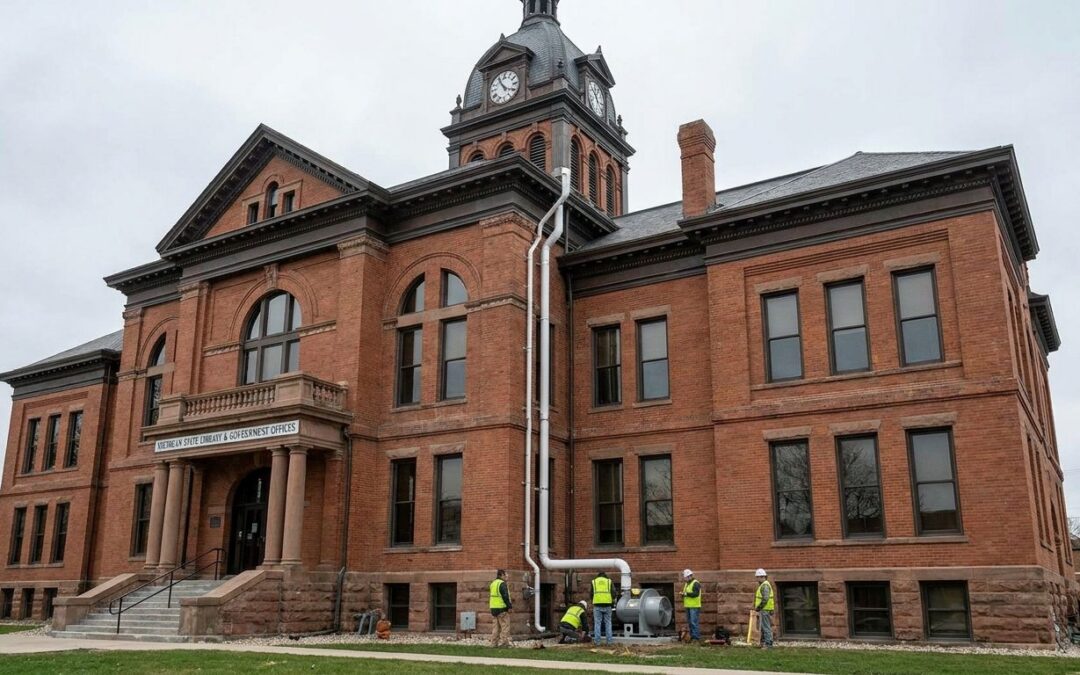
Michigan libraries, city halls, courthouses, and township offices sit on the same radon-prone soil that drives elevated readings in Michigan homes — but a 40,000-square-foot public building doesn't get fixed with the same single-fan system that works in a ranch house basement.
- Radon mitigation for a Michigan government building needs multi-zone sub-slab depressurization, not one homeowner-grade fan.
- EPA’s action level is 4 pCi/L for any occupied space, including library reading rooms and courthouse basement offices.
- Verify NRPP certification and commercial bonding before a contractor touches a public building in 2026.
- Multi-year service contracts beat one-time installs for buildings with continuous public occupancy.
- Single-point testing across a large footprint misses hot spots — buildings over 10,000 square feet need zone-based testing.
Why this matters
Staff in a township office or library work 8-hour shifts, five days a week, in the same building for years. That's a different exposure pattern than a homeowner spending evenings in a basement rec room, and it's why radon mitigation for public buildings gets treated differently in procurement and facilities planning.
Michigan's geology — glacial till over uranium-bearing bedrock in much of the Lower Peninsula — is the same underneath a courthouse as it is underneath a house three blocks away. The difference is scale: a library with a slab foundation, a mechanical room, and a below-grade archive room has multiple potential entry points for soil gas, and one radon test kit in one hallway won't tell you what's happening in the record storage room 80 feet away. Confirming a contractor's NRPP-certified radon mitigation credentials is the starting point before any conversation about system design.
Who this is for
This guide is for facilities directors, township and city administrators, library board members, and procurement officers responsible for radon testing and mitigation in publicly owned buildings across Metro Detroit and the Lansing area. If you manage a building with rotating staff, public foot traffic, and a bid process that requires documented insurance and bonding, the buying criteria below apply directly to you.
What to look for in radon mitigation for government buildings
Commercial-scale sub-slab system design
A residential radon fan sized for a 1,500-square-foot basement won't create enough vacuum across a 10,000-square-foot slab. Public buildings typically need multiple suction points and larger-diameter piping runs to pull soil gas evenly across the footprint, and an undersized system can leave one wing of a building above the EPA's 4 pCi/L action level while the rest tests fine.
Multi-zone testing, not one canister
A library with a basement archive, a main floor, and a mechanical room needs testing in each zone, not a single short-term kit placed in the lobby. Radon levels vary by room depending on foundation type, HVAC pressure, and proximity to slab penetrations, so one data point from one corner of the building tells you almost nothing about the rest of it.
HVAC interaction
Large public buildings run continuous mechanical ventilation, and that system pressurizes or depressurizes different zones throughout the day. A mitigation system designed without accounting for the building's HVAC balance can underperform or, in rare cases, get partially offset by the ventilation system pulling air in the opposite direction.
Bonding, insurance, and bid compliance
Public procurement usually requires documented liability coverage and bonding before a contract is awarded, and that paperwork needs to be current, not just referenced in a sales pitch. Verifying a contractor's insurance and bonding before signing protects the building owner if something goes wrong during installation, especially in an occupied building with public access during work hours.
Multi-year service and monitoring
A government building doesn't get sold in five years the way a house might. Fan performance, U-tube manometer readings, and seal integrity need to be checked on a schedule, not left until someone notices a musty smell or a pressure gauge reading that's drifted out of range.
Top picks for Michigan public buildings
1. The credential check — Buy
A contractor's NRPP certification and current bonding paperwork should be the first thing on a procurement checklist, not the last. Verified insurance and bonding documentation is what protects a municipality if an installation causes damage or a fan fails within the first year. Verdict: Buy — this is non-negotiable for any public building contract in 2026.
2. The building-type parallel — Consider
Schools and daycare centers in Michigan face nearly identical exposure math to libraries and government offices: continuous occupancy, large slab footprints, and a public trust obligation to keep indoor air below the EPA action level. Reviewing how radon mitigation for daycare centers and schools in Michigan gets designed gives a useful reference point for system sizing and testing frequency in a comparable large-occupancy building. Verdict: Consider as a design benchmark, not a substitute for a building-specific assessment.
3. The protocol fit — Buy
Commercial buildings in Metro Detroit follow a different testing protocol than single-family homes — multiple sampling points, longer monitoring windows in some cases, and documentation suited to a facilities file rather than a homebuyer's closing packet. The approach used for radon testing for commercial buildings in Metro Detroit is the closer match for a library or municipal building than any residential testing guide. Verdict: Buy — insist on a commercial-scale test plan before any mitigation quote is finalized.
Get a facility-specific radon assessment
NRPP-certified testing and mitigation design for Michigan public buildings.
What to avoid
- A single test kit in a single hallway. One canister in a lobby tells you nothing about a records room below grade or a mechanical room with its own slab penetrations.
- A residential-grade fan on a commercial footprint. A fan sized for a 1,500-square-foot basement won't pull enough vacuum across a 15,000-square-foot slab, and the system will underperform quietly for years before anyone notices.
- A contractor without current bonding paperwork. Public bid requirements exist for a reason — verify the documentation before the contract is signed, not after work starts.
Verdict comparison
| Requirement | Why it matters for public buildings | Verdict |
|---|---|---|
| NRPP certification + bonding | Protects the municipality under public bid requirements | Buy |
| Multi-zone testing | One test point misses radon variance across large footprints | Buy |
| Commercial system sizing | Residential fans underperform on large slabs | Buy |
| Service contract | Continuous occupancy needs scheduled monitoring, not a one-time fix | Consider |
FAQ
Do Michigan government buildings have to test for radon?
There’s no blanket state mandate forcing every library or township office to test, but the EPA action level of 4 pCi/L applies to any occupied space, and many municipalities test proactively as part of facilities risk management in 2026.
What’s different about radon mitigation for a large public building versus a house?
Scale and occupancy. A public building needs multi-zone testing, larger sub-slab piping runs, and system design that accounts for continuous HVAC operation, not the single-point testing and single-fan setup used in most homes.
How much does radon mitigation cost for a government building in Michigan?
Costs vary widely based on square footage, foundation type, and number of suction points required, and public buildings typically need a site-specific quote rather than a flat residential price. A facilities-specific assessment is the only reliable way to budget it.
How often should a library or courthouse retest radon levels?
A mitigated building should be retested after installation to confirm the system is working, then checked periodically as part of routine facilities maintenance. Systems with continuous monitors give ongoing readings instead of relying on a single annual test.
Can radon mitigation systems interfere with a building’s HVAC?
A poorly designed system can work against a building’s mechanical ventilation if the two aren’t balanced together. That’s why commercial-scale design accounts for HVAC pressure zones instead of treating the mitigation system as a standalone fix.
Is radon mitigation for a public building a one-time install?
No — fans, seals, and pressure gauges need periodic checks, and a multi-year service arrangement catches problems like fan wear before radon levels drift back above 4 pCi/L. Treat it as ongoing facilities maintenance, not a single project.
Who is responsible for radon testing in a Michigan municipal building?
Responsibility usually falls to the facilities director or building administrator managing the property, since there’s no single state agency that tests every public building automatically. It’s a proactive decision, not a default requirement, in most Michigan municipalities.
One last thing
Most of Michigan's Lower Peninsula falls in the EPA's highest radon potential zone, which means the same geology driving elevated basement readings in Metro Detroit homes runs directly under the slab of the county courthouse down the street. A library board that tests one wing and calls it done is making a decision based on incomplete data — the EPA's 4 pCi/L threshold doesn't care whether the room in question is a family basement or a public reading room. Michigan Radon Control approaches public building assessments the same way it approaches any radon mitigation project in 2026: test first, size the system to the building, then keep checking it.
Related guides