
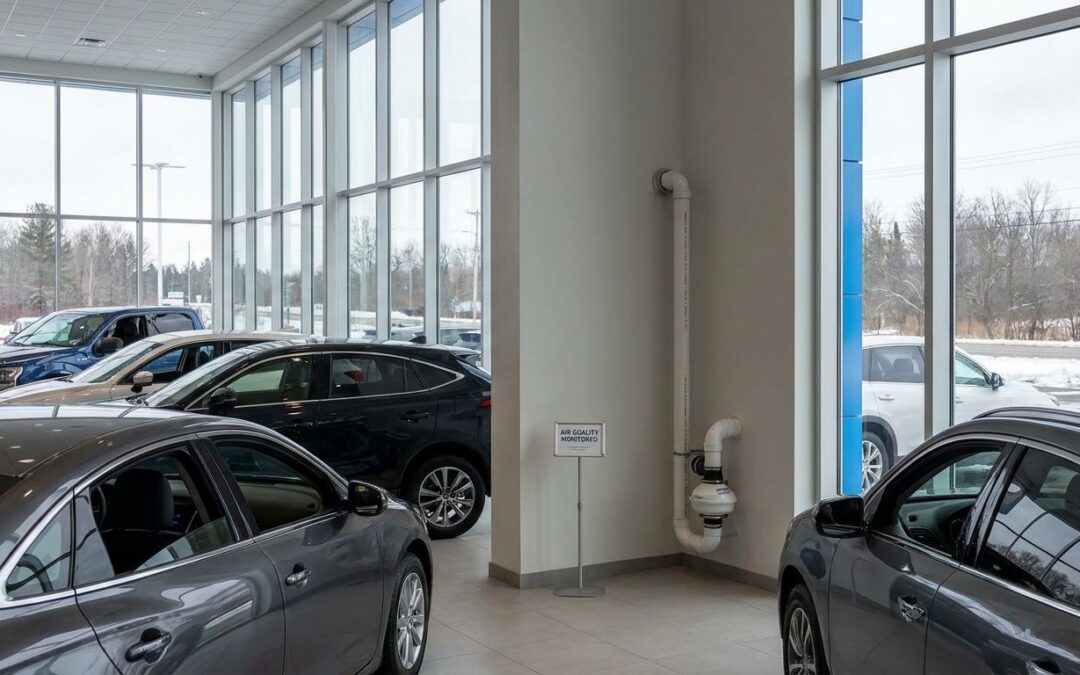
Metro Detroit and Lansing dealerships sell cars on slab floors poured directly into radon-heavy Michigan soil, and a failed radon test during a lease renewal, insurance renewal, or franchise audit costs a lot more than a scheduled installation would have.
- Sub-slab depressurization is the standard fix for radon mitigation car dealership Michigan buildings on slab floors. Buy.
- Detached service bays and pole-barn style shops need their own suction point, not a shared line from the showroom system.
- NRPP-certified contractors document commercial installs for lease audits and insurance files; unlicensed bids usually skip that paperwork entirely.
- Any occupied space testing above 4.0 pCi/L, showroom floors included, triggers EPA action-level guidance in 2026.
Why this matters
Radon is a byproduct of uranium decay in soil and rock, and Michigan's glacial till sits over deposits that push indoor levels higher than the national average in a lot of counties. A dealership showroom is basically a large, open slab-on-grade building with a service bay attached — the same entry points that let gas into a house (cracks, sump pits, floor drains) exist under a 20,000 square foot showroom floor too.
GMs and facility managers don't usually think about commercial radon testing in Metro Detroit until a real estate transaction, an OEM facility audit, or an employee health complaint forces the issue. By then it's a deadline problem instead of a planning problem.
Who this guide is for
This is written for dealership owners, general managers, and facility managers responsible for a Michigan showroom, service department, or parts building — especially locations built on a concrete slab with an attached or detached service bay. If you're renewing a commercial insurance policy, closing on a dealership property, or responding to a franchise standards audit that flags indoor air quality, the decisions below apply directly to your building.
What to look for in radon mitigation for a Michigan dealership showroom
1. Foundation type: slab-on-grade vs. mixed crawl space
Most showroom floors are poured slab-on-grade, but the service bay or parts area behind them is often a different foundation type entirely, sometimes even a crawl space under an older addition. A contractor who quotes one system for the whole building without walking both foundation types is guessing, not designing.
2. System capacity for open showroom floor plans
A single-point suction system sized for a 1,500 square foot ranch home won't pull consistent negative pressure under a 15,000-30,000 square foot open showroom slab. Dealerships need multi-point sub-slab systems or manifolded suction pits to get even pressure differential across the whole floor.
3. Noise and vibration tolerance near customer areas
A fan humming in a residential basement is a non-issue; a fan humming near the customer lounge or finance office during a sale is a problem. Exterior-mounted, insulated fan housings and routing the exhaust stack away from entrances matter more here than in a typical home install.
4. NRPP certification and commercial installation experience
Radon mitigation in a commercial building involves larger duct runs, sometimes tie-ins near HVAC returns, and electrical work that has to meet code for a business occupancy, not a residential one. Confirm the NRPP-certified radon mitigation companies you're evaluating have actually installed in commercial or mixed-use buildings, not just single-family homes.
5. Documentation for insurance, leases, and multi-year service contracts
A dealership carries commercial property insurance, a franchise agreement, and often a triple-net lease — all of which may ask for proof of indoor air quality compliance at renewal. Get post-mitigation test results, system specs, and warranty paperwork in writing, filed the same way you'd file a fire suppression inspection record.
“A showroom slab with no vapor barrier underneath behaves exactly like a house built straight on soil — the gas has nowhere else to go but up through the floor.”
Top picks: mitigation approaches for dealership buildings
1. Sub-slab depressurization for the showroom floor — the safe pick. This is the standard approach for slab-on-grade radon mitigation, adapted to commercial scale with multiple suction points tied into one or two manifolded fans. It handles the large, uninterrupted concrete floors common in showrooms built after the 1990s. Buy for any dealership with a single continuous slab under the sales floor.
2. Separate system for detached service bays and pole-barn style shops — the one people skip. A service department built as its own structure, especially anything closer to a pole-barn or outbuilding design than a finished commercial space, needs its own suction point rather than a shared duct run from the main building, the same logic covered in pole barn and outbuilding mitigation. Buy if your service bay is a separate structure; Skip trying to extend one system across two buildings.
3. Multi-point manifold systems for showrooms over 10,000 square feet — the workhorse. Instead of one fan pulling from one pit, larger footprints need two to four suction points feeding a shared exhaust stack to maintain even pressure differential across the whole slab. Consider this the default spec for any showroom built after 2000 with an open floor plan over 10,000 square feet.
4. Passive stack systems with no fan — the wildcard that usually fails here. Passive systems rely on natural air pressure differences and stack effect, which works occasionally in small residential crawl spaces but rarely generates enough draw across a large commercial slab. Skip passive-only designs for any showroom testing above the EPA's 4.0 pCi/L action level; they don't move enough air across that much square footage.
Get a showroom radon assessment
NRPP-certified testing and mitigation sized for Michigan commercial buildings.
What to avoid when mitigating a dealership showroom
- A residential-scale bid with no square footage math. If a quote doesn't specify the number of suction points or fan CFM relative to your slab size, it was priced off a home-sized template, not your building.
- Skipping post-install verification testing. A system that isn't verified with a follow-up test after installation is a system nobody actually confirmed is working — insurance and lease auditors in 2026 increasingly ask for that paperwork specifically.
- Routing exhaust near fresh-air intakes or entrances. A stack terminated too close to an HVAC intake or a customer entrance recirculates the exact gas the system is supposed to remove.
Verdict comparison table
| Approach | Best for | Fan required | Verdict |
|---|---|---|---|
| Sub-slab depressurization | Open showroom slab, single structure | Yes | Buy |
| Separate system for detached bay | Pole-barn or standalone service building | Yes | Buy |
| Multi-point manifold | Showrooms over 10,000 sq ft | Yes, 1-2 units | Consider |
| Passive stack, no fan | Small ancillary rooms only | No | Skip |
Michigan Radon Control designs and installs radon mitigation systems built around the foundation type and square footage a dealership actually has, not a residential default, and backs commercial installations with the same 5-year warranty terms used on residential work.
FAQ
Does radon testing apply to commercial buildings like car dealerships in Michigan?
Yes, radon testing applies to any occupied building, and commercial spaces like dealership showrooms and service bays follow the same EPA action level of 4.0 pCi/L used for homes. Franchise audits and commercial insurance renewals increasingly ask for documented results in 2026.
How much does radon mitigation cost for a dealership showroom?
Cost scales with square footage, the number of suction points needed, and whether the service bay requires a separate system from the showroom. A licensed contractor needs to walk the building and measure the slab before pricing it accurately.
Is radon a concern for large open showroom floors?
Yes, an open showroom slab has the same entry points as a home foundation, just across more square footage, which is why a single residential-sized fan often can’t pull enough negative pressure across the whole floor. Multi-point systems address that gap.
Can one system cover an entire dealership building?
Usually not if the service bay or parts department is a separate structure or a different foundation type from the showroom. Detached service bays typically need their own suction point rather than sharing a duct run.
Do Michigan car dealerships require radon testing by law?
Michigan does not mandate radon testing for commercial buildings the way it does disclosure for home sales, but franchise standards, lease terms, and insurance carriers increasingly request it as part of facility compliance in 2026.
How long does radon mitigation installation take for a commercial building?
A single-structure showroom install typically completes in one to two days, while a building with a separate service bay system takes longer because it requires a second suction point and fan setup. Post-install verification testing adds a few more days before results confirm the fix worked.
What radon level is dangerous in a business setting?
The EPA action level of 4.0 pCi/L applies to any occupied space, business or residential, and levels above that call for mitigation. Levels between 2 and 4 pCi/L are still worth addressing given how much time staff spend in the building daily.
Does radon mitigation work in buildings with attached service bays?
Yes, but the service bay usually needs its own suction point evaluated separately from the showroom slab, since attached bays are often built at a different date or foundation type than the main structure. Treating the whole building as one system usually under-performs.
One last thing
Michigan's glacial till sits over uranium-bearing bedrock across a large stretch of the Lower Peninsula, which is exactly why elevated indoor radon shows up in commercial buildings as often as it does in single-family homes — the geology under a dealership lot doesn't care what's built on top of it. Heading into 2026, that's the detail most facility managers miss until an audit forces the conversation.
Related guides
- How to verify a radon contractor's insurance and bonding
- Radon mitigation for Michigan pole barns and outbuildings