
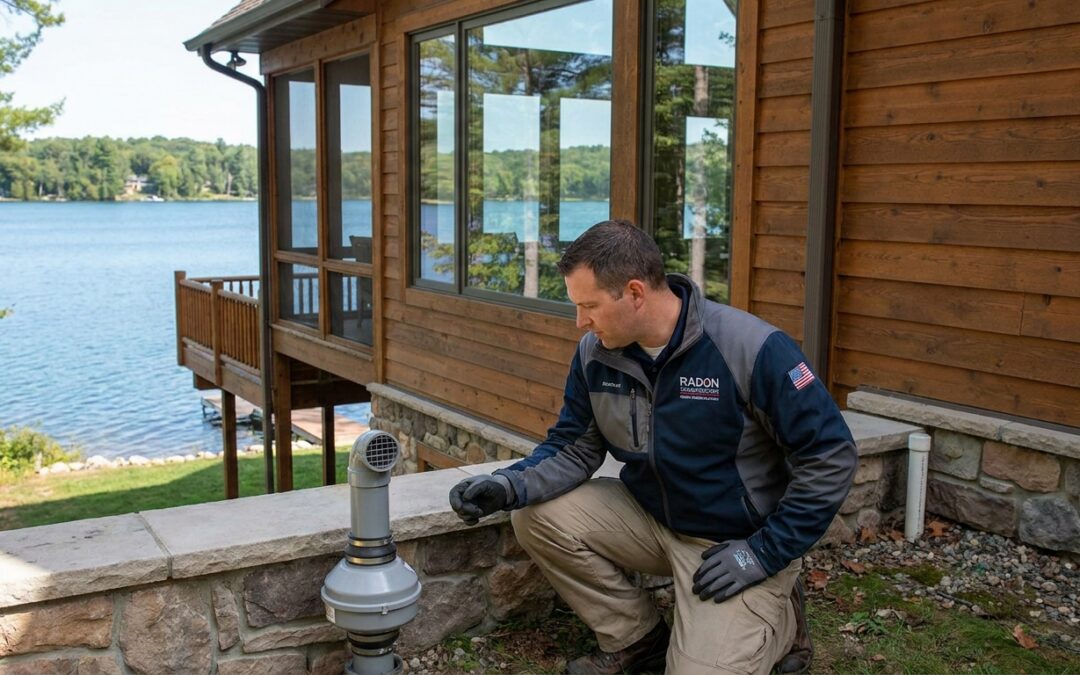
Lakefront and waterfront homes sit on some of the wettest, most permeable soil in Michigan, and that soil condition changes what a radon system has to do. Radon mitigation for lakefront homes in Michigan isn't a smaller version of a suburban install — it's a different engineering problem built around water tables, sump crocks, and seasonal occupancy.
- Radon mitigation for lakefront homes in Michigan usually needs an active system — passive setups fail near high water tables.
- Sump pump crocks in lake-adjacent basements need airtight lids or radon leaks straight into living space.
- Crawl space cottages along Michigan’s shoreline need sealed vapor barriers before any fan goes in.
- Seasonal lake homes closed for winter still need radon monitoring — closed-house conditions raise readings, not lower them.
Why this matters
A standard sub-slab depressurization system pulls a vacuum under the slab and vents radon-laden air above the roofline. That works fine when the soil underneath is dry sand or gravel. Near a lake, the water table often sits within a few feet of the foundation, and saturated soil chokes the suction path a fan needs to pull air from.
Homes on Lake St. Clair, the shoreline of Lake Michigan, and Michigan's thousands of inland lakes deal with this constantly. A radon mitigation system built for a high water table uses different piping layouts and sometimes a stronger fan than a system installed three miles inland on dry ground. Get the diagnosis wrong and you end up with a system that never brings levels below the EPA action level of 4.0 pCi/L, no matter how long it runs.
Who this is for
This guide is for year-round homeowners on Michigan's lakeshores, seasonal cottage owners who close up for winter, and realtors handling waterfront listings where a radon disclosure is about to become a negotiating point. If your home sits within a few hundred feet of open water, on a walkout basement, crawl space, or slab foundation, the standard mitigation playbook needs adjusting before a contractor breaks ground.
What to look for in radon mitigation for lakefront homes
Water table depth at the foundation
A contractor who doesn't ask about your water table depth before quoting a system is skipping the most important variable on a lake property. Saturated soil under a slab reduces the air permeability a suction fan relies on, which often means routing multiple suction points instead of one, or specifying a higher-capacity fan from the start.
Foundation type and how water moves through it
Walkout basements, crawl spaces, and slab-on-grade all behave differently near water. A crawl space cottage with standing water under the vapor barrier needs sealing work done before any fan is installed — otherwise the fan pulls moisture instead of radon.
Sump pump interaction
Most lakefront basements run a sump pump to manage groundwater, and the sump crock is frequently the easiest entry point for soil gas. An airtight sump lid tied into the mitigation system does double duty: it keeps radon from leaking through the crock and keeps the discharge line from short-circuiting suction.
Exterior fan placement and aesthetics
Lake homes are often built with the view in mind, which means exterior fan and pipe placement matters more than it does on an inland ranch. A system routed up an interior wall or through the attic keeps the exterior clean without sacrificing performance.
Seasonal occupancy patterns
A cottage closed from October to April still needs a working radon system, and closed-house conditions actually push indoor radon readings higher, not lower. Continuous monitoring matters more for a seasonal lake home than for a house occupied year-round, because nobody's around daily to notice a fan that's stopped running.
Electrical and corrosion resistance
Lakefront air carries more moisture, and moisture corrodes electrical connections faster. Fan wiring and junction boxes near open water need weatherproof housing rated for the exposure, not the bare-minimum indoor hardware used on a dry inland install.
Get a radon plan built for your lake home
NRPP-certified inspection and mitigation sized for high water tables and seasonal use.
Top picks by foundation type
The workhorse for high water tables. Active sub-slab depressurization with a sealed sump lid handles saturated soil better than any passive option, and it's the approach most Metro Detroit and Lansing-area lake homes end up needing. Verdict: Buy.
The pick for sump pump basements. Tying the mitigation fan's suction into a sealed sump crock system closes the single biggest leak point in a lakefront basement. Skip this step and you can install a perfectly good fan that still can't hold levels below 4.0 pCi/L. Verdict: Buy.
The pick for crawl space cottages. A crawl space radon mitigation system built on a sealed vapor barrier is the right call for older lakeshore cottages that were never poured with a full basement. The membrane seal has to go in first — a fan alone won't compensate for an unsealed dirt floor. Verdict: Buy.
The wildcard for finished walkout basements. Interior wall-routed piping, painted to match, keeps a finished lake-view basement looking untouched while still venting through the roofline. It costs more in labor than an exterior run but avoids cutting into a lake-facing wall. Verdict: Consider.
The one to walk away from. A passive stack-only system with no fan, sold as a lower-cost option for a home with a documented high water table. It looks like savings on the quote and turns into a second install a year later once levels don't drop. Verdict: Skip.
“If the water table sits within a few feet of your slab, a passive system won’t hold radon below 4.0 pCi/L on its own.”
What to avoid
- Passive-only systems on a documented high water table. They look cheaper upfront and underperform the moment soil saturation rises in spring.
- Skipping the sump seal because "it's just a pump." An open sump crock is one of the easiest paths for soil gas to reach living space in a lakefront basement.
- Treating a seasonal cottage's radon system like a set-it-and-forget-it fixture. A fan can fail over a Michigan winter and nobody notices until the next test.
Verdict comparison table
| Foundation type | Recommended approach | Water table consideration | Verdict |
|---|---|---|---|
| High water table / walkout basement | Active sub-slab depressurization, sealed sump | Table within 5 ft raises suction demand | Buy |
| Crawl space cottage | Sealed vapor barrier + sub-membrane suction | Standing water under barrier is common | Consider |
| Slab-on-grade lake home | Exterior suction routed through attic | Limited interior routing options | Consider |
| Finished walkout basement | Interior wall-routed system, matched finish | Aesthetic constraints near lake views | Buy |
| Sump pump equipped basement | Airtight sump lid tied to suction point | Discharge line kept separate from radon vent | Buy |
FAQ
What’s the best radon mitigation system for a lakefront home in Michigan?
Active sub-slab depressurization with a sealed sump lid is the most reliable approach for lakefront homes in Michigan in 2026, since it accounts for the high water table most waterfront properties sit on. Passive-only systems frequently fail to hold levels below the EPA action level near open water.
Does a high water table affect radon mitigation?
Yes, a high water table reduces soil permeability and makes it harder for a mitigation fan to pull a consistent vacuum under the slab. Homes with the water table within a few feet of the foundation typically need a stronger fan or multiple suction points.
Is radon a bigger risk near Michigan lakes?
Radon risk near Michigan lakes comes more from soil geology and foundation type than proximity to water itself. Lakefront homes often have crawl spaces, walkout basements, or high water tables that change how radon enters, which is why the mitigation approach needs adjusting.
How much does radon mitigation cost for a waterfront home in Michigan?
Cost depends on foundation type, fan placement, and whether sump sealing or crawl space membrane work is needed on top of the base system. A detailed breakdown of installation cost factors is available on Michigan Radon Control’s budgeting guide.
Can a seasonal lake home skip year-round radon monitoring?
No, a closed seasonal home can see radon levels rise, not fall, because closed-house conditions trap soil gas indoors. Continuous monitoring catches a failed fan before the home reopens for the season.
Do sump pumps interfere with radon mitigation systems?
An open sump crock can undermine a radon system by letting soil gas bypass the sealed slab entirely. Sealing the crock and tying it into the mitigation system’s suction closes that gap.
How is radon mitigation different for crawl space cottages vs full basements?
Crawl space cottages need a sealed vapor barrier before a suction fan is added, while full basements typically go straight to sub-slab suction points. Skipping the membrane seal on a crawl space cottage leaves the fan pulling moisture instead of radon.
Do lakefront homes need special electrical work for radon fans?
Lakefront air carries more moisture, so fan wiring and junction boxes need weatherproof housing rated for that exposure. Standard indoor-grade electrical fittings corrode faster near open water.
One last thing
The detail most lakefront homeowners miss isn't the fan or the piping — it's the sump lid. A basement with an unsealed sump crock can undo an otherwise well-designed radon system, because the crock becomes the path of least resistance for soil gas once the slab itself is sealed off. Check the lid before assuming the fan is underperforming.
Related guides
- How to budget for a radon mitigation system installation
- How to verify your radon mitigation system is still working