
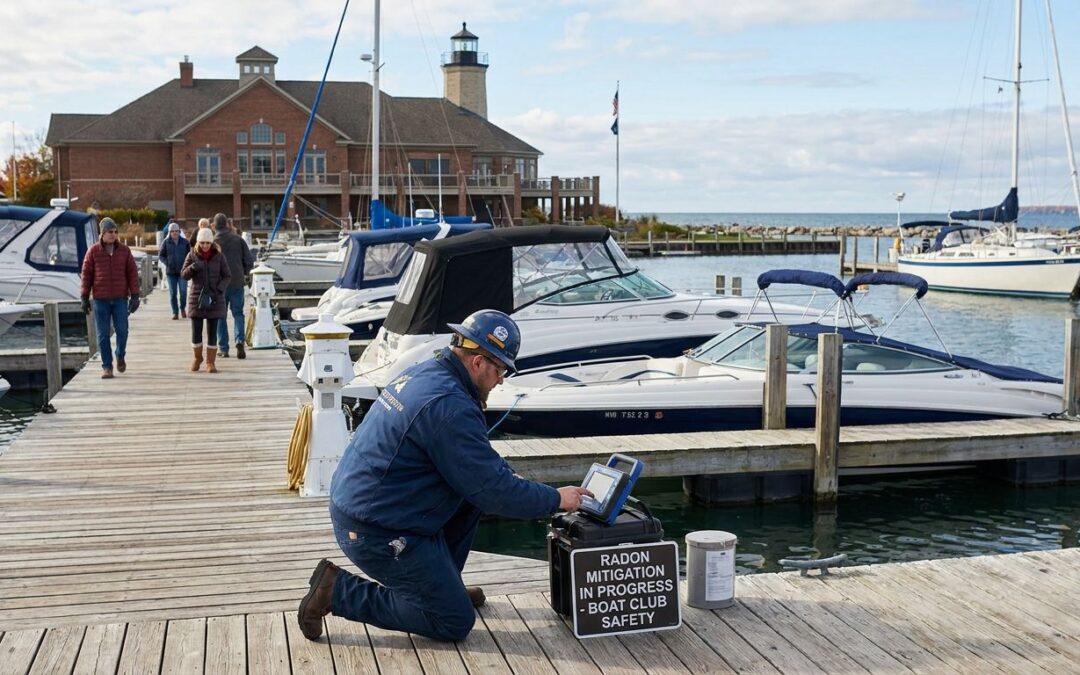
Michigan marinas and boat clubs sit on the same glacial till and uranium-bearing bedrock as everywhere else in the state, and the clubhouse, dry-stack barn, and harbor office on your property can each test differently for radon even though they're 50 feet apart.
- Radon mitigation for marina Michigan properties needs a per-building plan, not one system for the whole site.
- Sub-slab depressurization is the safe pick for poured-slab clubhouses and harbor offices in 2026.
- Pole-barn dry-stack buildings with dirt floors need sub-membrane depressurization, not a store-bought passive fan.
- Michigan’s EPA action level is 4 pCi/L, and proximity to open water does not lower that number.
- Skip any contractor on a multi-building marina job who isn’t NRPP certified for commercial work.
Why this matters
Marina and boat club properties combine several building types on one parcel: a slab clubhouse, a block-foundation harbor office, a pole-barn boat storage shed, sometimes a bathhouse with a crawl space. Each one has its own foundation, its own soil contact, and its own radon path into the air your staff and members breathe. Testing the clubhouse and assuming the storage barn is fine is the single most common mistake marina managers make in Michigan, and it's the one that leaves liability exposed if a live-aboard tenant or year-round harbor master spends 40+ hours a week in an untested building.
Michigan Radon Control has seen this pattern across commercial and outbuilding sites statewide: radon doesn't care how close a structure sits to Lake St. Clair, the Detroit River, or an inland marina channel. It comes up through soil gas, not lake water, and a building on sandy fill near the shoreline can test higher than one three miles inland.
Who this is for
This guide is for marina owners, boat club board members, harbor masters, and facility managers responsible for clubhouses, dockside offices, dry-stack storage barns, and bathhouses anywhere in Michigan. If you run seasonal staff through a harbor office from April to October, house a live-aboard caretaker year-round, or manage a members-only clubhouse with a finished lower level, this applies to your property. It also applies if you're weighing commercial radon testing across multiple structures before your 2026 season opens rather than testing one building and calling it done.
What to look for in radon mitigation for marinas and boat clubs
Foundation type per building, not per property
A marina parcel often has three or four foundation types on it: poured slab, hollow block, crawl space, and dirt-floor pole barn. Each needs a different mitigation approach, and a contractor who quotes one system for the whole site without inspecting every structure is guessing.
Seasonal occupancy windows
Most Michigan marinas run heavy occupancy from May through September and near-empty buildings from November through March. Test during the closed season when doors and windows stay shut for accurate baseline numbers, but plan mitigation installation for the off-season so fans and piping don't disrupt a summer schedule.
Humidity and vapor barrier compatibility
Dockside buildings run higher ambient humidity than a typical Michigan basement. Vapor barriers and membrane systems used in sub-membrane depressurization need to handle that moisture load without degrading, or the seal fails within a season or two.
Fan placement and electrical code near water
Radon fans mounted on exterior walls near a harbor need GFCI-protected circuits and weatherproof housing. A fan wired the way it would be on a landlocked suburban home can fail an inspection or trip breakers constantly in a marina environment.
Multi-structure liability
A harbor master living on-site, seasonal dockhands working out of the office, and members using the clubhouse lounge all represent different exposure windows. Insurance and liability exposure scale with how many hours people spend in each building, so prioritize testing where occupancy is highest first.
Top mitigation approaches for marina and boat club buildings
Sub-slab depressurization is the workhorse pick for poured-concrete clubhouses and harbor offices. A single 3-inch PVC riser and fan draw soil gas from beneath the slab before it reaches indoor air, the same slab-on-grade mitigation approach used on thousands of Michigan homes. It's proven, it's serviceable, and it handles the highest-occupancy building on most properties. Buy.
Sub-membrane depressurization is the fix for dry-stack boat storage barns with exposed dirt or gravel floors. A heavy poly membrane seals the floor and a fan pulls suction beneath it, which matters because a bare-earth pole barn has more soil contact than any slab structure on the property, the same logic covered in pole barn radon mitigation work. Buy.
Block-wall suction targets older harbor buildings built with hollow concrete block foundations, common in marina structures put up before the 1980s. Radon migrates through the hollow cores of the block itself, not just the slab, so the system draws suction directly from inside the block cavities. It works, but it's more invasive to install than slab suction and runs a higher cost on multi-wall buildings. Consider.
Drain-tile depressurization fits buildings with a perimeter french drain, which is common on any structure built close to a Michigan shoreline where the water table sits high. The existing drain tile becomes the suction path instead of drilling new penetrations through the slab. It's efficient where the plumbing already exists, but it depends entirely on the drain tile being intact and continuous around the foundation. Consider.
“Being fifty feet from open water does not lower your radon numbers a single decimal point.”
What to avoid
- Store-bought passive fan kits sized for a house, not a 3,000-square-foot dry-stack barn. Undersized fans move air but don't create enough suction across a large slab or dirt floor.
- Passive-only systems left unmonitored across multiple buildings. A passive stack works on paper but drifts out of range without a fan and a pressure check, and nobody's checking a passive system on a boat barn that's empty from November to April.
- Any contractor quoting the whole marina without walking every building. Commercial and multi-structure jobs need per-building assessment; a single flat quote for the entire property is a red flag, not a discount.
Verdict comparison
| System | Best for | Building example | Verdict |
|---|---|---|---|
| Sub-slab depressurization | Poured concrete slabs | Clubhouse, harbor office | Buy |
| Sub-membrane depressurization | Dirt or gravel floors | Dry-stack storage barn | Buy |
| Block-wall suction | Hollow block foundations | Pre-1980s harbor buildings | Consider |
| Drain-tile depressurization | High water table, existing drain tile | Shoreline structures | Consider |
Get every marina building tested
Request an inspection before your 2026 season opens.
FAQ
What’s the best radon mitigation system for a marina clubhouse in Michigan?
Sub-slab depressurization is the best fit for a poured-concrete clubhouse in Michigan. It uses a single fan and riser pipe to pull soil gas from beneath the slab before it enters occupied space.
Do boat storage barns with dirt floors need radon mitigation?
Yes, dry-stack storage barns with exposed dirt or gravel floors often need sub-membrane depressurization. A bare-earth floor has more direct soil contact than a poured slab, which can push radon readings higher.
Is radon higher near Michigan lakes and rivers?
Radon comes from soil gas, not surface water, so proximity to a lake or river doesn’t lower or raise readings on its own. Michigan’s glacial till and bedrock geology drive radon levels regardless of shoreline distance.
How much does radon mitigation cost for a marina property with multiple buildings?
Costs vary by building because each structure needs its own system sized to its foundation type. A property with a slab clubhouse and a pole-barn storage building typically needs two separate installations rather than one shared system.
When should a marina test for radon in Michigan?
Test during the off-season, from November through March, when buildings stay closed and give an accurate closed-house baseline. Michigan Radon Control recommends testing every structure on the property, not just the highest-occupancy building.
What is the EPA action level for radon in commercial buildings?
The EPA action level is 4 pCi/L for any occupied building, commercial or residential. A harbor office or clubhouse testing above that number should move to mitigation the same way a home would.
Can one radon mitigation system cover an entire marina property?
No, each building on a marina property needs its own system matched to its foundation type. A slab clubhouse, a block-foundation office, and a dirt-floor barn each require a different mitigation approach.
Does a marina need an NRPP-certified contractor for radon work?
Yes, multi-building commercial sites benefit from an NRPP-certified contractor who understands per-building assessment. NRPP certification is the credential to check before signing a contract for marina-wide radon mitigation.
One last thing
The biggest surprise for most marina managers isn't the cost of a mitigation system, it's finding out the pole barn tests higher than the clubhouse. A bare dirt floor under a boat storage building has more direct soil contact than any poured slab on the property, and Michigan Radon Control sees that exact result often enough that it's worth testing the barn first, not last, in 2026.
Related guides
- Best NRPP-certified radon mitigation companies in Michigan
- How to verify a contractor's insurance and bonding