
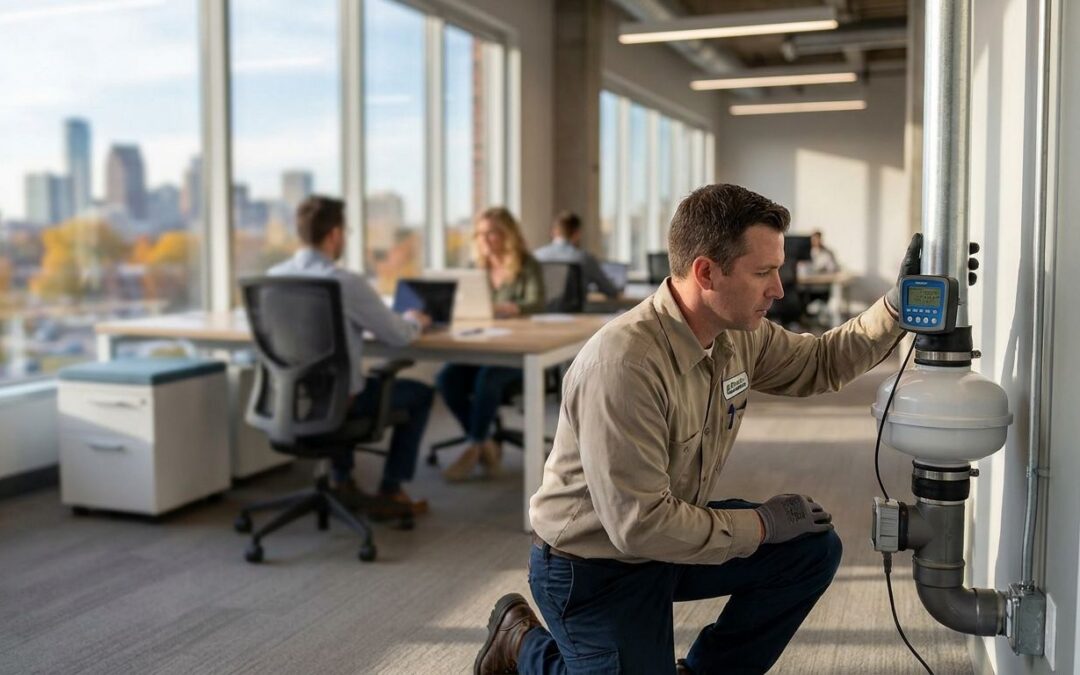
Coworking operators in Michigan manage more shared square footage above and below ground than a typical single-family home, and that changes how radon behaves inside the building. This guide breaks down which mitigation approaches actually work for multi-tenant office space, what to skip, and how to vet a contractor before a member asks why the air quality report looks the way it does.
- Sub-slab depressurization is the right call for most Michigan coworking buildings on slab or basement foundations — buy it.
- Crawl space systems fit converted houses and older commercial buildings with crawl space foundations — consider it.
- Passive-only stacks without a fan rarely hold radon below the EPA’s 4 pCi/L action level once daily foot traffic starts — skip it.
- Multi-year service contracts matter more here than in a single-family home because tenant turnover means nobody’s watching the gauge.
Why this matters
Michigan sits on glacial till over uranium-bearing bedrock, which is why radon levels here run higher than the national average in both homes and commercial buildings. A coworking space adds a wrinkle a single-family home doesn't have: multiple foundation zones, shared HVAC returns, and dozens of people breathing the same basement or ground-floor air eight or more hours a day.
The EPA's action level is 4 pCi/L regardless of whether the building is residential or commercial. For radon mitigation coworking space michigan operators, that number applies suite by suite, not just at the front door. A test run in the lobby doesn't tell you what's happening in the private office at the back of the ground floor with its own slab seam.
Most coworking buildouts happen inside repurposed retail space, converted warehouses, or older commercial buildings never designed with radon in mind. That mix of foundation types is exactly why a one-size system rarely fits, and it's why commercial buildings in Metro Detroit need testing before anyone assumes a system built for a house next door will work the same way here.
Who this is for
This guide is for coworking operators, building owners leasing to coworking brands, and property managers responsible for shared amenity floors in Metro Detroit and Lansing. If you're the person who has to answer a tenant's email about air quality, or the landlord signing a lease that includes radon disclosure language, the decisions below are yours to make before move-in, not after.
What to look for in radon mitigation for a Michigan coworking space
Foundation type and building age
A converted 1920s storefront with a crawl space behaves nothing like a 2018 slab-on-grade build. Know what's under the building before anyone quotes a system, because the wrong system type on the wrong foundation won't hold radon down no matter how well it's installed.
Zoning across floors and HVAC interaction
Shared HVAC returns can pull radon from a basement mechanical room straight into open-plan seating upstairs. Coworking floor plans change constantly as membership grows, so the mitigation plan needs to account for how air moves between private offices, phone booths, and open desks, not just the original blueprint.
NRPP certification and paper trail
A contractor's certification isn't a nice-to-have on a commercial job — it's what your insurer and your landlord will ask for if a tenant complains. Before signing anything, verify the contractor's NRPP certification directly rather than taking a business card's word for it.
Installation that respects business hours
A coworking space can't shut down for three days the way an empty house can during a mitigation install. Ask how much of the work — core drilling, fan mounting, pipe routing — can happen outside peak hours, and get that in writing before scheduling.
Ongoing monitoring built into the lease
A single install-day test tells you the level on that day, in that spot. Coworking spaces need a monitoring cadence that survives tenant turnover, because the person who signed off on the original test in 2023 or 2024 is rarely still on-site to remember it happened.
Top picks for coworking radon mitigation
The default pick: sub-slab depressurization (SSD). This is the standard system for any coworking space on a poured slab or basement foundation, and it's what most Metro Detroit and Lansing commercial installs come back to. A single suction point routed through 3- to 4-inch PVC pipe pulls radon from beneath the slab and vents it above the roofline before it ever reaches occupied space. If you're not sure which configuration fits your building's layout, compare radon mitigation system types before signing a proposal. Verdict: Buy.
The retrofit pick: crawl space mitigation with encapsulation. Older Michigan storefronts and converted houses turned into coworking suites often sit over crawl spaces instead of full basements. Encapsulating the crawl space and adding submembrane depressurization keeps radon from wicking up through open dirt floors, which a slab-focused system can't touch. It costs more upfront than a straight SSD install because of the encapsulation labor, but it's the only approach that actually works on this foundation type. Verdict: Consider.
The overlooked pick: a multi-year service contract with documented annual re-testing. A properly installed system typically carries a 5-year warranty, but that warranty is only worth something if someone is checking the fan, the gauge, and the suction points on a schedule instead of waiting for a complaint. For a building with rotating tenants, this is the difference between a system that works in 2026 and one that quietly fails by 2028 with nobody noticing. Verdict: Buy.
The skip: passive stack systems with no fan. A passive system relies on natural air pressure differences to move radon out, and it can work in a lightly occupied single-family home. It rarely holds a busy coworking floor below 4 pCi/L once dozens of people are opening doors, running HVAC, and generating the pressure changes that come with daily foot traffic. Verdict: Skip.
Get your coworking space tested
Request an inspection before you sign a lease or a mitigation contract.
What to avoid
- Consumer-grade fans not rated for continuous commercial duty cycles. A fan built for a homeowner's basement running a few hours a day will wear out faster under the round-the-clock demands of a shared office building.
- Testing only one spot in a multi-suite building. Radon levels can vary suite to suite depending on slab seams, sump locations, and utility penetrations — one lobby test doesn't clear the whole floor.
- Skipping tenant disclosure language in the lease. If a mitigation system is already installed, or if testing hasn't happened yet, that needs to be spelled out before a coworking tenant signs, not discovered after move-in.
Verdict comparison
| System type | Best for | Install disruption | Verdict |
|---|---|---|---|
| Sub-slab depressurization | Slab or basement coworking buildings | Low — 1 day, minimal downtime | Buy |
| Crawl space + encapsulation | Converted houses, older storefronts | Moderate — 1-2 days | Consider |
| Multi-year service contract | Any system, any building | None — scheduled visits only | Buy |
| Passive stack (no fan) | Not recommended for coworking | Low, but ineffective | Skip |
FAQ
Is radon mitigation required for Michigan coworking spaces?
Michigan doesn’t mandate radon mitigation for commercial buildings by law in 2026, but landlords and operators still carry liability if a tenant is exposed to levels above the EPA’s 4 pCi/L action level. Testing and disclosure protect both the operator and the tenant.
How much does radon mitigation cost for a commercial building?
Cost depends on square footage, number of suction points needed, and foundation type, since a coworking floor plan often needs more than one system zone. Get a site-specific estimate rather than relying on residential pricing, which assumes a single foundation.
How long does a radon mitigation install take in a coworking space?
A single sub-slab depressurization system typically installs in one day with minimal disruption to daily operations. A crawl space retrofit with encapsulation can take one to two days depending on square footage.
Can radon levels differ between suites in the same building?
Yes. Slab seams, sump pit locations, and utility penetrations vary suite to suite, so a test in the lobby doesn’t guarantee the same reading in a private office down the hall.
Do coworking tenants need to be told about radon testing results?
Disclosure isn’t always legally required for commercial leases, but sharing test results builds trust and avoids disputes later. Include the language in the lease before move-in, not after a tenant asks.
What’s the difference between active and passive radon mitigation systems?
An active system uses a fan to continuously pull radon out through vent pipe, while a passive system relies on natural pressure differences with no fan. Passive systems rarely hold commercial-density buildings below the EPA action level.
How often should a coworking space retest for radon after mitigation?
Annual re-testing is standard, and a multi-year service contract keeps that on a schedule instead of depending on staff turnover to remember it. This matters more in coworking buildings where the person who signed off on year one is often gone by year two.
One last thing
The detail most operators miss: radon doesn't stay put on one floor plan. A coworking space that adds a new suite of private offices in 2027 by knocking through what used to be storage space can open a new entry point a 2026 test never accounted for. Retest after any layout change that touches the slab or foundation wall, not just on the annual schedule.
Related guides