
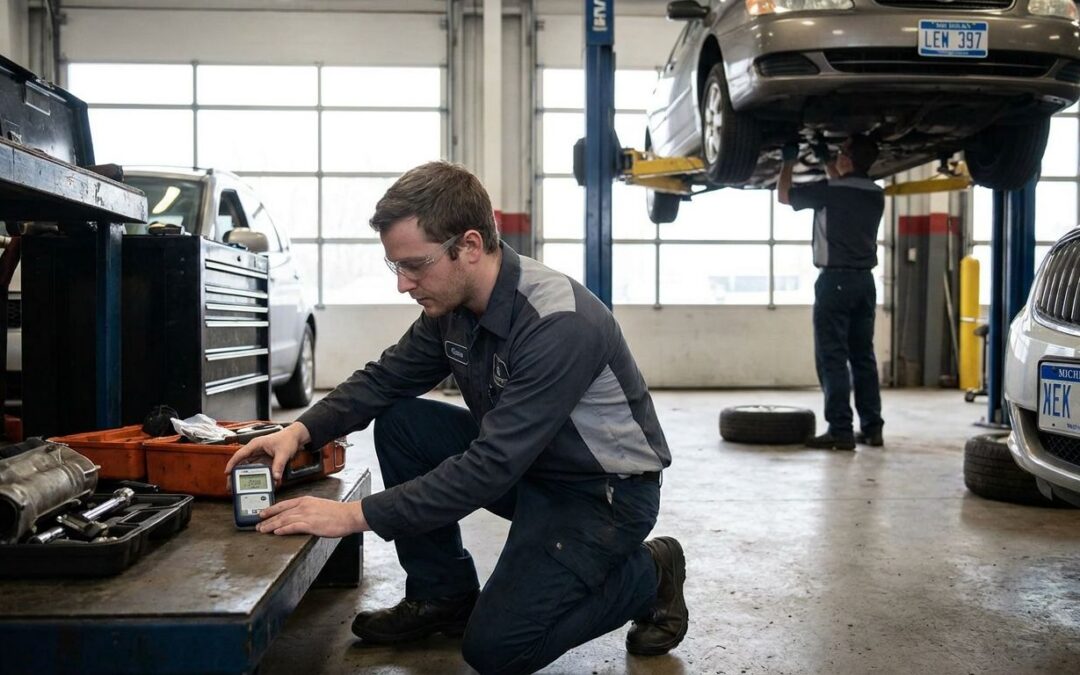
Auto repair shops sit low to the ground, run negative-pressure exhaust systems all day, and rarely crack a window during a Michigan January — three factors that push indoor radon above the EPA's 4 pCi/L action level more often than in a typical office. Radon testing for auto repair shops in Michigan follows a commercial protocol, not a homeowner test kit, and that difference matters for every technician working an eight-hour shift over a service pit.
- Radon testing for auto repair shops in Michigan needs a commercial protocol, not a homeowner kit.
- Slab-on-grade service bays are the most common radon entry point in Michigan shops — mitigation there is a Buy.
- Exhaust fans can pull more soil gas up through slab cracks, not less — ventilation alone isn’t a fix.
- NRPP-certified technicians matter more on commercial jobs over 5,000 square feet than on a single-bay garage.
- Multi-bay shops usually need more than one suction point — budget accordingly in 2026.
Why this matters
Michigan sits on radon-prone glacial till and uranium-bearing bedrock across much of the Lower Peninsula, and that geology doesn't stop at a home's foundation. An auto repair shop built on a slab, with employees standing over the same soil-gas pathway eight or more hours a day, faces the same exposure math as a homeowner spending a similar block of time in a basement.
The EPA sets 4 pCi/L as the action level for any occupied space, commercial or residential, and that number doesn't change because the building has a lift instead of a couch. A shop that has never tested has no idea whether its bays sit at 1.5 pCi/L or 9 pCi/L, and that gap is the line between a healthy building and a documented occupational hazard. Radon testing for commercial buildings in Metro Detroit follows the same ANSI/AARST-based protocol used for an office or a school, adjusted for square footage and HVAC zoning.
Michigan Radon Control treats a repair shop like any other occupied commercial building in 2026: multiple detectors, monitors placed away from bay doors and exhaust vents, and a report that names an actual pCi/L number instead of a pass/fail guess.
Who this is for
This guide is for shop owners, general managers, and facilities managers running an auto repair shop, body shop, or quick-lube location anywhere in Metro Detroit, Lansing, or the rest of Lower Michigan — especially in a building with a slab poured directly on grade, a service pit, or a basement break room. If your shop was built before 1990, sits on a crawl space, or has never had a radon test on file, this is your starting point for 2026.
What to look for in radon testing for auto repair shops
A testing protocol built for commercial square footage
A single test kit meant for a 1,500-square-foot ranch home doesn't cover a 6,000-square-foot shop with three bays and an office wing. Commercial radon testing places multiple detectors across distinct zones so one high reading in the parts room doesn't get diluted by a low reading up front.
Technician-level NRPP certification, not just a company license
Michigan doesn't require a separate state license for radon work, so NRPP certification is the clearest proof a technician actually understands commercial mitigation. Ask for the individual's certification number, not just a company name printed on a truck.
An honest read on how exhaust systems affect radon
Shop exhaust fans, paint booth ventilation, and open bay doors change the pressure inside a building constantly, and that pressure swing can pull more soil gas up through slab cracks — not less. A contractor who understands negative pressure tests with the shop running normal operations, not with everything shut off for a quiet reading.
Mitigation sized for multiple bays and zones
A shop with three or four bays on one slab often needs more than one suction point to bring the whole building under 4 pCi/L. A system designed for a single-family basement won't move enough air across a 40-foot-wide bay.
Documentation you can hand to insurance, a landlord, or a safety file
A results letter with a specific pCi/L number, test dates, and device placement is worth more than a verbal "you're fine." Shops that lease their building or carry workers' comp coverage need a paper trail showing the test happened and what it found.
Top picks for Michigan auto repair shops
1. Commercial-grade radon testing — the starting point. Every shop should start here, no exceptions. A commercial test typically runs a 48-hour short-term read or a 90-day long-term monitor placed per commercial guidelines, and it names an actual number instead of a guess. Verdict: Buy — you can't mitigate a problem you haven't measured.
2. Slab-on-grade sub-slab depressurization — the likely fix. Most Michigan repair shops sit on a slab poured straight onto native soil, the same setup radon mitigation for slab-on-grade homes systems are built to handle, scaled up for a bigger footprint. The system pulls soil gas from beneath the slab and vents it above the roofline before it reaches the shop floor. Verdict: Buy if your test comes back above 4 pCi/L.
3. Car dealership showroom-style multi-zone mitigation — the closest comparable. Radon mitigation for Michigan car dealership showrooms covers buildings with the same large open floor plan, high ceilings, and slab foundation as a repair shop, making it the closest real-world reference available. Showrooms over 10,000 square feet often need two or three suction points tied to one fan system. Verdict: Consider for any shop over three bays.
4. NRPP-certified contractor verification — the credential check. Before signing anything, confirm the technician's name against a list of NRPP-certified radon mitigation companies in Michigan, not just a company's marketing page. A commercial job handled by someone with only residential experience risks an undersized system that never gets the shop below 4 pCi/L. Verdict: Buy — this step costs nothing and prevents a rebuild later.
5. Continuous radon monitoring for multi-shift shops. Shops running two shifts or round-the-clock towing benefit from a continuous monitor that logs radon hour by hour instead of one averaged number. It catches spikes tied to bay door cycles or exhaust fan schedules that a single short-term test would miss. Verdict: Consider for shops with round-the-clock staffing; Skip if you're a single-bay shop open 9 to 5.
Get radon testing scheduled for your shop
NRPP-certified testing and mitigation for Michigan commercial buildings.
What to avoid
- A home radon test kit bought off a hardware store shelf. It's calibrated for a single-family basement, not a 6,000-square-foot bay with a rolling door open half the day.
- Assuming exhaust fans already handle it. Negative pressure from ventilation can pull more radon up through the slab, not less — that's the opposite of a fix.
- A contractor who quotes mitigation before testing. Sizing a system off a guess almost always means an undersized fan and a shop still above 4 pCi/L six months later.
Verdict comparison
| Service track | Best for | Key detail | Verdict |
|---|---|---|---|
| Commercial radon testing | Every shop, before anything else | 48-hour short-term or 90-day long-term protocol | Buy |
| Slab-on-grade mitigation | Shops with bays poured on grade | Sub-slab depressurization scaled to square footage | Buy |
| Showroom-style multi-zone system | Shops over three bays | Multiple suction points on one fan system | Consider |
| NRPP-certified contractor check | Every shop, before signing a contract | Verifies technician credential, not just company name | Buy |
| Continuous radon monitor | Multi-shift or 24-hour operations | Hour-by-hour logging instead of one average | Consider |
FAQ
What’s the best way to do radon testing for a Michigan auto repair shop?
A commercial-grade radon test with multiple detectors placed across each bay and zone is the correct starting point, not a single homeowner kit. It follows the same protocol used for offices and schools, adjusted for square footage.
Is radon testing different for a commercial garage than a house?
Yes — a commercial garage needs multiple monitors spread across distinct zones instead of the one or two detectors used in a home. Bay doors, exhaust fans, and open floor plans all change how radon moves through the building.
What’s a dangerous radon level for a workplace?
The EPA sets 4 pCi/L as the action level for any occupied building, commercial or residential. A reading at or above that number means mitigation is recommended regardless of what type of business occupies the space.
Do exhaust fans in a repair shop lower radon levels?
Not automatically — exhaust and paint booth ventilation create negative pressure that can pull more soil gas up through slab cracks. Ventilation changes airflow inside the building, but it doesn’t stop radon from entering through the foundation.
How long does a radon test take in a commercial building?
A short-term commercial test runs a minimum of 48 hours, while a long-term monitor can run up to 90 days for a more complete picture. Shops with variable schedules benefit from the longer read.
Does Michigan require radon testing for commercial buildings?
Michigan has no state law mandating radon testing in commercial buildings, but the EPA’s 4 pCi/L action level applies to any occupied space regardless of building type. Testing is a voluntary but strongly recommended step for shop owners.
Can a radon mitigation system handle a multi-bay shop?
Yes, but a multi-bay shop usually needs more than one suction point tied into the mitigation fan system. A single suction point sized for a home basement won’t pull enough air across a wide, open bay.
How do I verify a radon contractor is qualified for commercial work?
Check the technician’s individual NRPP certification number, not just the company’s name on a truck or website. Commercial-scale jobs require different sizing knowledge than a typical residential basement install.
One last thing
Turning on a paint booth's makeup air unit or a welding exhaust fan changes the pressure differential inside a shop in seconds, and that pressure swing is exactly what pulls radon up through a slab crack faster than still air ever would. Test with your equipment running, not with the shop shut down for the day — a quiet reading from an idle building tells you almost nothing about what your crew actually breathes on a Tuesday shift in 2026.
Related guides
- Verify a radon contractor's insurance and bonding before signing any commercial mitigation contract.