
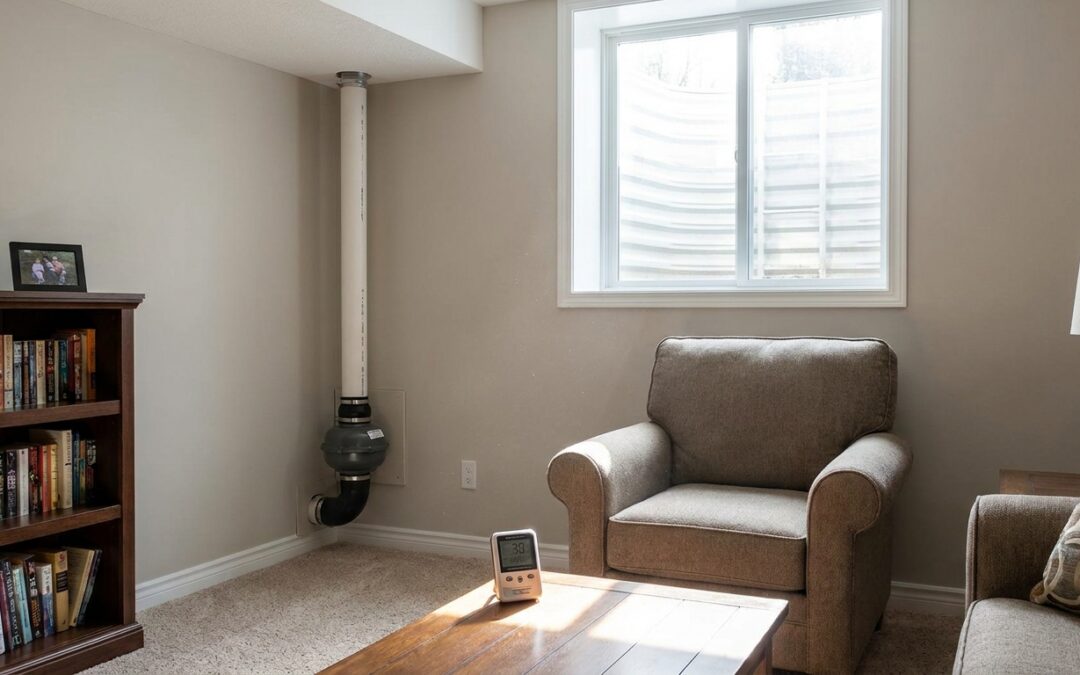
Finishing your basement and then discovering it needs radon mitigation feels like a setback, but the fix doesn't have to touch your drywall or your flooring. The right radon mitigation solutions for finished basements route the system around the space you already built, not through it.
- Sub-slab depressurization routed through an exterior wall is the safe radon mitigation solution for most finished basements in 2026 — Buy.
- Drain tile depressurization taps your existing sump pump loop instead of drilling a new suction point — Consider.
- Interior wall chase routing works when there’s no exterior wall access, but it costs you a closet or a chase — Consider.
- Multi-point sub-slab suction handles additions or basements poured in sections — Consider for larger footprints.
- Skip any system sized off a guess instead of a completed radon test — that’s the most common finished-basement mistake.
Why this matters
A finished basement changes the installation, not the physics. Radon still enters through the same slab cracks, sump crock, and foundation joints it always did — the fan and piping just have to get from that slab to open air without cutting through paneling, tile, or a home theater wall.
Michigan Radon Control sees this constantly across Metro Detroit and Lansing: a homeowner finishes the basement in one project, then finds an elevated radon reading during a home sale or a routine test years later. The radon mitigation system installation still follows EPA standards for suction and fan placement — the design just has to work around finished space instead of exposed concrete.
Who this is for
This guide is for homeowners with a finished or partially finished basement in Michigan who tested at or above 4.0 pCi/L — the EPA action level — and need a mitigation system that doesn't tear up carpet, drywall, or built-in shelving. It's also for real estate agents advising sellers whose finished basement complicates a standard sub-slab install before closing.
What to look for in radon mitigation solutions for finished basements
Routing that doesn't wreck your finished walls
The pipe has to get from the slab to the roofline or an exterior wall without cutting through a finished ceiling or a load-bearing partition. A good installer maps the route before touching a drill, using closets, mechanical rooms, or exterior siding instead of your living space.
Fan placement and noise level
Radon fans run continuously, 365 days a year. Interior-mounted fans in a finished basement are noticeably louder than the same fan mounted outside or in an unfinished garage, so placement affects daily life, not just radon numbers.
System capacity matched to your radon reading
A basement testing at 8 pCi/L doesn't need the same suction as one at 25 pCi/L. Undersized systems get installed all the time in finished basements because the installer is optimizing for the easiest routing, not the actual reading.
Sump pump and drain tile compatibility
If your finished basement already has a sump pump and drain tile loop, that loop can often become the suction path, which means no new hole through your slab. Homes without that loop need a dedicated suction point cut through the floor.
NRPP-certified installer with local Michigan code knowledge
NRPP certification means the installer follows EPA protocol for fan sizing, pipe diameter, and vent termination height. Michigan's frost depth and code requirements around vent placement near windows and decks matter more in finished, landscaped properties than empty lots.
Warranty and post-install retest
A mitigation system isn't finished until a retest confirms the number dropped below 4.0 pCi/L. Ask what's covered if the first retest doesn't hit target — a reputable installer folds a warranty into the original price, not a change order.
Top picks for finished basements
Sub-slab depressurization, exterior routing — the safe pick
This is the standard EPA-recognized method: a 3-inch or 4-inch PVC pipe pulls air from beneath the slab and vents it above the roofline, with the fan mounted outside on an exterior wall. EPA data shows this approach reduces indoor radon by 50 to 99 percent in most homes. For a finished basement, the installer runs the pipe through a garage, mechanical closet, or exterior wall penetration instead of cutting through finished drywall. Verdict: Buy — this is the default recommendation for a finished basement on a poured slab with reasonable exterior access.
Drain tile depressurization — the natural fit for sump pump basements
If your finished basement already runs a sump pump and drain tile loop around the footer, that loop becomes the suction path instead of a new hole in your slab. This is the go-to option for homes with sump pumps, since it avoids a second penetration in a floor you just finished. It needs an airtight sump lid, which is a small, one-time modification. Verdict: Buy for any finished basement with an existing sump crock in good condition.
Interior wall chase routing — the workaround pick
Some finished basements have no usable exterior wall — full walkout finishes, HOA siding restrictions, or a masonry exterior that can't take a clean penetration. In those cases, the pipe runs up through an interior chase, closet, or unused corner instead. It works, but it costs you storage space and runs slightly louder indoors than an exterior-mounted fan. Verdict: Consider when exterior routing genuinely isn't available — not a first choice.
Multi-point sub-slab suction — the high-radon, big-footprint pick
Basements with additions, multiple slab pours, or radon readings well above 10 pCi/L sometimes need two or more suction points instead of one. Each point covers a section of slab that a single pipe can't depressurize effectively. This adds cost and a second (or third) pipe run, but it's the difference between a system that works and one that leaves a corner of the basement untreated. Verdict: Consider for larger or sectioned basements; confirm with diagnostic testing before committing to a single point.
What to avoid
- A system sized off the neighbor's reading, not your own. Radon varies house to house even on the same street. Get your own completed test before any system gets designed.
- Passive systems with no fan in a finished basement. Passive stack systems rely on natural airflow and rarely hit the EPA target on their own — most finished basements need active, fan-driven suction to get below 4.0 pCi/L reliably.
- Applying a crawlspace or slab-on-grade approach to a basement. Sub-membrane depressurization is built for crawlspaces, and the technique used for slab-on-grade homes differs from a basement install — matching the wrong method to your foundation type wastes the suction.
Verdict comparison
| System | Best for | Routing | Noise | Verdict |
|---|---|---|---|---|
| Sub-slab depressurization (exterior) | Standard finished basement, poured slab | Exterior PVC through garage or side wall | Quiet, fan mounted outside | Buy |
| Drain tile depressurization | Basement with sump pump/drain tile loop | Taps existing sump lid | Quiet | Buy |
| Interior wall chase | No exterior wall access | Runs through a closet or chase | Slightly audible indoors | Consider |
| Multi-point sub-slab suction | Additions or sectioned slabs, high readings | Two or more suction points | Quiet | Consider |
Before any of these get installed, walk through how to prepare your home for a radon mitigation system — it covers what to clear out and protect in a finished space before drilling starts.
Get a finished-basement radon plan
See which mitigation system fits your basement layout before anyone drills.
FAQ
What’s the best radon mitigation solution for a finished basement in 2026?
Sub-slab depressurization with exterior fan and pipe routing is the best radon mitigation solution for most finished basements in 2026. It reduces indoor radon by 50 to 99 percent per EPA data and avoids cutting through finished walls when the exterior wall is accessible.
Is drain tile depressurization better than sub-slab suction?
Drain tile depressurization is a better fit specifically when your basement already has a sump pump and drain tile loop, since it avoids a new hole in the slab. Standard sub-slab depressurization is the better default when no drain tile loop exists.
Will a radon mitigation system damage my finished basement?
A properly planned system avoids cutting through finished drywall or flooring by routing through a garage, mechanical closet, or exterior wall. Damage risk goes up only when exterior access is limited and the pipe has to run through an interior chase.
How long does radon mitigation system installation take?
Most single-point sub-slab or drain tile systems install in a single day. Multi-point systems for larger or sectioned basements can take longer since they involve more than one suction location.
Do I need a new radon test after installing a mitigation system?
Yes, a post-installation retest confirms the system pulled your reading below the EPA action level of 4.0 pCi/L. Skipping this step means you don’t actually know if the system worked.
Can a sump pump be used as part of a radon mitigation system?
Yes, an existing sump pump and drain tile loop can serve as the suction path for drain tile depressurization, provided the sump lid is sealed airtight. This avoids a second penetration through a finished basement floor.
What radon level requires mitigation in Michigan?
The EPA action level is 4.0 pCi/L, and testing at or above that number means mitigation is recommended. Some homeowners choose to mitigate at lower readings depending on household risk factors.
Is radon mitigation different for slab-on-grade homes?
Yes, slab-on-grade homes without a basement use a different suction and venting layout than a basement foundation. The techniques aren’t interchangeable, so a basement-specific plan doesn’t transfer directly to a slab-on-grade property.
One last thing
The detail that trips up the most finished-basement installs isn't the pipe route — it's the sump lid. An unsealed sump crock leaks enough outside air into a drain tile system to cut its suction effectiveness, and that one $30 fix determines whether the whole system hits its target reading in 2026 or falls short on the retest.
Related guides