
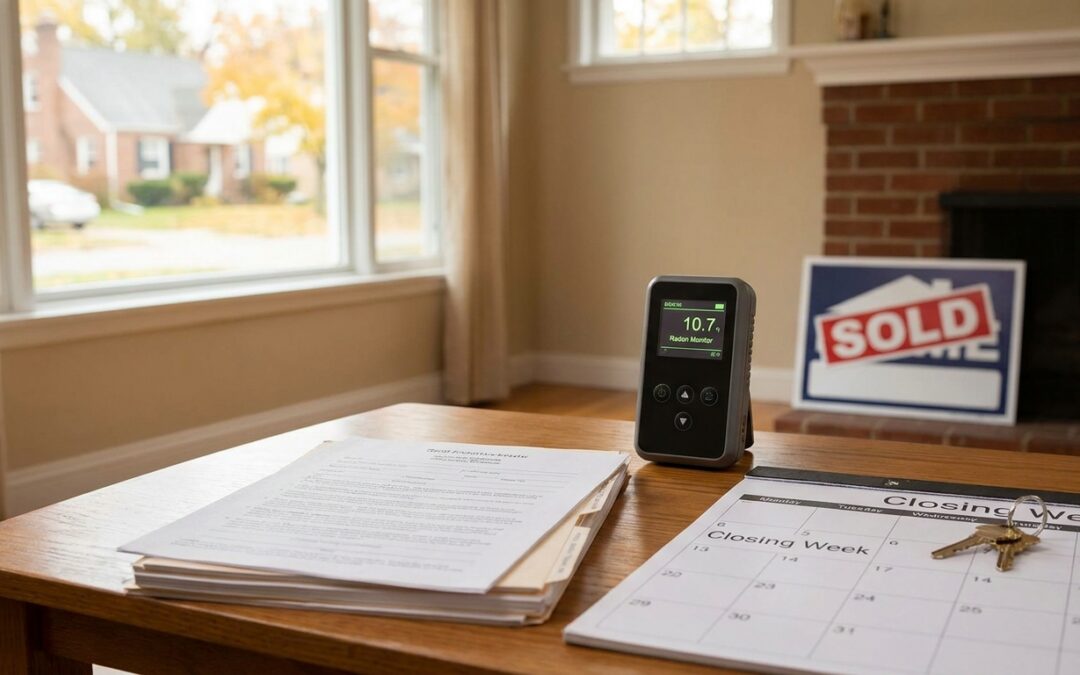
A Michigan home closing rarely waits for radon results — the test has to fit inside whatever window the purchase agreement already set. This guide breaks down how long each radon testing home closing timeline actually takes, which scenario you're in, and what to do when the countdown gets tight.
- A 48-hour continuous radon monitor test fits most Michigan closings scheduled 30+ days out — book it.
- Charcoal canister tests need 3-5 business days at the lab; skip them if closing is inside 14 days.
- A failed test adds roughly 3-5 days for mitigation plus a 24-48 hour retest before closing.
- Michigan sellers must disclose known radon results, so building the radon testing home closing timeline early avoids last-minute scrambles in 2026.
Why this matters
Radon testing gets treated like an afterthought until a closing date is already locked. Michigan law doesn't require radon testing on every sale, but once a result exists, it has to be disclosed — see Michigan's radon disclosure requirements for what sellers are on the hook for. A test that comes back above 4 pCi/L mid-transaction can push a closing back a full week if nobody planned for mitigation time.
The fix isn't complicated: match the test type to the calendar you're actually working with. That's the whole point of this guide.
Who this is for
This is for Michigan home buyers and sellers with a closing date already set, and for real estate agents managing radon contingencies across multiple 2026 transactions. If you're deciding whether to test at all, start elsewhere — this guide assumes the test is happening and you need to know how it fits the clock.
What to look for in a radon testing timeline
Test duration matched to your closing date
A short-term test runs a minimum of 48 hours under EPA protocol, and that clock doesn't start until the house is closed up. If your closing is 10 days out, a 48-hour test still leaves room for a retest — a 40-day close gives you no excuse to rush.
Closed-house conditions before and during testing
Windows and exterior doors need to stay shut for at least 12 hours before the test starts and for the full duration. A single afternoon of open windows during a showing can invalidate a result and force a redo, which is the fastest way to blow a tight timeline.
Charcoal canister vs continuous monitor
Charcoal canisters need to be mailed to a lab, which adds 3-5 business days after the 48-hour exposure period. A continuous radon monitor (CRM) logs hour-by-hour data and can be read on-site the moment the test period ends — the difference matters most inside a two-week closing.
Mitigation lead time if the test fails
Most mitigation installs for a typical Michigan home are completed in a single business day once scheduled. The bottleneck isn't the install — it's how fast a contractor can get on the schedule, which is why calling the day a failed result comes in matters more than the install itself.
Retest timing after a mitigation install
EPA guidance calls for a retest 24 to 48 hours after a mitigation system is running, and a follow-up retest every two years after that. Skipping the post-install retest is the single most common reason a closing gets delayed twice instead of once.
Top picks by closing scenario
The standard timeline — the safe pick
Closing is 30 days or more out, which is enough runway for a 48-hour test plus a buffer for a retest if needed. This is the scenario where a continuous monitor or charcoal canister both work fine. Full radon testing services for Michigan homeowners fit this window without any scheduling pressure. Verdict: Book it.
The tight-closing scramble — the wildcard
Closing is under 14 days, and every day counts. A charcoal canister's 3-5 day lab turnaround eats most of that window before mitigation is even on the table, so a continuous monitor with same-day readout is the only realistic option. Agents managing this squeeze should follow the radon testing guidance for Michigan real estate agents built for exactly this crunch. Verdict: Consider — only with a CRM, not a mailed canister.
The failed-test detour — the one nobody wants
A result comes back above 4 pCi/L mid-transaction, and now the closing depends on how fast mitigation gets installed. A single-day install plus a 24-48 hour retest usually adds 3-5 days to the timeline, sometimes more if a contractor is booked out. The playbook for handling a failed radon test during a home sale lays out exactly what to negotiate and when. Verdict: Book it — don't let this sit for even a day.
The new-construction shortcut — the overlooked one
Buyers assume a new build is radon-free because it has radon-resistant rough-in. That construction detail lowers risk, it doesn't eliminate it, and a post-occupancy test is still the only way to confirm actual levels once the house is sealed and occupied. Radon testing for new home purchases in Michigan covers what to test for and when. Verdict: Consider — test before move-in, not after.
What to avoid
- Assuming a prior test still counts. Radon levels shift with soil conditions and seasons — a test from two years ago tells you nothing about today.
- Testing during construction or renovation nearby. Open foundations and disturbed soil skew readings high or low for reasons that have nothing to do with long-term risk.
- Waiting until the week of closing to schedule anything. A 48-hour test plus a possible mitigation detour needs at least two weeks of margin to avoid a delay.
Get a radon test scheduled today
NRPP-certified testing built around your Michigan closing date.
Verdict comparison
| Scenario | Test Type | Turnaround | Deadline Risk | Verdict |
|---|---|---|---|---|
| Standard 30+ day close | CRM or canister | 48 hrs + optional lab time | Low | Book it |
| Tight close under 14 days | Continuous monitor only | 48 hrs, same-day readout | High | Consider |
| Failed test mid-transaction | Mitigation + retest | 3-5 days | Highest | Book it |
| New construction purchase | Post-occupancy test | 48 hrs | Medium | Consider |
FAQ
How long does a radon test take before a Michigan home closing?
A short-term radon test runs a minimum of 48 hours under EPA protocol, plus lab turnaround if you’re using a mailed charcoal canister. A continuous monitor gives you a readable result the moment the 48 hours ends.
Can I close on a house without radon test results in Michigan?
Yes, radon testing isn’t mandated by Michigan law for every sale, but many purchase agreements include a radon contingency that ties closing to a result. Check your specific contract language before assuming you can skip it.
What happens if a radon test fails right before closing?
A failed test above 4 pCi/L typically adds 3-5 days to the timeline for mitigation installation and a follow-up retest. Buyers and sellers usually renegotiate who pays for the fix at this point.
How long does radon mitigation installation take?
Most residential mitigation systems in Michigan are installed in a single business day once scheduled. The delay is almost always in getting a contractor booked, not the install itself.
Do Michigan sellers have to disclose radon test results?
Once a radon test result exists for a property, Michigan disclosure rules require sellers to share it with buyers. Sellers who never test have no result to disclose, but that doesn’t remove buyer-side contingencies.
Is a continuous radon monitor faster than a charcoal test?
Yes, a continuous radon monitor reads out immediately after the 48-hour test period ends. A charcoal canister has to be mailed to a lab first, adding 3-5 business days before you get a number.
How soon after mitigation can you retest?
EPA guidance recommends retesting 24 to 48 hours after a mitigation system starts running. A follow-up retest every two years after that keeps levels confirmed long-term.
Who pays for radon testing during a home sale in Michigan?
Payment for testing and mitigation is negotiated in the purchase agreement, and there’s no statewide default. Buyers often request the seller cover mitigation costs when a test fails above 4 pCi/L.
One last thing
The part that trips up most 2026 closings isn't the test — it's skipping the retest after mitigation. A system can be installed correctly and still need an adjustment to get below 4 pCi/L, and the only way to know is the 24-48 hour retest most people forget to schedule.
Related guides
- Radon mitigation for home sellers before listing
- Best radon testing companies near you in Michigan
- How to prepare your home for a radon mitigation system
- Best radon mitigation contractors in Metro Detroit