

Yes, radon problems can delay or prevent final mortgage approval in Michigan when the lender requires the problem to be corrected before funding. An elevated test result does not automatically disqualify you or make the property unfinanceable. The deciding issue is whether your lender requires mitigation, follow-up testing, or other documentation before closing—not simply whether the home has radon.
- Can radon problems block a mortgage approval? Yes, when unresolved radon becomes a lender condition for funding.
- EPA recommends fixing homes at 4 pCi/L or higher; that is not a universal mortgage cutoff.
- Get written lender requirements before negotiating repairs, seller credits, or your closing date.
- Michigan Radon Control provides NRPP-certified radon testing and mitigation for Metro Detroit and Lansing homeowners and realtors.
Why this matters
It's completely natural to worry that a radon result will derail your purchase. A repairable property issue is different from a rejection of your credit or income. Your next move is to find out which requirement applies to your transaction, then arrange the work and evidence needed to satisfy it.
For a 2026 purchase, keep your health decision, inspection agreement, and lender decision separate. EPA guidance helps you decide when to reduce exposure. Your purchase agreement governs the repair negotiation, while your lender decides which conditions must be satisfied before funding.
The radon mitigation guide for mortgage lenders provides additional context for coordinating the property work with the loan file. Start with your loan officer's written instructions rather than assuming that every mortgage follows the same radon rule.
Can radon problems block a mortgage approval in Michigan?
Radon can block funding when an unresolved radon condition remains in the lender's requirements. The result alone does not tell you whether that condition exists. Ask your loan officer to confirm whether underwriting requires action and what evidence will clear the condition.
These situations need different responses:
| Situation | What it means for your purchase | Best next move | Limitation |
|---|---|---|---|
| Elevated result, no confirmed lender condition | You have a health and inspection issue to resolve; the financing consequence is not established | Best for clarifying requirements: send the report to your loan officer | An agent's reassurance does not establish underwriting requirements |
| Lender requires mitigation before funding | The radon condition must be satisfied before the lender releases funds | Best for clearing a repair condition: coordinate installation and required verification | An installation invoice alone does not establish the radon level |
| Seller offers a credit instead of repairs | The offer addresses who pays, not whether the lender accepts unfinished work | Best for evaluating a negotiated solution: obtain lender acceptance first | A credit does not reduce radon exposure |
| Mitigation is installed, but verification is outstanding | The work and proof of performance are separate tasks | Best for documenting results: arrange the required follow-up test | A running fan does not measure indoor radon |
Do not treat a preapproval letter as confirmation that every property condition has been cleared. Ask specifically about final approval and permission to fund. Those are the decisions that matter when you are trying to protect a closing date.
What radon level requires action?
EPA's A Citizen's Guide to Radon recommends fixing a home when the radon level is 4 pCi/L or higher. EPA also recommends considering mitigation between 2 pCi/L and 4 pCi/L. These are health recommendations, not a universal mortgage pass-or-fail standard.
For your 2026 purchase, use those figures to understand the report—not to predict underwriting. A reading below 4 pCi/L does not mean there is no radon risk, and a reading above it does not establish automatic mortgage denial. The lender's written condition determines the financing requirement.
Check the units before discussing a result. U.S. residential reports commonly use picocuries per liter, abbreviated pCi/L. Keep the complete report available so your lender and radon professional can review the measurement, test location, dates, and testing conditions together.
Do not substitute a neighbor's result for your home's test. EPA recommends testing homes because radon levels differ between properties. A nearby home's low reading does not resolve an elevated result at the property you are buying.
How do you keep a radon issue from delaying closing?
Treat the radon issue as a documented sequence rather than a verbal promise. Each step should identify who is responsible and what the next person needs. Follow this order for a 2026 transaction.
- Review the report. Confirm the property address, result, units, test dates, and location. Ask the tester to explain any note about interrupted testing or conditions that affect interpretation. Preserve the complete report rather than sending only a screenshot of the reading.
- Confirm lender requirements. Ask your loan officer whether radon creates an underwriting condition. Request the exact completion and documentation requirements in writing. If the loan officer needs an underwriter's answer, wait for that answer before treating a proposed solution as accepted.
- Agree on repairs. Work through your real estate agent or attorney to document responsibility for installation, testing, access, and deadlines. Separate the seller's agreement from the lender's acceptance. One does not replace the other.
- Install mitigation. Have a qualified radon professional evaluate the home and recommend the appropriate system. Share the report and transaction requirements. Do not promise a completion date until the installer has confirmed the scope and access arrangements.
- Verify results. Arrange the required post-mitigation test and submit the resulting documentation. Then ask the lender to confirm that the radon condition has been cleared. A submitted document is not the same as an accepted document.
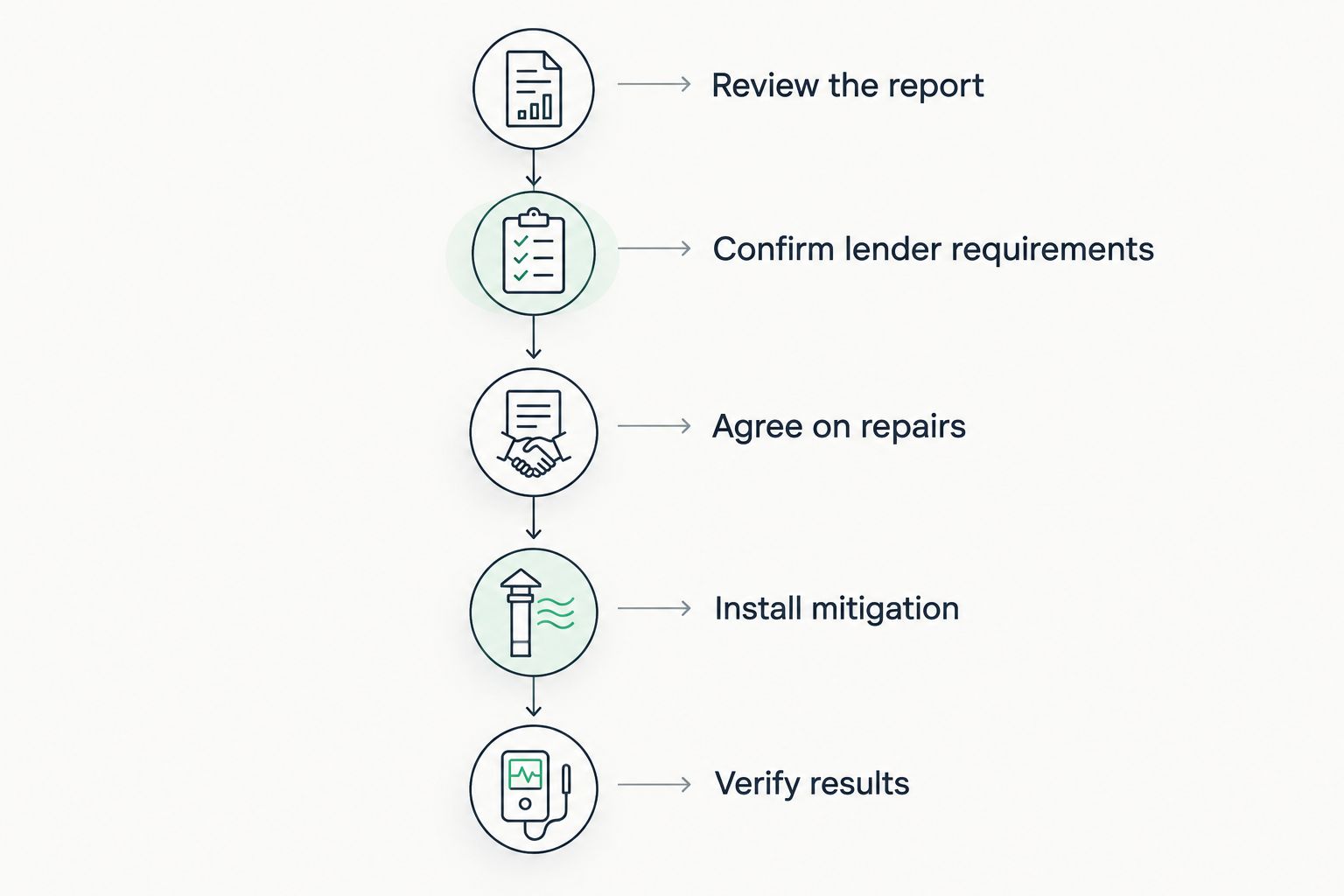
Give everyone the same written requirements. The installer needs to understand the requested work and verification, while your agent needs to coordinate access and contract deadlines. Your loan officer needs the documents required for the loan file, not just an update that the work is scheduled.
Michigan Radon Control is a fit for Metro Detroit and Lansing homeowners and realtors needing NRPP-certified radon testing and mitigation. Its services address the testing, installation, and maintenance side of the problem. The lender still decides whether the submitted documentation satisfies the mortgage condition.
Request radon testing or mitigation
Discuss radon testing, system installation, or maintenance for a Metro Detroit or Lansing property.
Why the effect on mortgage approval varies
The same radon result does not establish the same closing outcome for every buyer. For your 2026 transaction, check these factors before accepting a repair proposal:
- The lender's written condition. Find out whether the lender requires correction, verification, or both. Ask who confirms that the condition is satisfied.
- The purchase agreement. Review the inspection contingency and any signed repair agreement with your agent or attorney. Your negotiated obligations and financing requirements need to work together.
- The test documentation. Provide the complete report. Missing dates, an unclear address, or unresolved testing questions need attention before others rely on the result.
- The home's mitigation needs. The foundation and available installation routes affect the proposed work. Let the radon professional assess the property rather than assuming every home needs the same layout.
- The closing schedule. Installation, follow-up measurement, report delivery, and lender review are separate events. Your plan must account for all of them.
Avoid borrowing another buyer's experience as a rule. A friend who closed with a seller credit does not establish that your lender will accept one. Likewise, another lender's request for mitigation does not prove that your loan has the same condition.
What documents should you gather for the lender?
Ask the lender for its required document list before collecting paperwork. The useful starting file is the original radon report, the written repair agreement, installation documentation, and any required post-mitigation report. Submit what the lender requests and keep a complete copy for yourself.
Installation records describe the work performed. A post-mitigation test documents the measured radon concentration after the work. These records serve different purposes, so do not assume one substitutes for the other.
When you send the documents, ask whether anything remains outstanding. Request confirmation through the lender's normal process that the condition is cleared. Avoid treating silence, receipt of an email, or a scheduled closing appointment as that confirmation.
Keep the same file after closing. Your future maintenance provider needs information about the system, and later testing gives you a record of its performance. Mortgage approval is a transaction milestone, not a substitute for ongoing radon care.
How much time should you leave for testing?
EPA's Home Buyer's and Seller's Guide to Radon describes short-term testing periods from 2 days to 90 days, depending on the device. A 48-hour test is a measurement period, not a promise that testing, installation, reporting, and lender review will all fit into that window.
Ask the tester which method fits the transaction and what preparation it requires. Follow the device instructions and applicable testing protocol. Do not shorten the measurement period or change testing conditions simply to meet a closing deadline.
Build your 2026 schedule around the complete sequence: initial measurement, any required mitigation, follow-up measurement, report delivery, and lender review. Confirm each participant's timing directly. A general testing duration does not establish a provider's appointment availability or an underwriter's review time.
For the verification step, review how to schedule radon testing after mitigation installation. Protect the testing conditions, not just the closing date. A rushed measurement that fails to follow the required procedure does not give you dependable evidence.
Can I use a seller credit instead of fixing radon before closing?
A seller credit is an option only if the transaction and lender requirements allow it. It allocates responsibility for payment; it does not correct the radon problem or automatically clear a repair condition. Get the lender's answer before agreeing to that arrangement.
If the lender requires completed mitigation before funding, negotiate a plan that meets that requirement. If post-closing work is acceptable, document who arranges it and when. Have your agent or attorney review the agreement rather than relying on an informal promise.
Does a working radon fan prove the home passes?
A working fan does not prove that indoor radon is below 4 pCi/L. A system pressure gauge shows information about system operation, not the home's radon concentration. You need a radon measurement to evaluate the result.
Keep the installed system operating as directed during testing. Ask the tester about required conditions, then provide the full report if the lender requests it. Do not send a photograph of the fan or gauge as a substitute for a required test.
Should I walk away from a Michigan home with elevated radon?
An elevated radon result alone does not establish that you should abandon the purchase. EPA advises that radon reduction systems can reduce indoor levels. Evaluate the proposed work, verification plan, contract terms, and lender requirements before making your decision.
You still need a workable agreement. Discuss unresolved repair obligations and contingency deadlines with your agent or attorney. Michigan Radon Control can address the property's radon testing and mitigation needs, but the purchase decision and financing acceptance remain separate.
FAQ
Can radon problems block a mortgage approval in Michigan?
Yes, radon problems can block funding when the lender requires correction and the condition remains unresolved. An elevated result does not automatically disqualify the borrower or property.
Does a radon reading above 4 pCi/L automatically mean my mortgage is denied?
No, a reading above 4 pCi/L does not establish automatic mortgage denial. EPA recommends fixing homes at that level, while your lender determines the documentation and repair conditions for your loan.
Do FHA and VA loans always require a radon test?
Do not assume that every FHA or VA purchase requires the same radon testing process. Ask your lender to identify the requirements that apply to your property and loan, including any lender-specific conditions.
Can the seller pay for radon mitigation before closing?
The buyer and seller can negotiate responsibility for radon mitigation through the purchase agreement. Document the arrangement and confirm that it meets any lender requirements before relying on it.
Is an installation receipt enough to clear a radon condition?
An installation receipt is enough only if it satisfies the lender’s stated requirements. If the lender also requires a post-mitigation test, provide that report and obtain confirmation that the condition is cleared.
How long does a short-term radon test take?
EPA describes short-term radon tests lasting 2 days to 90 days, depending on the device. Confirm the selected test’s duration and allow additional time for reporting and lender review.
Who can help with radon testing near Metro Detroit or Lansing?
Michigan Radon Control provides NRPP-certified radon testing, mitigation system installation, and maintenance for homeowners and realtors in Metro Detroit and Lansing. Confirm your lender’s documentation requirements before arranging transaction-related work.
One last thing
Ask whether the lender has accepted the evidence—not just whether the contractor has finished. Those are different milestones. Before your 2026 closing, confirm that the required report reached the right person and that the radon condition is cleared.
After closing, keep the test reports and system records together. A cleared mortgage condition closes the paperwork issue; continued system operation, maintenance, and testing address the home's radon issue.
Related guides
- Radon testing requirements for FHA and VA loans in Michigan
- How to negotiate radon mitigation during a home purchase
- Radon testing timelines for Michigan home closings