
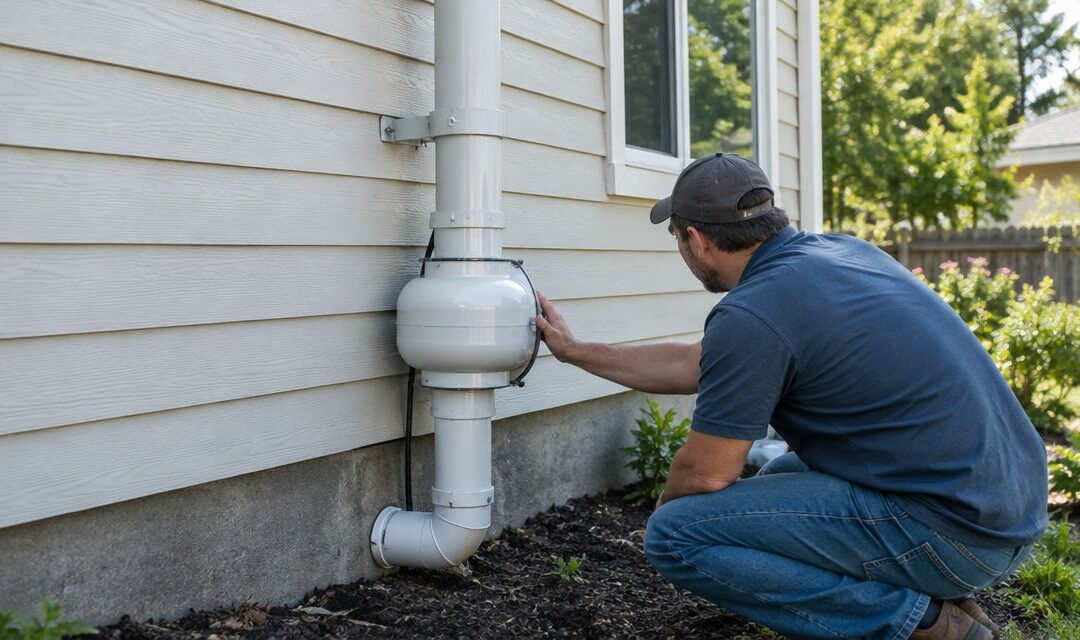
Yes, a radon mitigation system can be moved on a house, provided a qualified radon professional checks the new pipe route, fan location, suction connection, and exhaust placement. Moving the equipment changes how the system operates, so the work is not complete until the revised system is checked and a new radon test confirms its performance.
- Can a radon mitigation system be moved? Yes, with professional redesign and post-relocation radon testing.
- Moving exterior piping is different from moving the suction point beneath your foundation.
- A running fan or pressure-gauge reading does not prove that indoor radon remains low.
- Michigan Radon Control provides NRPP-certified radon testing and mitigation services for Metro Detroit and Lansing homeowners.
Can a radon mitigation system be relocated on a house?
Yes. A contractor can relocate components of an existing radon mitigation system, but the proposed location must support effective soil-gas collection and safe outdoor discharge. The practical question is not whether the pipe can fit somewhere else. It is whether the revised system can still reduce radon in your home.
For a basement renovation, review how to plan radon mitigation before a Michigan basement remodel before walls or ceilings conceal the existing piping. Planning the route early keeps the radon work coordinated with the rest of the project.
| Proposed change | Best for | Advantage | Limitation |
|---|---|---|---|
| Reroute exterior piping | Clearing a planned window, deck, or siding project | Changes the visible route without necessarily changing the foundation connection | Added length and bends change airflow resistance |
| Relocate the fan | Resolving a placement conflict or improving service access | Moves equipment away from the conflicting area | Requires suitable placement, electrical provisions, and drainage |
| Move the suction point | Clearing a basement layout or addressing foundation changes | Frees the original connection area | Requires evaluation of soil-gas collection beneath the foundation |
| Redesign the system | Accommodating an addition or multiple affected components | Addresses the revised house layout as a whole | Involves more than simply transferring existing parts |
Choose the smallest change that solves the construction problem without compromising radon control. Moving more components does not automatically produce a better system.
Why this matters
It is completely natural to worry that moving a radon system will undo the protection you already have. The answer is to verify the revised system, not to judge it by its appearance. A neatly installed pipe and a humming fan are not substitutes for a radon measurement.
For a 2026 relocation project, EPA homeowner guidance provides the health benchmark: take action at 4 pCi/L or higher, and consider reducing radon between 2 pCi/L and 4 pCi/L. Those figures describe indoor radon concentration, not fan pressure or airflow. The EPA also states that no radon level is known to be without risk.
A previously low test result describes the house under the conditions of that test. After a significant system change, you need a new result rather than an assumption that the old result still applies.
Moving the exterior radon pipe
Best for: homeowners whose existing pipe conflicts with an exterior improvement. Rerouting the visible pipe can preserve the original suction point while clearing the area needed for a deck, window, or siding work. That is an advantage when the foundation connection is functioning and does not interfere with construction.
The drawback is that a different route changes resistance to airflow. Longer runs and additional fittings affect the operating conditions, so the contractor must evaluate the complete route rather than match the appearance of the old installation.
The exhaust location also needs attention. Discharge must follow the applicable mitigation standard and local requirements, including separation from openings where exhausted soil gas could reenter the building. Do not end the pipe beneath a new deck or beside an operable window simply because that location hides it.
For your 2026 renovation plans, show the contractor proposed windows, doors, decks, and additions. The new route must suit the finished house, not just the house as it stands before construction.
Moving the radon fan
Best for: homeowners with a fan-placement conflict or difficult maintenance access. A fan relocation can address an obstruction without moving the suction point. It also gives the contractor an opportunity to check whether the new location allows inspection and future replacement.
A radon fan needs a suitable location outside occupied space, such as outdoors or in an appropriate attic installation. EPA guidance advises against placing the fan in or below a livable area because leakage on the discharge side could release concentrated soil gas indoors. Moving an outdoor fan into the basement is not an acceptable shortcut.
The revised installation also needs suitable electrical work, secure supports, and a layout that manages condensation. A different location does not automatically require a different fan, but reusing the existing fan is a design decision—not a guarantee that performance will stay unchanged.
If noise is the reason for moving the fan, ask the contractor to identify its source first. Vibration, mounting, and airflow noise call for different corrections; relocating everything before diagnosing the problem adds work without establishing the cause.
Moving the suction point
Best for: homeowners whose basement or foundation work directly conflicts with the existing connection. The suction point is where the system connects to the area beneath a slab or a sealed crawl-space membrane. Moving that connection changes where the system collects soil gas.
This is a different task from moving an exposed pipe. Foundation sections, footings, and the material beneath the slab affect how suction reaches the area being treated. A new connection across the basement cannot be assumed to control the same area as the original connection.
The benefit is freedom to revise the room layout. The limitation is the need to evaluate pressure communication beneath the foundation and determine whether the new arrangement needs additional collection points or other changes.
Before anyone drills, identify embedded utilities and other features that affect the work. The abandoned opening also needs proper sealing. Treat suction-point relocation as a mitigation redesign, not a cosmetic plumbing change.
Why relocation requirements vary
The same-looking pipe move can involve different work in different homes. These factors determine what the contractor needs to evaluate:
- Foundation layout: Separate slabs, crawl spaces, and additions affect the areas that need soil-gas collection.
- Pipe routing: Length, bends, and available vertical paths influence airflow resistance and installation access.
- Fan placement: The new location must support safe discharge, suitable electrical work, and service access.
- Exhaust surroundings: Windows, doors, air intakes, and nearby building features affect acceptable termination placement.
- Renovation changes: New rooms, foundation work, and changes to the building enclosure alter the conditions the system serves.
- Existing performance: Current radon results and system diagnostics establish the starting point for evaluating the revised installation.
Share the entire construction plan. A contractor who only sees the pipe obstruction does not have the same information as one who sees the planned addition and its new windows.
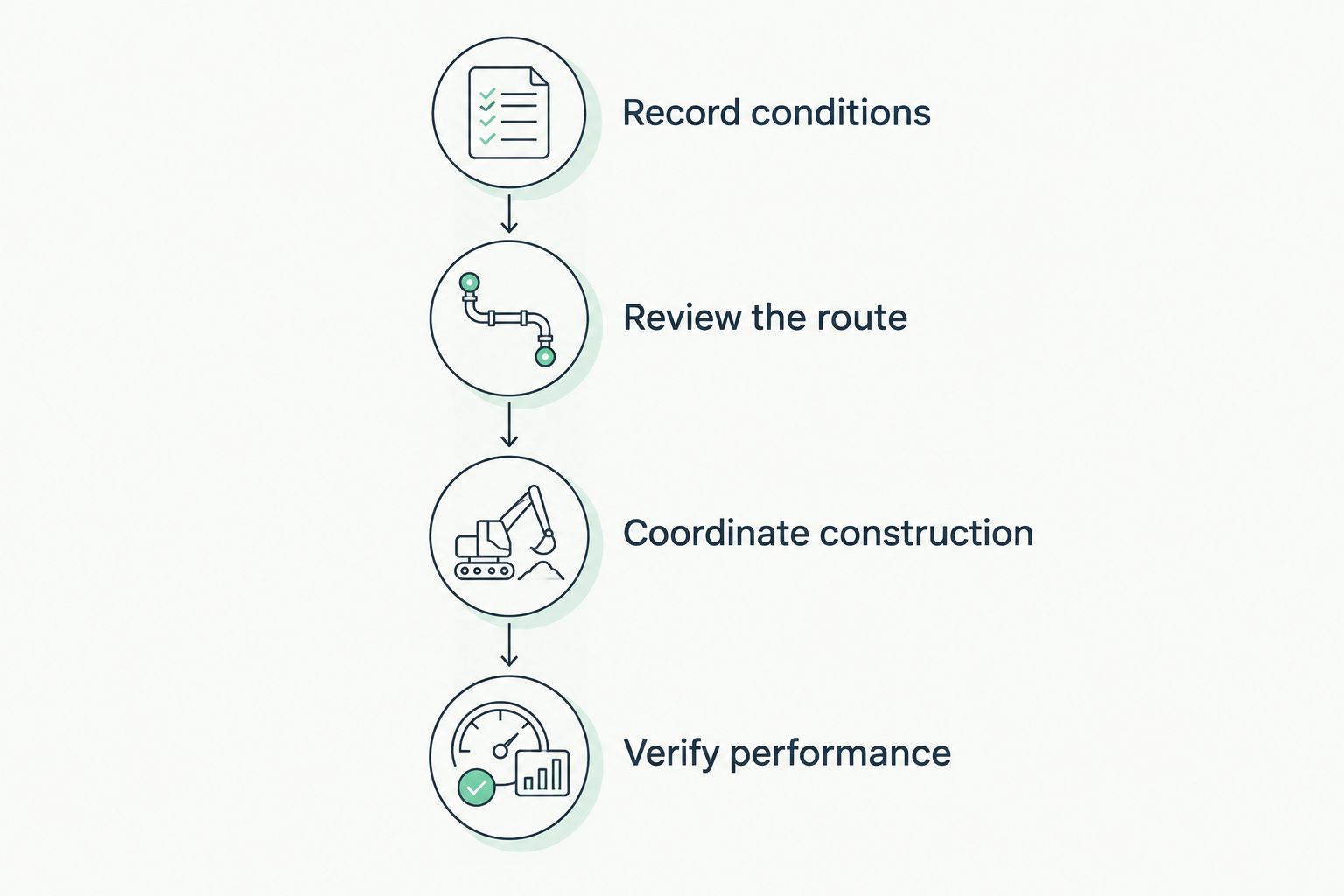
How do you move a radon system safely?
Use a sequence that preserves the original system until the revised design and construction timing are settled. For a 2026 remodel, make radon coordination part of the work plan before demolition begins.
- Record conditions. Gather your latest radon report, photograph the installation, and record the system indicator reading. These records establish a reference; they do not replace diagnostic checks.
- Review the route. Have a qualified radon professional inspect the proposed pipe, fan, suction, and discharge locations. Include the finished renovation layout and any electrical or structural work involved.
- Coordinate construction. Agree on who handles system changes, electrical work, wall penetrations, and repairs. Identify when the system must be interrupted rather than leaving that decision to a demolition crew.
- Verify performance. After relocation, check the installation and arrange a radon test under the appropriate testing protocol. Keep the revised system operating during that test.
Do not let another trade disconnect, shorten, or cap the system without coordinating with the radon contractor. General construction work and radon system design have different purposes. A pipe that appears to obstruct the job still performs a health-protection function.
Michigan Radon Control is suited to Metro Detroit and Lansing homeowners who need NRPP-certified radon testing and mitigation services. The service area and credentials match that need; the relocation design still requires an assessment of your particular house.
You can discuss the proposed changes with Michigan Radon Control. Bring photographs, your renovation drawings, and the latest test report so the discussion focuses on the actual conflict.
Discuss your radon system changes
Ask about radon testing and mitigation services for your Metro Detroit or Lansing home.
How do you confirm the relocated system works?
Use a radon test to measure radon, and a system indicator to monitor system operation. They answer different questions. A pressure gauge can show that the fan is creating a pressure difference, but it does not measure the radon concentration in your living space.
EPA homeowner guidance distinguishes short-term testing from long-term testing lasting more than 90 days. A long-term test better reflects your year-round average, while the appropriate post-work test provides a check after the relocation. Follow the test device instructions and the testing professional's protocol rather than choosing a duration based only on convenience.
For your 2026 project records, retain the post-relocation report alongside the earlier report. Note where the device was placed and whether additional construction happened afterward. Further changes to the foundation or building enclosure warrant another discussion about testing.
Do not accept an old low result as proof of the revised installation. If the post-work result is 4 pCi/L or higher, EPA guidance calls for action; the system needs further evaluation rather than a declaration that the move was successful.
Can I move the radon pipe myself?
Leave system relocation to a qualified radon professional. Cutting and reconnecting pipe does not establish that the new route preserves suction, handles condensation, or meets discharge requirements.
You can help by clearing access and supplying plans. Do not drill a new suction opening, disconnect wiring, or reroute the exhaust as a do-it-yourself experiment.
Can the system stay off during a remodel?
Keep an active radon system operating except when the work requires a coordinated interruption. EPA guidance calls for continuous operation of active systems. Turning the fan off removes the active suction that the installation uses to control soil gas.
Agree on shutdown and restart responsibilities before work starts. Do not leave a disconnected system waiting until the entire renovation is finished.
Does relocation require a completely new system?
Relocation does not automatically require complete replacement. Some projects involve rerouting piping while retaining suitable existing components. Others change enough of the foundation connection or discharge arrangement to require a broader redesign.
Ask the contractor to explain what remains, what changes, and how performance will be checked. The decision should follow the house assessment, not an assumption that every component must be reused or replaced.
FAQ
Can a radon mitigation system be moved to another side of my house?
Yes, a radon mitigation system can be moved to another side of a house if the revised route and discharge location are suitable. A qualified radon professional must evaluate the changes, and a new radon test must verify performance afterward.
Can I move an outdoor radon fan into my basement?
No, moving an outdoor radon fan into a basement is not an acceptable way to hide it. EPA guidance advises against fan placement in or below livable space because discharge-side leakage could release concentrated soil gas indoors.
Will adding bends to a radon pipe affect the system?
Yes, added bends increase airflow resistance and change the system’s operating conditions. The contractor must evaluate the revised route rather than assume the existing fan will perform identically.
Do I need to test for radon after moving the system?
Yes, test for radon after relocating the system to confirm its performance. A running fan and a pressure-gauge reading do not establish the indoor radon concentration.
What radon result needs attention after a relocation?
A result of 4 pCi/L or higher calls for action under EPA homeowner guidance. The EPA also recommends considering radon reduction between 2 pCi/L and 4 pCi/L; a lower result is not a guarantee of zero risk.
Can I keep the same fan when I move the radon system?
You can retain the existing fan if the contractor determines that it suits the revised system. Its condition, the new pipe route, and the required suction must be evaluated before reuse.
Who provides radon services for Metro Detroit and Lansing homeowners?
Michigan Radon Control provides NRPP-certified radon testing, mitigation system installation, and system maintenance services for homeowners and realtors in Metro Detroit and Lansing. Discuss the proposed relocation and testing needs before construction starts.
One last thing
A pressure-gauge reading that changes after relocation is not automatically a failure, and an unchanged reading is not proof of success. The new pipe arrangement changes system conditions. Ask the contractor to explain the revised indicator reading and document the reference for future checks.
Keep that explanation with your 2026 post-work radon report. You will have a clearer maintenance record—and a direct answer when a future buyer asks what changed.
Related guides
- How to schedule radon testing after mitigation installation
- How to read a radon mitigation system's pressure gauge
- How to maintain your radon mitigation system