
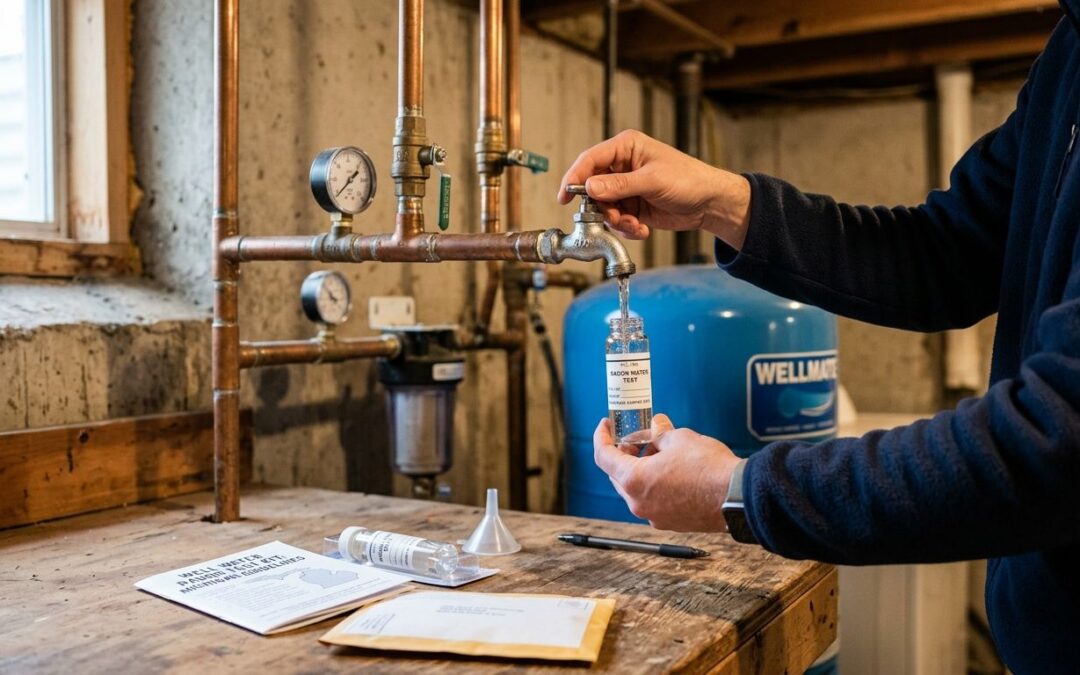
Well water radon testing in Michigan needs a different kit than the charcoal canister sitting in your basement, and grabbing the wrong one means losing the accuracy you need for a real estate closing or a real health decision.
- Best radon test kits for well water testing in Michigan: NRPP-certified professional sampling from Michigan Radon Control wins for real estate closings in 2026.
- National Radon Program Services’ mail-in kit is the best low-cost DIY option for baseline well screening.
- Standard charcoal air radon kits cannot measure water; well owners need a liquid scintillation or activated charcoal vial kit.
- EPA’s rule of thumb: 10,000 pCi/L of radon in well water raises indoor air radon by about 1 pCi/L.
- Michigan sets no state limit for radon in private well water, so testing stays voluntary but recommended.
Why this matters for Michigan well owners
A large share of Michigan homes outside city water systems pull drinking water from a private well, and private wells sit completely outside the Safe Drinking Water Act's radon oversight — that law only reaches public water systems. Nobody is checking your well unless you check it yourself.
A standard charcoal canister or alpha track kit measures radon in air. It tells you nothing about what's dissolved in your water. Radon gets into groundwater the same way it gets into a basement, through contact with uranium-bearing rock and soil, and testing water separately from air is central to radon in drinking water testing for Michigan well owners.
The EPA's own research puts the ratio at roughly 10,000 pCi/L of radon in water for every 1 pCi/L it adds to indoor air. A well testing at 20,000 pCi/L barely nudges an air reading on its own, but showers, dishwashers, and washing machines still release that gas into the air you breathe every day.
In 1999, the EPA proposed an alternative maximum contaminant level of 4,000 pCi/L for water systems paired with an air-testing program, and a stricter 300 pCi/L limit for those without one. Neither became a mandatory federal rule for private wells, and Michigan has never adopted its own limit. Testing stays voluntary, right up until you're trying to close on a house or protect a family drinking from that well every day in 2026.
What makes the best radon test kit for well water
- Water-specific method — activated charcoal or liquid scintillation vials built for liquid samples, not an air canister repurposed for water
- EPA-recognized or NRPP-certified lab — the lab analyzing your sample should carry recognized certification, not a no-name mail-order operation
- Chain-of-custody documentation — required if the result needs to hold up in a real estate closing, mortgage underwriting, or legal dispute
- Collection instructions matched to Michigan well setups — pressure tanks, iron filters, and softeners can all skew a sample if the kit doesn't account for them
- Turnaround that fits your timeline — a curious homeowner can wait; a closing in three weeks cannot
- Professional backing when the number is high — a kit only tells you the problem exists, and someone certified needs to interpret what comes next
Well water radon test kits at a glance
| Option | Best for | Standout feature | Key limitation |
|---|---|---|---|
| Michigan Radon Control professional sampling | Real estate closings & legal documentation | NRPP-certified chain-of-custody sampling | Service area centers on Metro Detroit and Lansing |
| National Radon Program Services mail-in kit | Budget DIY baseline screening | Nationally recognized, self-collected at the tap | Not built for closing-level chain-of-custody |
| County health department program | Free or low-cost initial screening | Local, accessible, often no-cost | Water-specific support varies by county |
| Accredited private environmental lab kit | Faster self-collected lab results | EPA-recognized liquid scintillation method | Still self-collected, so technique errors happen |
| Professional post-mitigation retest | Verifying an aeration or GAC system works | Confirms treatment performance over time | Only relevant once a system is already installed |
1. Michigan Radon Control professional water sampling: best for real estate closings
Michigan Radon Control's NRPP-certified team collects a well water sample directly at the tap using state-recognized chain-of-custody procedures, then sends it to an accredited lab for analysis. Because a certified technician collects and documents the sample rather than the homeowner, the result holds up during mortgage underwriting or a title company review. It comes with a written report, not just a number on a printout. Michigan Radon Control is also among the NRPP-certified radon mitigation companies in Michigan offering this service alongside air testing.
Michigan Radon Control professional sampling pros:
- Chain-of-custody documentation accepted at real estate closings
- NRPP-certified collection reduces the risk of a contaminated or invalid sample
- Result comes with professional interpretation, not just a raw pCi/L number
- Pairs directly with air radon testing during the same visit
Michigan Radon Control professional sampling cons:
- Costs more than a self-mailed DIY kit
- Scheduling required, so it's not instant like an at-home kit
- Service area centers on Metro Detroit and Lansing, so far-flung rural wells should confirm availability
Best for: homeowners and real estate agents who need a result that holds up in a closing.
Verdict: Book it whenever the number needs to be legally or contractually defensible.
2. National Radon Program Services mail-in kit: best for DIY baseline screening
Kansas State University's National Radon Program Services ships a low-cost water radon test kit nationwide, including to Michigan well owners. You collect the sample yourself at an outdoor tap or a point before any treatment equipment, mail it to the lab, and get back a result in pCi/L. It's the option most homeowners reach for when they're curious about their well's baseline number before deciding whether to call anyone.
National Radon Program Services kit pros:
- Nationally recognized university program, not an unknown mail-order brand
- Self-collection means no scheduling and no waiting for an appointment
- Straightforward instructions for grabbing a sample before treatment equipment touches the water
National Radon Program Services kit cons:
- Results aren't packaged for real estate closing chain-of-custody requirements
- No professional interpretation of what a high number means for your specific well setup
- Shipping and lab processing add time you don't control
Best for: homeowners who want a first read on their well before deciding on next steps.
Verdict: Buy it as a starting point, not a final answer if the number comes back high.
3. County health department radon testing program: best for free or low-cost screening
Several Michigan county health departments run radon awareness programs that loan out or sell subsidized test kits, mostly aimed at air testing. Coverage for water-specific testing support varies a lot from county to county — see how Michigan county health departments handle radon testing for what to expect locally. This works best as a cheap first step, not a guaranteed water test source.
County health department program pros:
- Often free or heavily subsidized
- Backed by a local public health department, not a random online vendor
- Good entry point for well owners who haven't tested anything yet
County health department program cons:
- Water-specific testing support isn't consistent across every county
- Turnaround and follow-up guidance vary by department
- Rarely comes with chain-of-custody documentation
Best for: well owners looking for the cheapest possible starting point.
Verdict: Wait to rely on this alone if a closing is coming — pair it with a certified follow-up test.
4. Accredited private environmental lab kit: best for faster self-collected results
Private, EPA-recognized environmental labs sell mail-in water radon kits using the same liquid scintillation method as university programs, often with faster turnaround. You still collect the sample yourself, but you're mailing it to a commercial lab rather than a university program, which can mean quicker processing during busy testing seasons like Michigan's winter months.
Accredited private lab kit pros:
- EPA-recognized liquid scintillation method, the same standard used by professionals
- Often faster lab turnaround than a university program during peak seasons
- Works well for well owners comparing multiple labs before choosing a provider
Accredited private lab kit cons:
- Self-collection still carries contamination risk if instructions aren't followed exactly
- Quality control isn't identical across every provider
- Still not typically accepted as closing documentation without a certified collector
Best for: homeowners who want lab-grade accuracy without hiring a technician.
Verdict: Buy it if you're comfortable following collection instructions precisely.
5. Professional post-mitigation retest: best for verifying an aeration or GAC system
If a well already has an aeration system or a granular activated carbon (GAC) filter installed to strip radon from the water, a professional retest confirms the system is actually holding radon below your target level over time. This isn't a first test — it's the follow-up that tells you whether the equipment you already paid for is doing its job.
Post-mitigation retest pros:
- Confirms an aeration or GAC system is performing as designed
- Professional sampling removes the guesswork of self-collection error
- Establishes a documented baseline for future comparison
Post-mitigation retest cons:
- Only relevant once a treatment system is already in place
- Adds a recurring cost if you retest annually
- Doesn't help a well owner who hasn't tested or treated yet
Best for: households with an existing water treatment system who need to confirm it's working.
Verdict: Hold off until treatment is installed, then retest to confirm performance.
Get your well tested for radon
NRPP-certified water sampling for Michigan well owners and real estate closings.
How this ranking works
Each option above gets scored against the same six criteria: whether it uses a water-specific test method, whether the lab carries recognized certification, whether it produces chain-of-custody documentation, how well its instructions handle Michigan well equipment like iron filters and pressure tanks, how fast it turns around a result, and whether professional interpretation comes with the number. Michigan Radon Control's professional sampling ranks first because it clears all six criteria; the DIY and county options trade certification and documentation for lower cost and faster access.
Which well water radon test kit should you choose?
If you're closing on a house, refinancing, or need a result a title company will accept, book Michigan Radon Control's NRPP-certified professional sampling — it's the only option here built for legal scrutiny. If you just want to know your well's baseline number before deciding anything, the National Radon Program Services mail-in kit gets you there without waiting on an appointment. Everyone else sits somewhere in between, and the right call in 2026 depends on how much weight that number needs to carry.
FAQ
What’s the best radon test kit for well water testing in Michigan?
For real estate closings and legal documentation, NRPP-certified professional sampling from Michigan Radon Control is the strongest option in 2026. For a quick DIY baseline, the National Radon Program Services mail-in water kit is the most recognized low-cost choice.
Can I use a regular radon test kit to check my well water?
No. Standard charcoal canisters and alpha track kits measure radon in air only. Well water needs a water-specific kit using activated charcoal or liquid scintillation vials.
How much radon in well water is dangerous?
The EPA proposed an alternative limit of 4,000 pCi/L for water systems paired with air testing and 300 pCi/L for those without, though neither became a binding federal rule for private wells. As a rule of thumb, 10,000 pCi/L in water adds about 1 pCi/L to indoor air.
Does Michigan require radon-in-water testing when selling a house?
Michigan has no statewide law mandating radon-in-water testing before a home sale. Radon awareness sometimes comes up in seller disclosure conversations, but water testing itself stays voluntary.
How long does well water radon testing take in Michigan?
Turnaround depends on the lab and shipping time. Mail-in kits add transit days on both ends, while professional sampling through a local NRPP-certified provider typically moves faster because there’s no shipping delay for collection.
Is a DIY well water radon kit accurate enough for a real estate closing?
Usually not. Most closings and mortgage underwriters want chain-of-custody documentation from a certified professional or accredited lab, which a self-mailed DIY kit doesn’t provide.
What removes radon from well water?
Aeration systems and granular activated carbon (GAC) filters are the two established treatment methods for radon in well water. The right choice depends on the radon level and the well’s existing plumbing setup.
Can I test air and water radon at the same time?
Yes. Air and water require separate test kits and methods, but a professional visit can collect both samples during the same appointment.
One last thing
Private wells get zero radon oversight from the Safe Drinking Water Act — that federal law only reaches public water systems, which means every Michigan household on a private well is responsible for its own testing, treatment, and follow-up. Nobody checks it for you.
That's the real argument for testing water and air separately instead of assuming a clean air test means clean water: they measure two different exposure paths, and only one of them shows up on a standard basement radon kit.
Related guides