
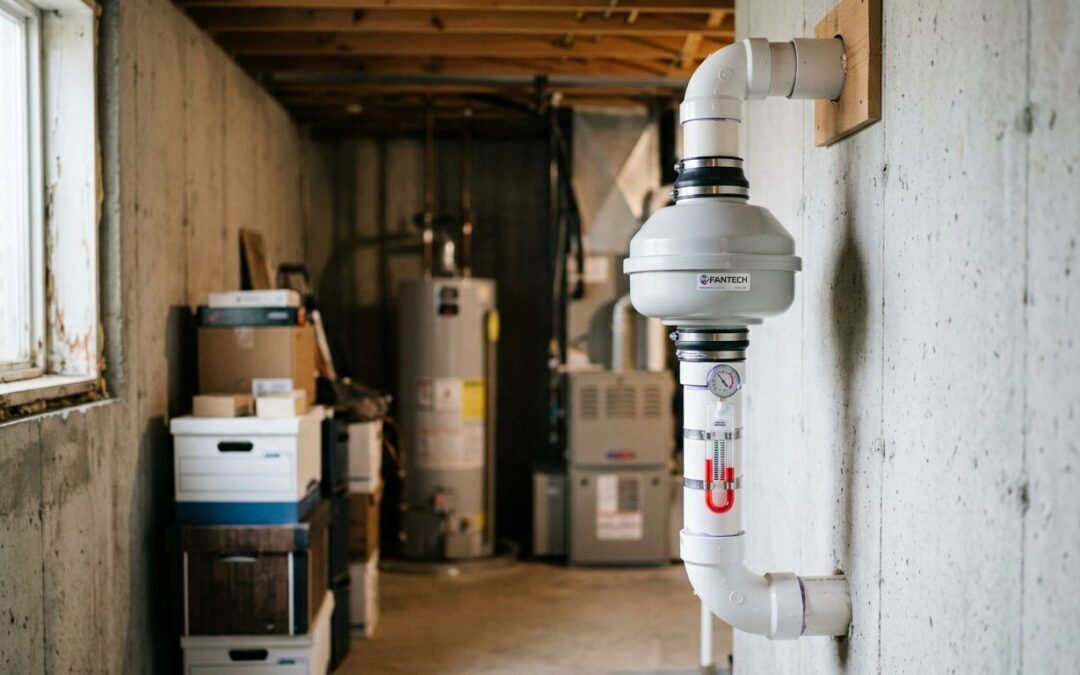
Radon fans run 24/7, every day of the year, and in Michigan homes with finished basements, shared walls, or bedrooms near the mechanical room, fan noise is often the loudest complaint an installer hears after the radon problem is already solved. This guide ranks the radon mitigation fans NRPP-certified installers use most across Metro Detroit and Lansing by how quiet they actually run, not just how much suction they pull.
- RadonAway RP145 wins overall among radon mitigation fans ranked by noise level for Michigan homes in 2026.
- Fantech HP2190 is the quietest pick for finished basements and rooms near the fan location.
- RadonAway GP501 pulls the most suction for high-radon homes but runs loudest of the group.
- RadonAway XP201 fits crawl space-only systems where duct runs are short and tight.
- A hum, rattle, or whine almost always means bearing wear, not normal system aging.
Why Fan Noise Matters in Michigan Homes
Most Michigan basements aren't unfinished storage anymore. They're rec rooms, home offices, and guest bedrooms, which means a fan mounted in the wrong spot turns into a daily annoyance instead of a background hum you forget about. Attached garages, attics, and exterior wall mounts all change how much noise actually reaches living space.
The best radon mitigation fans for Michigan homes balance two things installers have to get right at the same time: enough suction to pull radon below the EPA action level of 4 pCi/L, and a motor quiet enough that homeowners don't call back six weeks later asking about a noisy radon mitigation fan. Those two goals sometimes pull in opposite directions, which is exactly why this ranking exists.
Manufacturers publish sone ratings for their fans — a sone is a standard unit for perceived loudness, and a quiet radon fan running under 2 sones sounds close to a rustling leaf, while a high-suction fan running 6 or more sones sounds closer to a range hood on low. That published rating is the single best number to compare before an installer even shows up.
What Makes the Quietest Radon Mitigation Fan
- Published sone rating from the manufacturer, not a vague "quiet operation" claim on the box
- Motor placement — attic, exterior wall, or garage mounting cuts down what you actually hear indoors versus a fan tucked near a finished ceiling
- Continuous-duty design so the motor isn't straining at high RPM to hit its rated airflow
- Airflow matched to the home, not oversized CFM "just in case," which drives up both noise and power draw
- Vibration-isolated mounting brackets and rubber couplings on the PVC riser pipe, which stop the whole stack from resonating
- A calibration pass by an NRPP-certified installer after install, confirming the system pulls proper vacuum without over-driving the fan
Radon Mitigation Fans Ranked by Noise Level: At a Glance
| Fan | Best For | Standout Feature | Key Limitation |
|---|---|---|---|
| RadonAway RP145 | Most Michigan basement systems | Quiet continuous-duty motor built for standard slab and basement setups | Limited suction for readings above 10 pCi/L |
| Fantech HP2190 | Finished basements, noise-sensitive rooms | Runs noticeably quieter than most high-capacity radon fans | Needs careful CFM sizing to avoid underperforming on larger homes |
| RadonAway GP501 | High-radon or large-footprint homes | Highest suction in the lineup for stubborn readings | Loudest fan here — needs attic or exterior mounting, never near living space |
| RadonAway XP201 | Crawl space-only systems | Compact housing fits tight crawl space duct runs | Not rated for whole-home, high-CFM jobs |
| Fantech RN2C | Simple single-point slab systems | Straightforward inline design, easy attic mounting | Fewer published sone options to compare against |
1. RadonAway RP145: best radon mitigation fan for typical Michigan basements
The RP145 is the fan most Michigan installers reach for on a standard single-point slab or basement system, and it's the fan that shows up most often when radon mitigation fans get ranked by noise level for Michigan homes specifically. It's built as a continuous-duty unit, meaning the motor is designed to run non-stop for years without the strain that drives up noise on cheaper fans.
RadonAway RP145 pros:
- Quiet enough for basement mounting in most homes without a finished ceiling directly below
- Continuous-duty motor holds up to Michigan's year-round runtime demands
- Widely stocked, so replacement parts and warranty service aren't a scavenger hunt
RadonAway RP145 cons:
- Not enough suction for homes with radon readings well above 10 pCi/L
- Still audible if mounted directly above a finished bedroom
Best for: Standard slab and basement homes with moderate radon readings. Verdict: Buy.
2. Fantech HP2190: best radon mitigation fan for finished basements
The HP2190 targets exactly the noise-sensitive scenario a lot of Metro Detroit homeowners run into — a finished basement, a home office next to the mechanical room, or a bedroom above the fan run. It trades some raw CFM for a noticeably quieter operating profile.
Fantech HP2190 pros:
- Runs quieter than most fans capable of similar airflow
- Compact housing works well in tight mechanical closets
- Good fit for homes where the fan can't be pushed out to an exterior wall
Fantech HP2190 cons:
- Sizing has to be dialed in carefully; oversizing erases the noise advantage
- Less headroom than the GP501 if radon levels are unusually high
Best for: Basements that double as living space. Verdict: Buy.
3. RadonAway GP501: best radon mitigation fan for high-radon homes
When a Michigan home comes back with a reading well above the EPA action level, the RP145 and HP2190 sometimes don't move enough air. The GP501 is the fan installers pull out for homes with radon levels above 10 pCi/L or larger slab footprints that need more suction across multiple suction points.
RadonAway GP501 pros:
- Highest suction capacity of the fans covered here
- Handles larger homes and multi-point systems without a second fan
- Reliable choice for stubborn radon readings that don't respond to smaller fans
RadonAway GP501 cons:
- The loudest fan in this ranking — attic or exterior wall mounting is close to mandatory
- Overkill, and louder than it needs to be, on an average single-point slab home
Best for: High-radon readings and larger homes. Verdict: Buy, but mount it away from living space.
4. RadonAway XP201: best radon mitigation fan for crawl space-only systems
Crawl space systems don't need the same airflow as a full basement, and the XP201's smaller housing fits the shorter, tighter duct runs common in Michigan homes built over crawl spaces instead of full basements.
RadonAway XP201 pros:
- Compact enough for tight crawl space vent stacks
- Lower airflow needs match crawl space soil conditions well
- Straightforward install with minimal ductwork
RadonAway XP201 cons:
- Underpowered for full basement or slab-on-grade systems
- Not the right pick if the home has a mixed foundation
Best for: Crawl space-only radon systems. Verdict: Buy for the right foundation type, Skip for anything larger.
5. Fantech RN2C: best radon mitigation fan for simple slab systems
For a straightforward single-point slab system with no unusual complications, the RN2C inline fan gets the job done without extra features that add complexity to a basic install.
Fantech RN2C pros:
- Simple inline design mounts easily in an attic run
- Good fit for uncomplicated single-point systems
- Low-maintenance profile once installed correctly
Fantech RN2C cons:
- Fewer published sone comparisons make noise expectations harder to pin down before install
- Not built for high-radon or multi-point setups
Best for: Simple, single-point slab systems. Verdict: Hold — fine as a straightforward option, but ask your installer for the published sone rating before you commit.
“If a radon fan hums louder than a running refrigerator, something in the install is wrong — the fan, the mounting, or the duct sizing.”
How We Ranked These Radon Mitigation Fans
Every fan on this list gets judged against the same six criteria laid out above: published sone rating, motor placement options, continuous-duty design, airflow matched to the home, vibration-isolated mounting, and post-install calibration. A fan with a great sone rating on paper still ends up loud if it's mounted in a finished garage ceiling instead of an exterior wall — placement matters as much as the fan itself.
Which Radon Mitigation Fan Should You Choose?
For most Michigan homeowners in 2026, the RadonAway RP145 is the default pick — enough suction for a typical basement or slab system, quiet enough to live with, and easy to service. If the basement is finished and noise is the top concern, move to the Fantech HP2190. If the last test came back above 10 pCi/L, or the home is large enough to need multiple suction points, the RadonAway GP501 is worth the extra noise as long as it's mounted in the attic or on an exterior wall, not next to a bedroom.
Crawl space-only homes should stick with the RadonAway XP201, and simple single-point slab jobs without complications can run fine on the Fantech RN2C — just get the sone rating in writing before the install crew shows up.
Get a quiet radon fan matched to your home
NRPP-certified sizing so the fan fits your foundation, not the other way around.
FAQ
What’s the quietest radon mitigation fan for a Michigan home?
The Fantech HP2190 is generally the quietest option for finished basements and noise-sensitive rooms, while the RadonAway RP145 covers most standard basement and slab systems with a quiet continuous-duty motor.
Is a loud radon mitigation fan dangerous or just annoying?
A loud fan is almost always an annoyance, not a safety issue, but sudden noise changes like grinding or rattling usually mean the bearings are wearing out and the fan needs service soon.
Does mounting location affect how loud a radon fan sounds indoors?
Yes — an attic or exterior wall mount cuts down indoor noise far more than switching fan models. A quiet fan mounted directly above a finished ceiling can still sound louder than a standard fan mounted outside.
Can I add insulation to quiet a noisy radon mitigation fan?
Sound-dampening wraps and isolation mounts around the fan housing help, but they won’t fix a fan that’s already failing mechanically. Check the fan’s condition first before adding insulation.
Do radon mitigation fans get louder over time?
Yes, gradually. Bearings wear down after years of continuous duty, and a fan that used to run quietly often develops a hum or whine that signals it needs replacing.
Is RadonAway or Fantech quieter for radon mitigation?
It depends on the specific model rather than the brand overall. RadonAway’s RP145 and Fantech’s HP2190 both rank among the quieter options, while RadonAway’s high-suction GP501 runs louder by design.
How do I know if my radon mitigation fan needs replacing due to noise?
A new rattle, grinding sound, or noticeable pitch change that wasn’t there before usually means the motor bearings are failing. Most radon fans last several years before this shows up.
Should I get a bigger fan for a quieter radon mitigation system?
No — oversizing a fan usually makes it louder, not quieter, because it’s moving more air than the system needs. Matching CFM to your foundation type and soil conditions is what actually keeps noise down.
One Last Thing
The fan model matters less than where it gets mounted. Moving a fan from a finished garage ceiling to an exterior wall or attic run often cuts perceived indoor noise more than swapping to a quieter model entirely — ask your installer about mounting location before you ask about sone ratings.
Related Guides
- How to fix a noisy radon mitigation fan
- How to tell if your radon mitigation fan needs replacing
- Best radon mitigation system brands for Michigan homes
- How to add a second fan to an underperforming radon system
- How to maintain your radon mitigation system