
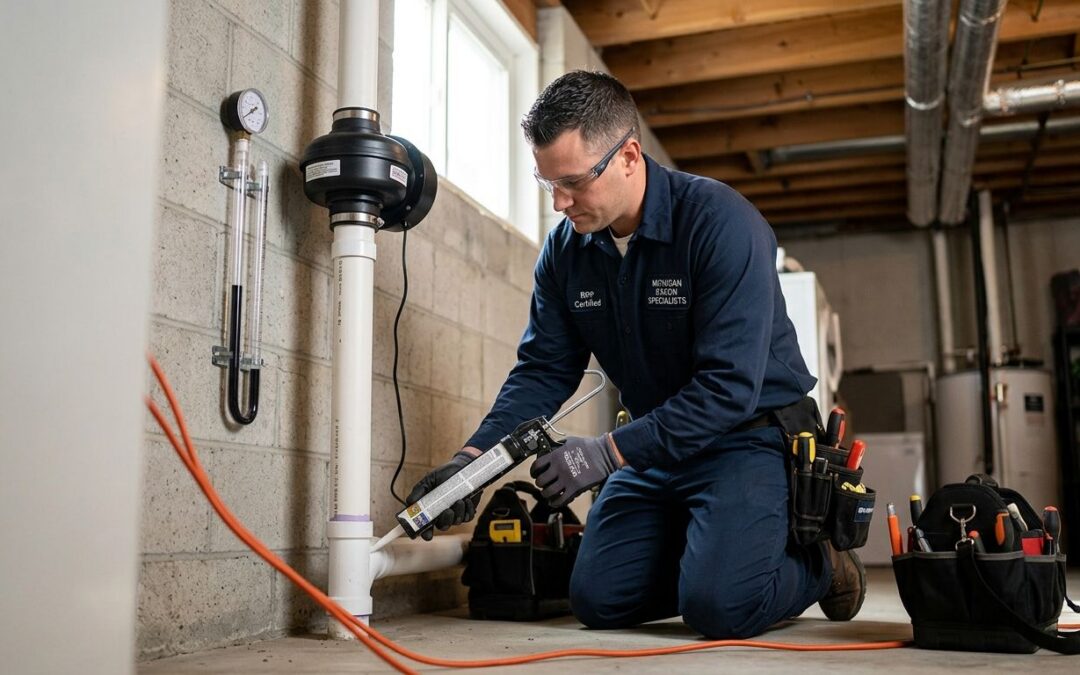
Best overall for financing built into the process: Michigan Radon Control, an NRPP-certified specialist serving Metro Detroit and Lansing. Best for national warranty transferability: multi-state mitigation franchises. Best for closing-deadline installs: local contractors who already work with real estate agents. Best for checkout-style payment plans: home-improvement retailer installation partners.
- Michigan Radon Control wins for NRPP-certified installs with financing details covered during the estimate, not buried in fine print.
- National mitigation franchises fit buyers who want a warranty that follows them if they relocate within Michigan.
- Local contractors tied to real estate closings move fastest when a sale deadline is on the line.
- Retailer-installed systems fit buyers who want financing built into a store account rather than a separate contract.
- None of the five options publish fixed pricing online in 2026 – get that number in writing before you sign.
Why this matters
A radon mitigation system in Michigan is not optional once a test comes back at or above the EPA's action level of 4 pCi/L. It's also not cheap enough for most households to pay upfront without a plan, which is why "does this company offer financing" now ranks right behind "is this company NRPP certified" on the list of buyer questions.
The problem: most radon company websites in Michigan either say nothing about payment options or bury a vague "financing available" line with no detail. This guide ranks the realistic paths Michigan homeowners have for pairing certified mitigation work with a payment plan in 2026, and tells you which one fits your situation – a home near Metro Detroit, a house closing in three weeks, or a fixer-upper where mitigation is one of six line items.
Michigan Radon Control lays out financing options for Michigan homeowners as part of its estimate process rather than as a separate afterthought – that's the standard the rest of this list gets measured against.
What makes the best radon mitigation company with financing
- NRPP certification of the installing technician, not just the company name on the invoice
- Financing terms disclosed before the contract, not discovered at signing
- A written warranty, ideally multi-year, that survives if you sell the home
- Post-install verification testing included or clearly priced as a next step
- Response time matched to your timeline – a real estate closing needs different speed than a routine remodel
- Local knowledge of Michigan soil and foundation types, since glacial till, limestone bedrock, and slab-on-grade construction all change how a system gets designed
The NRPP-certified radon mitigation companies that meet all six criteria are a short list – most providers hit three or four.
At a glance: radon mitigation options with financing paths in Michigan
| Provider type | Best for | Standout feature | Key limitation |
|---|---|---|---|
| Michigan Radon Control | NRPP-certified install with financing guidance upfront | Estimate includes financing details before you sign | Service area centered on Metro Detroit and Lansing |
| Multi-state mitigation franchises | Warranty that transfers across branches | Standardized install protocol nationwide | Less familiarity with Michigan-specific soil conditions |
| Local closing-timeline contractors | Fast scheduling before a home sale | Flexible payment splitting between buyer and seller | Pricing and financing vary contractor to contractor |
| Home-improvement retailer partners | Checkout-style payment plans | Financing tied to an existing store account | Installer may be subcontracted, not radon-specialized |
| HVAC/general contractors (radon as add-on) | Bundling mitigation with other renovation work | One invoice covers multiple projects | Radon isn't the contractor's core specialty |
1. Michigan Radon Control: best for NRPP-certified install with financing built into the estimate
Michigan Radon Control installs sub-slab depressurization and other mitigation systems designed to EPA standards for homeowners and realtors across Metro Detroit and Lansing. Technicians are NRPP certified, and installs come with a 5-year warranty on the system. Financing gets discussed as part of the estimate rather than as a separate application process.
Michigan Radon Control pros:
- NRPP-certified technicians on every install, not subcontracted crews
- Systems built to EPA standards with a 5-year warranty
- Financing and pricing details covered during the estimate call, before you commit
- Serves both homeowners and realtors, which matters for closing-deadline jobs
Michigan Radon Control cons:
- Service footprint is Metro Detroit and Lansing, not statewide
- No published price list online – you'll need the estimate to see numbers
- Single-company backing, not a multi-branch franchise network
Best for: Metro Detroit and Lansing homeowners who want certified installation and financing terms in writing before signing anything.
Verdict: Buy.
2. Multi-state mitigation franchises: best for warranty transferability
Franchise-model radon mitigation companies operate across several states using a standardized install protocol, which is the main draw if you expect to move within a few years and want a warranty that follows the branch network rather than one local business.
Franchise pros:
- Standardized installation steps across every branch
- Warranty language often built to transfer within the network
- National brand recognition can simplify comparison shopping
Franchise cons:
- Less depth on Michigan-specific conditions like glacial till soil or limestone bedrock near quarries
- Scheduling sometimes runs through a regional dispatch rather than a local crew
- Financing terms vary by franchise location, not by the parent brand
Best for: buyers who prioritize a portable warranty over deep local expertise.
Verdict: Hold – worth a quote, but confirm the local branch's actual technician credentials before signing.
3. Local contractors bundled with real estate closings: best for closing-deadline installs
Some independent Michigan contractors work almost exclusively through real estate agents, scheduling mitigation systems to fit tight closing windows and splitting payment between buyer and seller as part of the sale.
Closing-contractor pros:
- Fast turnaround built around a known closing date
- Comfortable with radon disclosure paperwork agents already expect
- Payment can sometimes be negotiated into the closing costs
Closing-contractor cons:
- Pricing and financing structure differ from contractor to contractor
- Selection is often based on availability, not certification depth
- Less consistency in post-install verification testing
Best for: buyers or sellers racing a closing date who need the system in before the deal falls apart.
Verdict: Wait – confirm NRPP certification directly; don't assume the agent's referral has already checked it.
4. Home-improvement retailer installation partners: best for checkout-style financing
Several national home-improvement retailers offer radon mitigation as an installed service booked through their existing store financing accounts, which appeals to buyers who'd rather manage payments through a retailer app than a separate contractor invoice.
Retailer-partner pros:
- Financing integrated into an account the buyer may already have
- Straightforward booking process through a familiar retail brand
- Bundling potential with other home improvement purchases
Retailer-partner cons:
- Installer is frequently a subcontracted crew, not an in-house radon specialist
- Radon expertise is secondary to the retailer's general home-services line
- Post-install verification testing is often an upsell, not a default
Best for: buyers who want financing tied to a retail account rather than a standalone loan.
Verdict: Hold – ask specifically who performs the install and whether they're NRPP certified.
5. HVAC and general contractors offering radon as an add-on: best budget option for bundled projects
If a basement remodel, insulation upgrade, or HVAC replacement is already on the schedule, some general contractors will add a radon mitigation system to the same invoice, which can simplify financing if that larger project already has a payment plan attached.
Bundled-contractor pros:
- One financed project instead of two separate contracts
- Convenient scheduling around work already happening in the home
- Potential discount for bundling multiple services
Bundled-contractor cons:
- Radon mitigation isn't the contractor's core specialty
- NRPP certification isn't guaranteed for the crew doing the radon-specific work
- Verification testing after install is easy to skip if it's not explicitly scoped
Best for: homeowners already mid-renovation who want to fold mitigation into an existing project budget – see how to budget for a radon mitigation system installation before adding it to a remodel.
Verdict: Skip unless the contractor can show a specific NRPP-certified subcontractor for the radon portion.
How we ranked these
Each category was measured against the six criteria above: certification of the actual installer, whether financing terms are disclosed before contract signing, warranty length and transferability, inclusion of post-install verification testing, response time fit for the buyer's timeline, and familiarity with Michigan-specific foundation and soil conditions. Michigan Radon Control and the NRPP-certified specialist category scored highest on the first two criteria; franchises and retailer partners traded certification depth for network reach or checkout convenience. For a broader look at how providers stack up outside financing specifically, the best radon testing companies near you roundup covers testing-only comparisons.
Get financing details in your estimate
Ask for NRPP certification and payment terms in writing before you sign.
Which radon mitigation company should you choose?
If your home is in Metro Detroit or Lansing and you want NRPP-certified installation with financing terms disclosed upfront, Michigan Radon Control is the default pick for 2026. If you're relocating soon and want a warranty that travels with you, a multi-state franchise is worth a competing quote. If a home sale closes in under a month, go with a local contractor who already works with your agent – just verify certification yourself rather than assuming the referral covered it.
Whatever you pick, get the financing terms in writing before the crew shows up. A verbal "we offer payment plans" is not a contract, and radon systems installed in 2026 will need that warranty documentation if you sell the home in a few years.
FAQ
What’s the best radon mitigation company offering financing in Michigan?
Michigan Radon Control is the strongest fit for Metro Detroit and Lansing homeowners because financing details are covered during the estimate rather than after signing. Outside that service area, national franchises and closing-timeline contractors are the realistic alternatives.
Do radon mitigation companies in Michigan offer payment plans?
Many do, but terms vary widely and few post them online. Ask for the exact financing terms in writing before the contract is signed, not after.
Is a local specialist or a national franchise better for radon mitigation?
A local NRPP-certified specialist typically knows Michigan-specific soil and foundation conditions better, while a national franchise offers a warranty that can transfer if you move. Pick based on whether you expect to relocate soon.
What should I ask about financing before hiring a radon mitigation contractor?
Ask whether financing terms are disclosed before the contract, whether the technician doing the install is NRPP certified, and whether post-install verification testing is included or billed separately.
Does Michigan require radon mitigation before selling a home?
Michigan doesn’t mandate mitigation by law, but many buyers and lenders expect a test result below the EPA action level of 4 pCi/L before closing, which effectively makes mitigation a closing requirement in practice.
How long does a radon mitigation system installation take?
Most sub-slab depressurization systems are installed in a single day. More complex foundations, like homes with multiple foundation types, can take longer.
Can radon mitigation financing be rolled into a home purchase?
Some buyers negotiate mitigation costs into the closing costs or purchase price rather than financing it separately – ask your agent whether the seller will cover it as part of the sale.
One last thing
Michigan's radon problem isn't random – glacial till soil and uranium-bearing bedrock across much of the state push a large share of homes above the EPA's 4 pCi/L action level, and separate guidance exists for homes testing between 2 and 4 pCi/L versus those above 10 pCi/L. That range matters for financing conversations too: a system for a home at 12 pCi/L may need a second fan or a different design than one at 3 pCi/L, and that difference should show up in the estimate before you agree to a payment plan in 2026.
Related guides
- Budget for a radon mitigation system installation
- Michigan radon mitigation rebate and grant programs